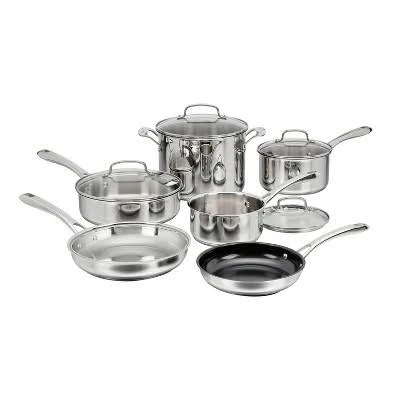
Cuisinart · Stainless Steel Cookware
Cuisinart Classic Stainless Steel Cookware Set 10pc, Is It Non-Toxic?
Lower PFAS concern, stainless steel cookware avoids Teflon-family coating without Cuisinart PFAS commitment.
Cuisinart's traditional stainless steel set has no nonstick coating, eliminating the primary PFAS vector in cookware. Cuisinart does not publicly disclose PFAS policies or test results.
Still want this one anyway? Check the price on Amazon. We’d swap it.
Material
Stainless steel construction, no nonstick coating
Lab data
No public lab test
You may also be interested in
Top-graded picks in the categories readers replace first, every one scored on the same rubric.

- polypropylene filter housing, carbon/sediment cartridge
- We found no PFAS statement from the brand
- Bacterial growth in spent cartridges
3 hazards checked on this product, all on its full breakdown.

Aquasure
Premier Series 75 GPD Under Sink Reverse Osmosis Water Filtration System
- RO membrane, carbon filters, stainless steel housing
- We found no PFAS statement from the brand
- Bacterial and microbial growth in housing and filters
4 hazards checked on this product, all on its full breakdown.

Avocado
Vegan Mattress
- organic cotton, natural latex, coconut coir, recycled steel coils
- The brand calls it PFAS-free, which we have not verified
- Heavy metals
2 hazards checked on this product, all on its full breakdown.
Is Cuisinart Classic Stainless Cookware Set non-toxic? What it is made of
Cuisinart Classic uses 18/10 stainless steel (18% chromium, 10% nickel), a stable austenitic alloy that does not require protective nonstick coatings. Stainless steel cookware does not off-gas Teflon-family coating or other volatile compounds during normal cooking. The material is inherently passive and does not leach significantly into food under typical use, making it one of the lower-concern construction types for cookware.
What’s concerning
Category baseline
The starting point for this type of product, before anything specific to this product is counted.
No PFAS disclosure
No public statement from the brand about PFAS in this product.
Nickel leaching from stainless steel
18/10 stainless steel contains 10% nickel. Leaching is negligible under neutral pH and normal cooking, but acidic or salty foods (tomato sauce, vinegar, brines) may increase nickel release slightly. Risk is low for most users but higher for individuals with nickel sensitivity or those eating predominantly acidic foods.
Handle material safety
Handles on this set are typically stainless steel or heat-resistant phenolic/composite. Phenolic handles can emit formaldehyde or other VOCs if heated excessively, though normal stovetop use keeps handles below degradation temperature. Phenolic resin quality varies among manufacturers and is not independently certified on this product.
What’s reassuring
Bare uncoated material
Recorded as a bare, uncoated material with no surface coating or treatment.
Coating degradation or corrosion
No protective coatings are present on this product, so there is no risk of ceramic, enamel, or nonstick layer flaking or degrading into food over time.
Teflon-type coating fume emission or thermal decomposition
Stainless steel cookware does not contain Teflon-family coating or Teflon-type coating coatings, eliminating the risk of Teflon-type coating off-gassing or fume inhalation at any temperature.
Lead
No recalls or documented contamination with lead or cadmium have been reported for this specific product or brand. Stainless steel cookware does not require lead-stabilized glazes or cadmium pigments as some ceramic or enameled products do.
Source, ATSDR ↗How is this PFAS grade calculated?
The brand's record and disclosure
Cuisinart is a major cookware manufacturer owned by Conair Group with decades of market presence. The company has not published explicit PFAS-free commitments or third-party safety certifications for this line. No significant recalls or documented material defects specific to this stainless steel set have been established in public safety databases. The brand's transparency on chemical composition and manufacturing standards is limited compared to some premium competitors.
How it compares in its category
Stainless steel cookware without nonstick coating sits at the lower end of chemical hazard risk in the cookware category, avoiding the Teflon-type coating fume and coating degradation concerns of nonstick alternatives. It is heavier and less nonstick than Teflon-family coating-coated or ceramic-coated pans, requiring more oil and higher heat retention. Price-wise, this 10-piece set is mid-range, comparable to other mainstream stainless steel offerings and typically cheaper than high-end clad cookware with certified PFAS-free status.
If you buy it
Use appropriate fat or oil to prevent sticking and ensure even heat distribution; stainless steel conducts heat less evenly than clad designs. Avoid prolonged high heat (above 500F) although stainless does not off-gas at typical stovetop temperatures. Hand-wash or use dishwasher on a normal cycle; stainless is durable and does not degrade with age in the way nonstick coatings do. Monitor handles for looseness over time, as riveted or welded joints may eventually wear with repeated use over many years.
What is not known about PFAS in this product?
- Basis
- Model estimate, 82% confidence, not a lab result
- Lab test
- None on record for this exact product
- Brand statement
- Cuisinart has made a specific claim
Formulations change between production runs, so check the current label. How we grade.
More stainless steel cookware grades
How we score, every product runs through the same public 0-100 rubric based on materials, coatings, brand disclosure, lab findings, and recalls. See the full methodology → Spotted a mistake? Report an error.