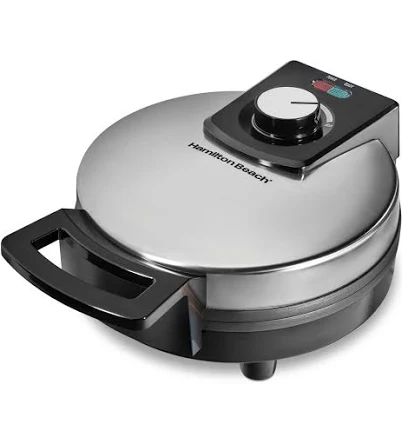
Hamilton Beach · Waffle Makers
Hamilton Beach Belgian Waffle Maker
Avoid until brand reveals coating chemistry or switches to Teflon-type coating-free nonstick.
Hamilton Beach/Waffelo keeps the nonstick polymer type secret on this waffle maker. Standard nonstick cookware frequently contains Teflon-type coating or Teflon-family coating tied to PFAS without brand transparency.
Still want this one anyway? Check the price on Amazon. We’d swap it.
Material
nonstick-coated cooking surface, unspecified polymer
Brand disclosure
Brand is silent on PFAS
Lab data
No public lab test
You may also be interested in
Top-graded picks in the categories readers replace first, every one scored on the same rubric.

- polypropylene filter housing, carbon/sediment cartridge
- We found no PFAS statement from the brand
- Bacterial growth in spent cartridges
3 hazards checked on this product, all on its full breakdown.

Aquasure
Premier Series 75 GPD Under Sink Reverse Osmosis Water Filtration System
- RO membrane, carbon filters, stainless steel housing
- We found no PFAS statement from the brand
- Bacterial and microbial growth in housing and filters
4 hazards checked on this product, all on its full breakdown.

Avocado
Vegan Mattress
- organic cotton, natural latex, coconut coir, recycled steel coils
- The brand calls it PFAS-free, which we have not verified
- Heavy metals
2 hazards checked on this product, all on its full breakdown.
What Hamilton Beach Belgian Waffle Maker is made of, ingredients and materials
Hamilton Beach (not Waffelo, which appears to be a reseller or alternate branding) equips this waffle maker with a nonstick-coated cooking surface of unspecified polymer composition. The manufacturer has not publicly disclosed whether the coating is Teflon-type coating-based, ceramic, silicone, or proprietary, which obscures potential PFAS exposure. Aluminum substrate is typical for this category and poses minimal risk under normal use, but coating integrity is the critical variable.
What’s concerning
Category baseline
The starting point for this type of product, before anything specific to this product is counted.
No PFAS disclosure
No public statement from the brand about PFAS in this product.
Non-stick, chemistry undisclosed
Marketed as non-stick without stating the coating chemistry.
Nonstick coating degradation and particle shedding
Unspecified nonstick polymer is vulnerable to chipping and flaking with use, especially if preheated excessively or scratched during cleaning. Particles in food are a known mechanism of chronic microplastic ingestion in users of degraded nonstick cookware.
Thermal fume release from nonstick overheating
If preheated above manufacturer specs or left on heat after ready, an unspecified nonstick coating may decompose and release volatile compounds. Consumer exposure is largely avoidable with adherence to instructions and proper ventilation.
Inadequate product documentation on coating chemistry
Manufacturer silence on nonstick polymer identity prevents independent risk assessment and comparison shopping. This is a transparency failure, not a confirmed hazard, but it obstructs informed consumer choice in a category where PFAS alternatives are available.
What’s reassuring
Aluminum substrate leaching under acidic conditions
Aluminum body poses minimal leaching risk for typical waffle batters (neutral to slightly acidic pH), and the nonstick coating provides a barrier. No established incidents reported for this product or category.
How is this PFAS grade calculated?
The brand's record and disclosure
Hamilton Beach (a subsidiary of NACCO) has not issued public statements on PFAS phase-out, PFAS-free nonstick alternatives, or independent coating safety certifications for this product line. The company maintains a largely silent stance on nonstick chemistry disclosure, which is increasingly unusual as competitors begin voluntary transparency. No major recalls specific to nonstick coating hazards have been documented for this model.
How it compares in its category
Most commercial waffle makers still use conventional nonstick coatings without full disclosure; ceramic-coated and uncoated cast-iron alternatives exist but are niche and pricier. Hamilton Beach's approach reflects industry-wide opacity rather than exceptional risk, but transparency leaders (e.g., GreenPan with ceramic) now offer comparable waffle makers with disclosed coatings. This product sits in the mainstream ambiguous tier of the category.
If you buy it
Use only at manufacturer-recommended temperatures (typically below 400F); never preheat beyond the "ready" indicator. Avoid metal utensils and abrasive scrubbing, which accelerate coating breakdown and particle shedding. Replace the waffle maker if the nonstick surface visibly chips, peels, or flakes. Hand-wash only and allow full cooling before cleaning to minimize thermal stress on the coating.
What is not known about PFAS in this product?
- Basis
- Model estimate, 35% confidence, not a lab result
- Lab test
- None on record for this exact product
- Brand statement
- Hamilton Beach has made none
Formulations change between production runs, so check the current label. How we grade.
What are the PFAS-free alternatives to Hamilton Beach Belgian Waffle Maker?
- Cast aluminum with unspecified nonstick coating
- The brand calls it PFAS-free, which we have not verified
- Nonstick coating degradation and fume release
4 hazards checked on this product, all on its full breakdown.
Find an alternative on AmazonMore waffle makers grades
How we score, every product runs through the same public 0-100 rubric based on materials, coatings, brand disclosure, lab findings, and recalls. See the full methodology → Spotted a mistake? Report an error.