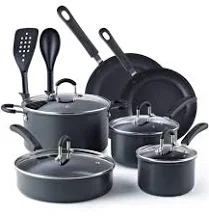
Cook N Home 12 Piece Nonstick Hard Anodized Cookware Set
Skip; nonstick type and coating chemistry undisclosed by brand.
Cook N Home does not disclose what nonstick coating system is used on this hard anodized aluminum cookware. Many hard anodized nonstick cookware lines use Teflon-type coating-based coatings; without brand transparency or testing, PFAS risk cannot be ruled out.
The better-graded swap
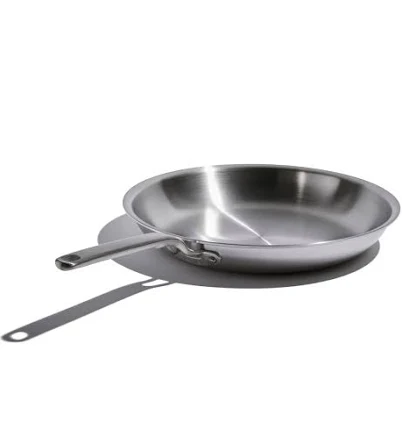
Heritage Steel
Heritage Steel Eater Fry Pan
100/100 safety
Same rubric that flunked this product. The swap earned Excellent.
Still want this one anyway? Check the price on Amazon. We’d swap it.
Material
Hard anodized aluminum with nonstick coating, type unspecified
Brand disclosure
Brand is silent on PFAS
Lab data
No public lab test
Is Cook N Home 12 Piece Nonstick Hard non-toxic? What it is made of
Cook N Home uses hard anodized aluminum as the base, a process that creates a dense oxide layer on the aluminum surface, theoretically protecting against direct aluminum leaching into food. However, the nonstick coating type is not specified by the brand, which is a critical gap, nonstick coatings may contain Teflon-type coating (Teflon), PFOA, GenX, or other fluorinated compounds that carry distinct thermal decomposition and leaching risks. Without this disclosure, you cannot assess whether the coating introduces PFAS or other volatile organics under heat.
What’s concerning
Non-stick, chemistry undisclosed
Marketed as non-stick without stating the coating chemistry.
Category baseline
The starting point for this type of product, before anything specific to this product is counted.
No PFAS disclosure
No public statement from the brand about PFAS in this product.
Teflon-type coating/nonstick fume risk (undisclosed coating type)
The brand does not disclose whether the nonstick coating is Teflon-type coating-based. Teflon-type coating-coated cookware can release fumes above 500°F (260°C); without confirmation of the coating chemistry, you cannot rule out this risk, and the absence of public PFAS-free claims suggests the possibility of fluorinated coatings.
Aluminum leaching under compromised anodization
Hard anodization protects aluminum from direct food contact, but if the anodized layer is damaged by scratching, prolonged use, or dishwasher cycles, underlying aluminum may contact acidic or alkaline foods and leach. The brand does not specify thickness or durability standards for the anodized layer.
Nonstick coating degradation over time
Hard anodized nonstick cookware, regardless of coating type, degrades with repeated washing, metal utensil contact, and thermal cycling. Cook N Home does not publish expected lifespan or durability benchmarks, making it unclear how long the coating will remain intact or safe.
Formaldehyde / VOCs
Nonstick and anodization finishes may include solvent residues or cross-linkers; without chemical disclosure, low-level off-gassing during initial use or at elevated temperatures cannot be ruled out, though this is typically not a primary hazard in hard anodized cookware compared to Teflon-type coating risk.
Source, ATSDR ↗What’s reassuring
Lead
Hard anodized aluminum cookware does not use enamel or ceramic glaze, so traditional lead/cadmium glaze contamination is not a concern for this product category.
Source, ATSDR ↗The full breakdown
The brand's record and disclosure
Cook N Home does not publicly disclose the chemistry of its nonstick coating, PFAS-free status, or any third-party certifications (such as FDA compliance beyond baseline regulations, or GREENGUARD). The brand has not issued a public PFAS stance or commitment to reformulation. This silence is notable in a market where some competitors now explicitly state Teflon-type coating-free or PFOA-free claims; absence of such statements suggests either lack of such assurance or poor consumer communication.
How it compares in its category
Hard anodized aluminum cookware is a mid-range category option. Compared to stainless steel alternatives, it offers nonstick convenience but introduces coating chemistry risk. Compared to ceramic-coated cookware, hard anodized typically has longer nonstick durability but requires certainty that the nonstick layer is not Teflon-type coating-based. This product's lack of transparency puts it at a disadvantage against brands that openly declare PFAS-free coatings or offer certified ceramic options.
If you buy it
Never exceed medium heat; high or open flame can cause nonstick coating degradation and potential fume release, especially if Teflon-type coating is present. Hand wash only; dishwashers accelerate coating wear. Inspect the pan quarterly for scratches, flaking, or discoloration; once the coating degrades, stop using it, as anodized aluminum alone does not guarantee food safety if the protective oxide layer is compromised. Store with cloth separators to prevent coating contact damage.
What we don’t know
- Basis
- Model estimate, 35% confidence, not a lab result
- Lab test
- None on record for this exact product
- Brand statement
- Cook N Home has made none
Formulations change between production runs, so check the current label. How we grade.
Better-graded alternatives in Cookware
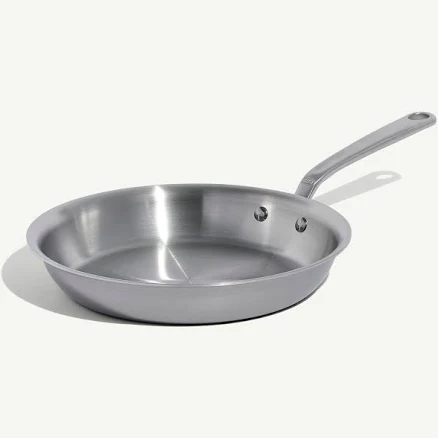
Made In
Stainless Clad Fry Pan
- Stainless steel clad construction, no nonstick coating
- The brand calls it PFAS-free, which we have not verified
- Clad separation or delamination over time
Made In
10' Stainless Clad Frying Pan
- stainless steel clad construction, no nonstick coating
- The brand calls it PFAS-free, which we have not verified
- Nickel leaching from stainless steel
3 hazards checked on this product. See all of them.
Heritage Steel
Eater Fry Pan
- Clad stainless steel, no coating
- The brand calls it PFAS-free, which we have not verified
- Metal ion release during cooking (iron, nickel, chromium)
More cookware grades
How we score, every product runs through the same public 0-100 rubric based on materials, coatings, brand disclosure, lab findings, and recalls. See the full methodology → Spotted a mistake? Report an error.