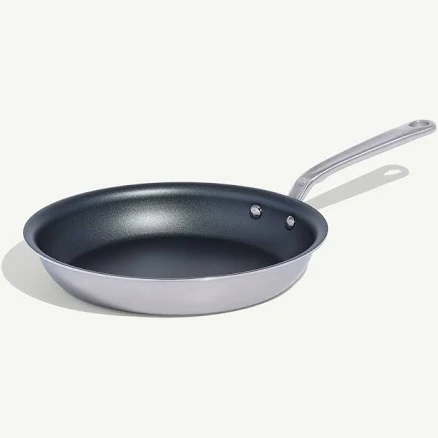
Made In Non-stick Frying Pan, Is It Non-Toxic?
Teflon-type coating non-stick coating, disclosed by the brand.
Made In's California AB 1200 disclosure says its Non Stick products contain Teflon-type coating, FEP and PFA, which are Teflon-family coating in the PFAS family.
The better-graded swap
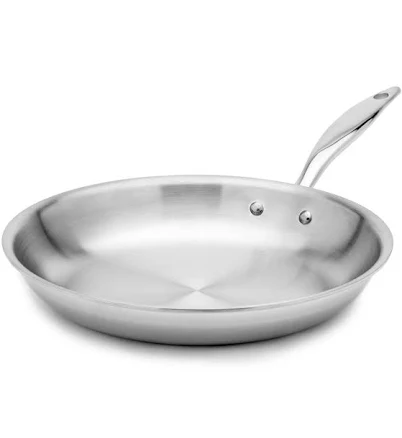
Heritage Steel
Heritage Steel Fry Pan
100/100 safety
Same rubric that flunked this product. The swap earned Excellent.
Still want this one anyway? Check the price on Amazon. We’d swap it.
Material
Teflon-type coating non-stick coating, with FEP and PFA, as disclosed by Made In
You may also be interested in
Top-graded picks in the categories readers replace first, every one scored on the same rubric.

- polypropylene filter housing, carbon/sediment cartridge
- We found no PFAS statement from the brand
- Bacterial growth in spent cartridges
3 hazards checked on this product, all on its full breakdown.

Aquasure
Premier Series 75 GPD Under Sink Reverse Osmosis Water Filtration System
- RO membrane, carbon filters, stainless steel housing
- We found no PFAS statement from the brand
- Bacterial and microbial growth in housing and filters
4 hazards checked on this product, all on its full breakdown.

Avocado
Vegan Mattress
- organic cotton, natural latex, coconut coir, recycled steel coils
- The brand calls it PFAS-free, which we have not verified
- Heavy metals
2 hazards checked on this product, all on its full breakdown.
Is Made In Non-stick Frying Pan non-toxic? What it is made of
Made In discloses this pan uses Teflon-type coating non-stick coating with FEP and PFA Teflon-family coating. Teflon-type coating itself is stable below 500°F but begins degrading at higher temperatures, releasing fumes. FEP and PFA are lower-concern PFAS variants than legacy PFOA, but still fluorinated. The substrate is likely aluminum or steel; no ceramic or ceramic-hybrid alternative is marketed by this brand for non-stick.
What’s concerning
No PFAS disclosure
No PFAS-free statement from the brand for this product.
PTFE / Teflon confirmed
The brand discloses a Teflon-type coating.
Category baseline
The starting point for this type of product, before anything specific to this product is counted.
Teflon-type coating thermal degradation and fume release
Teflon-type coating coatings are stable under normal cooking (up to 350-400°F) but degrade rapidly above 500°F, releasing Teflon-family coating fumes. Home cooks rarely reach these temperatures intentionally, but unattended dry heating or broiler use can exceed the temperatures at which this coating's thermal stability becomes a concern. Empty pan heating, even briefly, can approach unsafe temperatures.
Coating wear and microparticle shedding
Any Teflon-type coating non-stick coating sheds microscopic particles with use, accelerated by dishwasher washing, metal utensils, or high heat. Ingestion of small amounts of Teflon-type coating is not believed to cause acute toxicity, but long-term accumulation in the body is not fully characterized. Visible scratches or peeling are clear signals to retire the pan.
Coating degradation over time
Teflon-type coating coatings are inherently temporary. Even with careful use, durability is typically 3-5 years; beyond that, micro-abrasion, thermal cycling, and chemical exposure degrade the layer. Made In pans likely have thicker coatings than budget alternatives, but degradation is inevitable and replacement is the only mitigation.
What’s reassuring
Aluminum leaching
If the base is aluminum, leaching can occur in acidic or alkaline foods, especially at high temperatures. Made In does not publicly disclose the base material composition for this pan, so aluminum leaching risk cannot be assessed without confirmation of substrate. Steel or hard-anodized aluminum would reduce this hazard.
Lead
No record of Made In cookware containing lead or cadmium in coatings or glazes. Teflon-type coating non-stick is not enameled; however, without third-party testing or certification, legacy batch contamination cannot be ruled out entirely.
Source, ATSDR ↗How is this PFAS grade calculated?
The brand's record and disclosure
Made In explicitly names Teflon-type coating, FEP, and PFA in product descriptions, which is transparent relative to brands that obscure coating chemistry. No public record of recalls, PFAS reformulation timeline, or third-party certifications (e.g., GOTS, Greenguard) for this cookware line. The brand does not publish a PFAS reduction commitment or timeline for phasing non-stick coatings.
How it compares in its category
Teflon-type coating non-stick cookware remains the most durable and widely used non-stick option; ceramic and mineral-reinforced alternatives exist but offer shorter lifespan and lower non-stick performance. Made In's pricing sits in the premium range, similar to All-Clad and OXO, but Made In has not adopted ceramic or PFAS-free alternatives even as competitors (e.g., GreenPan, Caraway) market them. Compared to budget Teflon-type coating pans, Made In likely uses thicker coatings and better base materials, reducing coating degradation risk.
If you buy it
Never exceed 500°F; most cooking occurs well below that, but broiling and oven use above 350°F should be avoided. Hand wash only; dishwashers accelerate coating wear. Inspect the coating monthly for chips, scratches, or peeling; discard the pan if coating is visibly compromised. Replace every 3-5 years depending on frequency; even well-maintained Teflon-type coating coatings degrade over time and shedding risk rises with age.
What is not known about PFAS in this product?
- Basis
- Model estimate, 100% confidence, not a lab result
- Lab test
- None on record for this exact product
- Brand statement
- Made In has made a specific claim
Formulations change between production runs, so check the current label. How we grade.
What are the PFAS-free alternatives to Made In Non-stick Frying Pan?
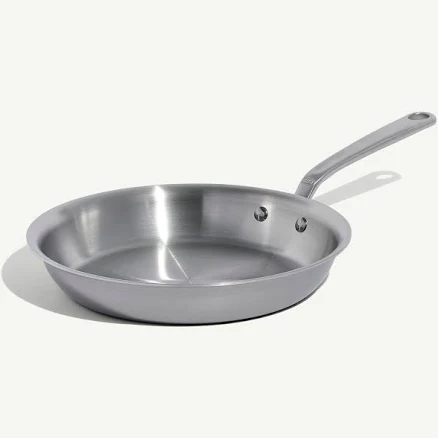
- Stainless steel clad construction, no nonstick coating
- The brand calls it PFAS-free, which we have not verified
- Clad separation or delamination over time
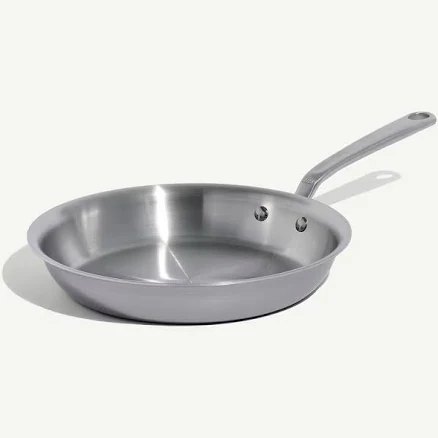
- stainless steel clad construction, no nonstick coating
- The brand calls it PFAS-free, which we have not verified
- Nickel leaching from stainless steel
3 hazards checked on this product, all on its full breakdown.
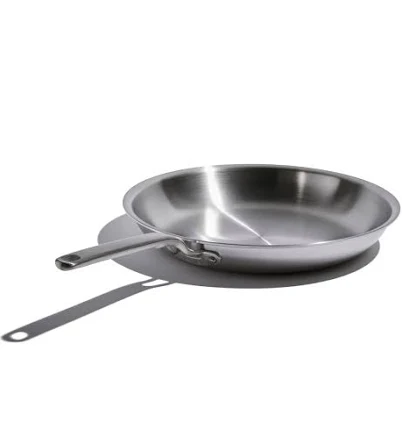
- Clad stainless steel, no coating
- The brand calls it PFAS-free, which we have not verified
- Metal ion release during cooking (iron, nickel, chromium)
More cookware grades
How we score, every product runs through the same public 0-100 rubric based on materials, coatings, brand disclosure, lab findings, and recalls. See the full methodology → Spotted a mistake? Report an error.