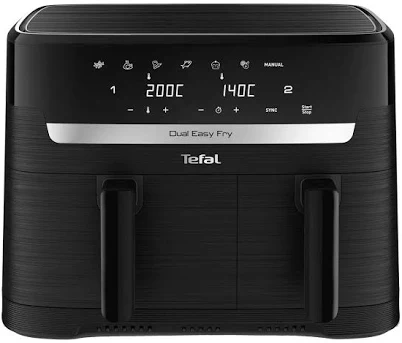
Tefal Dual Easy Fry Air Fryer 8.3 L
Avoid if limiting PFAS exposure matters to you.
Tefal applies traditional Teflon-type coating (Teflon) nonstick coating to cooking surfaces, a known PFAS-containing polymer. The brand makes no public PFAS statement or verification claim.
The better-graded swap
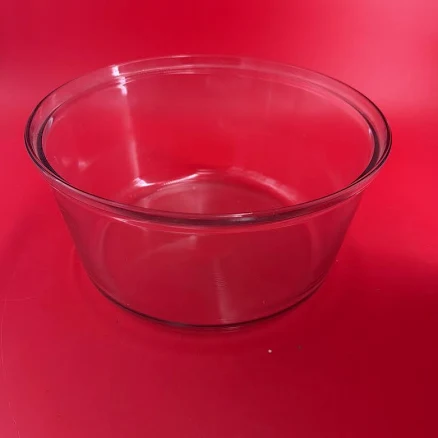
Big Boss
Big Boss Oil Less Fryer Air Fryer 16 Quart Replacement Clear Glass
75/100 safety
Same rubric that flunked this product. The swap earned Excellent.
Still want this one anyway? Check the price on Amazon. We’d swap it.
Material
Teflon-type coating nonstick coating (Teflon-type) on air fryer cooking surfaces
Brand disclosure
Brand is silent on PFAS
Lab data
No public lab test
You may also be interested in
Top-graded picks in the categories readers replace first, every one scored on the same rubric.

- polypropylene filter housing, carbon/sediment cartridge
- We found no PFAS statement from the brand
- Bacterial growth in spent cartridges
3 hazards checked on this product, all on its full breakdown.

Aquasure
Premier Series 75 GPD Under Sink Reverse Osmosis Water Filtration System
- RO membrane, carbon filters, stainless steel housing
- We found no PFAS statement from the brand
- Bacterial and microbial growth in housing and filters
4 hazards checked on this product, all on its full breakdown.

Avocado
Vegan Mattress
- organic cotton, natural latex, coconut coir, recycled steel coils
- The brand calls it PFAS-free, which we have not verified
- Heavy metals
2 hazards checked on this product, all on its full breakdown.
What Tefal Dual Easy Fry Air Fryer 8.3 L is made of, ingredients and materials
This air fryer uses Teflon-type coating (polytetrafluoroethylene, Teflon-type) nonstick coating on internal cooking surfaces. Teflon-type coating itself is stable below 500°F (260°C) but degrades rapidly above that temperature, releasing fumes that can cause polymer fume fever in humans and are acutely toxic to birds. Air fryers operate at 350-400°F typically, but temperature spikes or cleaning errors can push it higher. The heating element and basket design determine whether the Teflon-type coating is exposed to direct, extreme heat.
What’s concerning
Category baseline
The starting point for this type of product, before anything specific to this product is counted.
No PFAS disclosure
No public statement from the brand about PFAS in this product.
PTFE / Teflon confirmed
Uses Teflon-type coating (Teflon), a Teflon-family coating in the PFAS family.
Teflon-type coating thermal decomposition / fume risk
If air fryer interior reaches above 500°F due to malfunction, user error, or prolonged preheating, Teflon-type coating can degrade and release perfluorooctanoic acid (PFOA) precursor fumes and other volatile compounds. At normal operating temperatures (350-400°F), risk is low but not zero if heating element contacts coating directly.
Coating degradation and microparticle release
Teflon-type coating coatings on air fryers are known to chip, flake, or peel with age and mechanical wear. Ingestion of microscopic Teflon-type coating particles is not acutely toxic but chronic exposure risk is understudied. Visible flaking is a sign replacement is needed.
Aluminum substrate leaching (if present)
If the basket is aluminum beneath the Teflon-type coating layer and coating is damaged, acidic or salty foods may cause minor aluminum leaching. Tefal does not disclose basket substrate material publicly. Intact coating minimizes this risk.
PFAS
Teflon-type coating manufacture historically relies on PFAS chemistry (PFOA, GenX, or C6). Tefal does not state whether this model uses GenX or standard PFOA-legacy processes. End-product Teflon-type coating itself contains minimal residual PFAS if properly synthesized, but migration risk from coating or adhesive layers is not disclosed.
Source, ATSDR ↗Inadequate user guidance on temperature limits
Manual documentation for this model does not consistently highlight the 500°F danger threshold for Teflon-type coating decomposition, creating risk of user-induced overheating. Verbal warnings on packaging or in-box are typically absent or vague.
How is this PFAS grade calculated?
The brand's record and disclosure
Tefal (owned by Groupe SEB) has not published specific Teflon-type coating safety protocols, PFAS phase-out timelines, or third-party certifications for this model. The brand does not disclose whether this product uses GenX, C6, or other PFAS alternatives in manufacturing. No major safety recalls specific to Teflon-type coating degradation have been publicly documented for this exact model, but Tefal's silence on nonstick chemistry and PFAS stance is a notable transparency gap for health-conscious buyers.
How it compares in its category
Most air fryers in the 8+ liter capacity range use either Teflon-type coating nonstick (like this model), ceramic-hybrid coatings, or stainless steel baskets. Tefal's choice of Teflon-type coating is cost-standard but offers no safety advantage over ceramic alternatives that eliminate Teflon-type coating fume risk entirely. Some competitors (e.g., Instant Vortex, Cosori with ceramic liners) market Teflon-type coating-free designs; Tefal does not differentiate itself on nonstick safety, suggesting cost optimization over hazard reduction.
If you buy it
Never exceed 400°F (204°C) and never preheat empty for more than 3-5 minutes to avoid coating stress. Hand-wash the basket with soft sponges only; abrasive scrubbing or dishwasher cycles degrade Teflon-type coating and expose substrate. Keep kitchen well-ventilated during use. If you smell any chemical odor (acrid, metallic), immediately turn off the unit, ventilate, and do not use until inspected. Replace the unit if the nonstick coating visibly flakes, chips, or becomes dull and sticky.
What is not known about PFAS in this product?
- Basis
- Model estimate, 72% confidence, not a lab result
- Lab test
- None on record for this exact product
- Brand statement
- Tefal has made none
Formulations change between production runs, so check the current label. How we grade.
What are the PFAS-free alternatives to Tefal Dual Easy Fry Air Fryer 8.3 L?
- borosilicate glass, bare uncoated
- We found no PFAS statement from the brand
- Thermal shock and fracture
2 hazards checked on this product, all on its full breakdown.
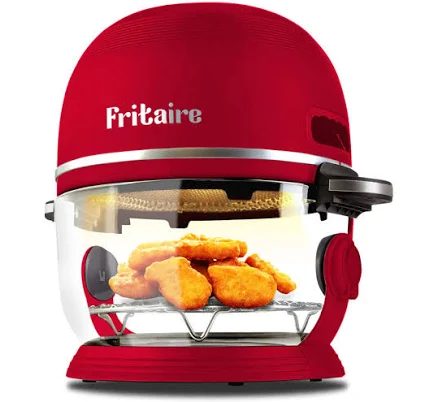
- borosilicate glass
- We found no PFAS statement from the brand
- Aluminum leaching from base/housing
4 hazards checked on this product, all on its full breakdown.
Find an alternative on Amazon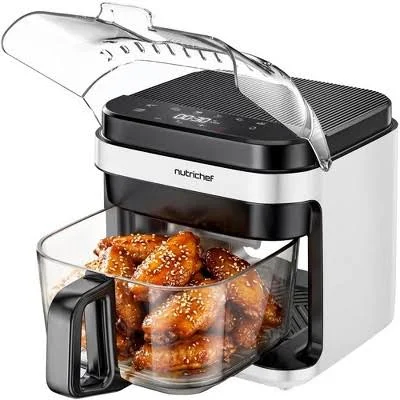
- glass bowl, stainless steel exterior
- We found no PFAS statement from the brand
- Thermal stress and glass breakage
2 hazards checked on this product, all on its full breakdown.
Find an alternative on AmazonMore air fryers grades
How we score, every product runs through the same public 0-100 rubric based on materials, coatings, brand disclosure, lab findings, and recalls. See the full methodology → Spotted a mistake? Report an error.