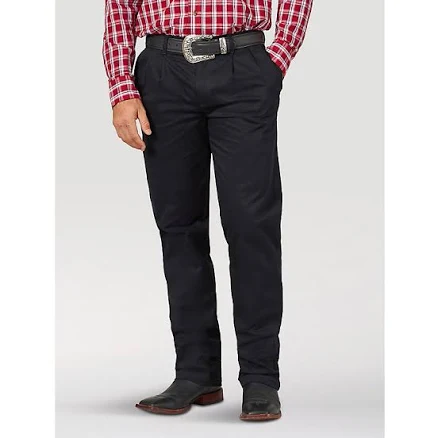
Wrangler · Stain-Resistant Professional Workwear
Wrangler Men's Riata Pleated Front Casual Pants
No known PFAS risk in standard cotton casual pants.
Wrangler Riata pleated pants are basic cotton twill with no water-resistant or stain-resistant coating disclosed. Untreated cotton carries minimal PFAS risk.
Still want this one anyway? Check the price on Amazon. We’d swap it.
Material
Cotton twill, standard weave
Brand disclosure
Brand is silent on PFAS
Lab data
No public lab test
What Wrangler Men's Riata Pleated Front Casual is made of, ingredients and materials
Wrangler Riata pants are constructed from cotton twill, a tightly woven natural fiber with diagonal ribbing that provides durability and structure without chemical coatings typical of performance fabrics. Cotton twill in casual menswear carries minimal inherent chemical burden compared to synthetics or heavily treated textiles, as the material itself does not require Teflon-type coating, antimicrobial, or water-resistant chemical finishes. The standard weave designation confirms this is a basic construction without advanced finishing treatments that would introduce processing chemicals.
What’s concerning
Category baseline
The starting point for this type of product, before anything specific to this product is counted.
No PFAS disclosure
No public statement from the brand about PFAS in this product.
Azo dyes and color-fastness residues
Cotton twill casual pants rely on synthetic azo dyes for color, which may leave reactive dye residues or heavy metal catalyst traces (chromium, copper) if rinsed inadequately during manufacturing. No documented contamination specific to Wrangler Riata, but conventional cotton dyeing worldwide is not typically monitored for these residues at consumer level.
Formaldehyde / VOCs
Many cotton twill garments receive formaldehyde-based finishes for wrinkle resistance, shrink control, or crease retention during manufacturing and transport. Wrangler does not publicly disclose finish chemistry for this product; residual formaldehyde is typically low in casual pants but may be present at trace levels, most relevant for sensitive individuals or prolonged skin contact.
Source, ATSDR ↗Heavy metals
Conventional cotton dyeing and finishing can introduce trace lead, cadmium, or chromium as byproducts of dye chemistry and mordants. No specific testing or recall data for Wrangler Riata, but this hazard is inherent to mass-produced cotton textiles not certified for heavy metal limits.
Source, FDA ↗Volatile organic compound off-gassing from sizing and finishes
New cotton twill garments may off-gas low levels of volatiles from sizing compounds, dye carriers, and finishing resins when first opened; this is temporary and typically resolves after initial wash and airing. No brand-specific data available, but pre-wash is standard practice to minimize exposure.
What’s reassuring
Base material not linked to PFAS
The main material recorded for this product is not one associated with PFAS.
Antimony in polyester thread or trims
Wrangler Riata is described as cotton twill with standard construction; if polyester thread or elastic waistband components are present, they could theoretically contain antimony oxide as a catalyst, though documentation of this specific product's thread composition is not publicly available. Cotton-heavy garments typically carry lower antimony risk than synthetic-dominant apparel.
The full breakdown
The brand's record and disclosure
Wrangler (owned by Kontoor Brands) maintains a public sustainability program and chemical management policy but has not published detailed product-level testing or certification data for standard casual pants lines like Riata. No major safety recalls or chemical controversy specifically tied to this product line appear in public records. The brand's silence on PFAS is consistent with most traditional denim and twill manufacturers, as this product category typically does not receive intentional PFAS treatment, though absence of public disclosure does not guarantee testing has occurred.
How it compares in its category
Cotton twill casual pants like this occupy the low-concern middle ground of menswear; they avoid synthetic microfiber shedding and heavy chemical finishing but lack third-party certifications (organic, GOTS, OEKO-TEX) that would verify absence of dyes and processing residues. Compared to performance trousers with water-repellent or stain-resist coatings, standard Wrangler Riata pants require no special hazard monitoring. Compared to certified organic or tested alternatives, this product offers no chemical transparency advantage, making it a conventional choice rather than a premium one.
If you buy it
Wash before first wear to remove residual finishes and dye bleeding, using cold water and standard detergent. Avoid high heat (tumble dry low or air dry) to prevent accelerated wear and minimize any volatile off-gassing from processing residues common in conventional cotton manufacturing. No special storage or maintenance is required beyond standard garment care. Replace when seams or fabric integrity degrade, typically after 2-3 years of regular wear.
What we don’t know
- Basis
- Model estimate, 78% confidence, not a lab result
- Lab test
- None on record for this exact product
- Brand statement
- Wrangler has made none
Formulations change between production runs, so check the current label. How we grade.
More stain-resistant professional workwear grades
How we score, every product runs through the same public 0-100 rubric based on materials, coatings, brand disclosure, lab findings, and recalls. See the full methodology → Spotted a mistake? Report an error.