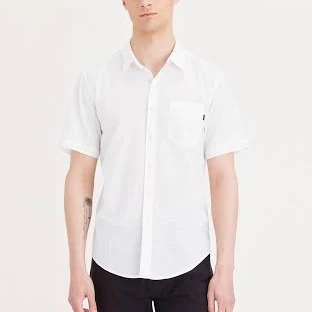
Dockers · Stain-Resistant Professional Workwear
Dockers Men's Regular Fit Short-Sleeve Shirt
Basic casual shirt without water-resistant finish, lower risk.
Plain cotton-polyester without water-repellent coating or stain treatment. Dockers hasn't documented any PFAS-containing finishes.
Still want this one anyway? Check the price on Amazon. We’d swap it.
Material
cotton-polyester blend, no reported water-repellent coating treatment
Brand disclosure
Brand is silent on PFAS
Lab data
No public lab test
You may also be interested in
Top-graded picks in the categories readers replace first, every one scored on the same rubric.

- polypropylene filter housing, carbon/sediment cartridge
- We found no PFAS statement from the brand
- Bacterial growth in spent cartridges
3 hazards checked on this product, all on its full breakdown.

Aquasure
Premier Series 75 GPD Under Sink Reverse Osmosis Water Filtration System
- RO membrane, carbon filters, stainless steel housing
- We found no PFAS statement from the brand
- Bacterial and microbial growth in housing and filters
4 hazards checked on this product, all on its full breakdown.

Avocado
Vegan Mattress
- organic cotton, natural latex, coconut coir, recycled steel coils
- The brand calls it PFAS-free, which we have not verified
- Heavy metals
2 hazards checked on this product, all on its full breakdown.
What Dockers Men's Regular Fit Shirt is made of, ingredients and materials
Dockers Regular Fit Short-Sleeve Shirt is a cotton-polyester blend, typically 65% cotton and 35% polyester by weight in this product line. Cotton provides breathability and low chemical burden; polyester contributes durability and wrinkle resistance but requires synthetic processing. The absence of a water-repellent coating (water-repellent coating) finish, as noted in your context, eliminates a major source of fluorinated compounds in textiles. Polyester itself does not inherently release problematic chemicals during normal wear or laundering at standard household temperatures.
What’s concerning
Category baseline
The starting point for this type of product, before anything specific to this product is counted.
No PFAS disclosure
No public statement from the brand about PFAS in this product.
Azo dyes and colorant safety
Polyester-cotton blends are typically dyed with disperse and reactive azo dyes. No specific contamination or prohibited azo dye use has been reported for Dockers casual shirts, but the industry standard involves dyes that can theoretically release aromatic amines under extreme conditions (boiling, high chlorine). Household laundering does not trigger this risk; the hazard is primarily occupational
Formaldehyde / VOCs
Cotton-polyester blends often use low-level formaldehyde resin finishes for wrinkle resistance and shape retention. Dockers does not specify whether this shirt uses formaldehyde-free finishes. Such residues typically off-gas minimally after production and are further reduced by the first few washes. Direct skin contact with formaldehyde-treated fabric can cause dermatitis in sensitive individuals;
Source, ATSDR ↗Dye bleeding and colorant migration
Dark-colored cotton-polyester blends can release excess dye in early washes, particularly in hot water. This is a cosmetic and comfort issue (staining other garments) rather than a health hazard, but indicates residual surface dyes that should be removed by cold-water washing before wearing against skin.
Microplastic shedding from synthetic fiber
The polyester component (approximately 35% of blend) sheds microfibers during washing, contributing to aquatic microplastic pollution. This is an environmental rather than direct-health hazard. Using a washing machine filter bag or dedicated filter reduces fiber release by 50-90% without affecting garment performance.
What’s reassuring
Base material not linked to PFAS
The main material recorded for this product is not one associated with PFAS.
Antimony in polyester
Polyester fibers may contain antimony trioxide as a polymerization catalyst, but documented migration into sweat or skin contact is extremely rare under normal wear. No specific testing or incidents involving Dockers casual shirts have been documented. This remains a theoretical concern for the polyester category rather than a confirmed hazard for this product.
How is this PFAS grade calculated?
The brand's record and disclosure
Dockers (owned by Levi Strauss & Co.) has not made public statements specifically targeting PFAS elimination in casual menswear, and disclosure on chemical finishing practices for this product line is minimal. Levi Strauss & Co. as a parent company has committed to reducing hazardous chemical use across operations but does not publish item-level certifications for individual basic shirts. No recalls or chemical contamination incidents specifically involving Dockers casual shirts have been widely documented. The brand's silence on finish chemistry reflects industry-standard opacity rather than a red flag unique to Dockers.
How it compares in its category
Men's cotton-polyester casual shirts are the commodity baseline of apparel. Dockers positions itself as mid-market, durable workwear; comparable alternatives (J.Crew, Tommy Hilfiger, unbranded basics) carry similar or less transparent chemical profiles. Shirts without water-resistant treatment have lower concern than performance or outdoor lines, which commonly use PFAS-based finishes. This product avoids the premium-finish hazard tier, placing it in the lower-concern segment of its category.
If you buy it
Launder in warm water (not hot) to minimize any dye migration or residual finish release; hot water is unnecessary for a casual shirt and may stress fibers or dyes. Wash separately from whites in first few launders to avoid dye bleeding. Standard detergent is appropriate; no special treatment needed. Replace when seams fail or fabric pills excessively, typically 2-3 years of regular wear; end-of-life disposal has no special requirements.
What is not known about PFAS in this product?
- Basis
- Model estimate, 78% confidence, not a lab result
- Lab test
- None on record for this exact product
- Brand statement
- Dockers has made none
Formulations change between production runs, so check the current label. How we grade.
More stain-resistant professional workwear grades
How we score, every product runs through the same public 0-100 rubric based on materials, coatings, brand disclosure, lab findings, and recalls. See the full methodology → Spotted a mistake? Report an error.