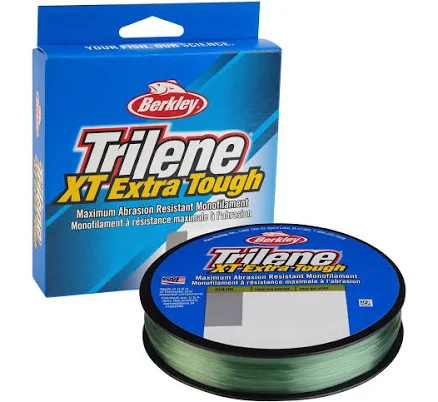
Berkley Trilene XT Monofilament Fishing Line
Low concern for basic nylon line without water-repellent coating or special coatings.
Standard nylon monofilament with no publicly known water-repellent, stain-resistant, or non-stick coating requiring PFAS. Berkley makes no PFAS claims either way.
We flunk more products than we pass. This one earned its grade. How we grade
Material
Nylon monofilament (extruded polymer)
Brand disclosure
Brand is silent on PFAS
Lab data
No public lab test
You may also be interested in
Top-graded picks in the categories readers replace first, every one scored on the same rubric.

- polypropylene filter housing, carbon/sediment cartridge
- We found no PFAS statement from the brand
- Bacterial growth in spent cartridges
3 hazards checked on this product, all on its full breakdown.

Aquasure
Premier Series 75 GPD Under Sink Reverse Osmosis Water Filtration System
- RO membrane, carbon filters, stainless steel housing
- We found no PFAS statement from the brand
- Bacterial and microbial growth in housing and filters
4 hazards checked on this product, all on its full breakdown.

Avocado
Vegan Mattress
- organic cotton, natural latex, coconut coir, recycled steel coils
- The brand calls it PFAS-free, which we have not verified
- Heavy metals
2 hazards checked on this product, all on its full breakdown.
What Berkley Trilene XT Fishing Line is made of, ingredients and materials
Berkley Trilene XT is extruded nylon monofilament, a synthetic polymer spun into a single continuous filament. Nylon monofilament is chemically stable under normal use conditions (water immersion, UV exposure, temperature swings typical of fishing). Unlike braided or coated lines, monofilament has no adhesive binders, textile weaves, or proprietary surface treatments that could leach additives into water or skin contact.
What’s concerning
Category baseline
The starting point for this type of product, before anything specific to this product is counted.
No PFAS disclosure
No public statement from the brand about PFAS in this product.
Nylon polymer degradation and microplastic release
Extended UV and thermal exposure can cause nylon monofilament to become brittle, crack, and fragment into microparticles that may enter water. This is an intrinsic property of nylon, not a manufacturing defect, but is relevant for fishing line because it is deliberately immersed in aquatic environments and subject to abrasion.
UV stabilizer additives in polymer matrix
Nylon monofilament contains UV absorbers or hindered amine light stabilizers (HALS) to prevent yellowing and brittleness. Berkley does not disclose which stabilizers are used. Under normal fishing conditions, these additives remain bound in the polymer; leaching risk is low but not zero during extended water immersion or if line is degraded.
Skin irritation or eye contact from monofilament filament
Fishing monofilament is physically sharp when cut and can embed in skin or cause corneal scratches on eye contact. This is a mechanical rather than chemical hazard, but is category-standard and documented in fishing line safety guidance.
What’s reassuring
Base material not linked to PFAS
The main material recorded for this product is not one associated with PFAS.
Heavy metals
Trilene XT comes in various colors (clear, green, brown, etc.). No published data or recalls document heavy metal contamination (cadmium, lead) in Berkley's colorants. Established nylon line manufacturers typically use approved azo dyes and titanium dioxide. No evidence specific to this product.
Source, FDA ↗Leaching of nylon processing residues or plasticizers
Extruded nylon monofilament is a finished polymer with no added plasticizers required for flexibility. Processing residues are minimal in standard extrusion. No documented leaching incidents reported for Trilene XT or similar monofilaments into water or skin contact.
How is this PFAS grade calculated?
The brand's record and disclosure
Berkley (owned by Pure Fishing, a Newell subsidiary) does not publicly disclose detailed ingredient lists, processing chemistry, or third-party testing for fishing lines. No published certifications (e.g., NSF, EPA, EU Ecolabel) exist for this product category. No recalls or contamination incidents are on record for Trilene XT monofilament. The brand maintains a general silence on PFAS use, which is typical for fishing tackle manufacturers, though the basic nylon formulation carries lower fluorochemical risk than treated or water-resistant lines.
How it compares in its category
Trilene XT occupies the mainstream middle market for monofilament. It competes directly with Spiderwire, Stren, and store-brand nylon lines. Most standard monofilaments are chemically similar (extruded nylon with UV stabilizers and coloring). Braided or fluorocarbon-coated alternatives may introduce more complex additive packages. Trilene XT's lack of stated specialty coatings or treatments reduces additive complexity compared to premium hybrid lines.
If you buy it
Store spool indoors away from direct sunlight to slow UV degradation and preserve strength over seasons. Replace line annually or after visible cracking, cloudiness, or loss of elasticity, since nylon becomes brittle with UV and heat exposure. Avoid storing in extreme heat (e.g., hot car trunk) as nylon softens above 80 C and may off-gas minor volatile compounds. Dispose of spent line in regular trash (not water) to prevent wildlife entanglement; nylon does not biodegrade quickly.
What is not known about PFAS in this product?
- Basis
- Model estimate, 72% confidence, not a lab result
- Lab test
- None on record for this exact product
- Brand statement
- Berkley has made none
Formulations change between production runs, so check the current label. How we grade.
More fishing line grades
How we score, every product runs through the same public 0-100 rubric based on materials, coatings, brand disclosure, lab findings, and recalls. See the full methodology → Spotted a mistake? Report an error.