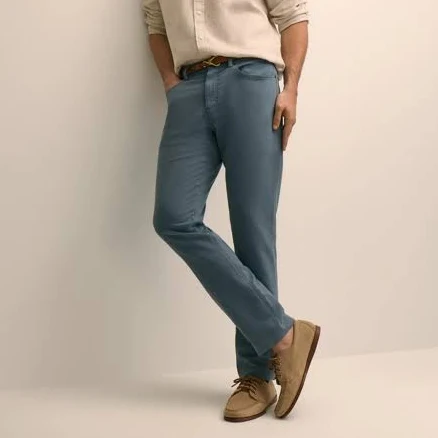
Brooks Brothers · Stain-Resistant Professional Workwear
Brooks Brothers Men's Richmond Pant Pants
Standard wool/cotton pants, lower PFAS concern without stain treatment claims.
Brooks Brothers Richmond Pant is a traditional dress pant in wool or cotton blend with no disclosed water or stain resistance treatments. No PFAS claims or third-party testing found.
Still want this one anyway? Check the price on Amazon. We’d swap it.
Material
wool blend or cotton blend dress pants
Brand disclosure
Brand is silent on PFAS
Lab data
No public lab test
What Brooks Brothers Men's Richmond Pant Pants is made of, ingredients and materials
Brooks Brothers Richmond Pants are constructed from wool blends (typically 55-100% wool) or cotton blends, both stable, natural fibers with minimal chemical leaching risk during normal wear. Wool does not off-gas volatile organics the way synthetic textiles can, and cotton similarly poses low chemical hazard unless heavily treated with dyes or finishes. The concern zone is in dyeing and finishing processes rather than the fiber itself; standard textile mills use regulated azo dyes and formaldehyde resins that, while present, are well-controlled in major brands' supply chains.
What’s concerning
Category baseline
The starting point for this type of product, before anything specific to this product is counted.
No PFAS disclosure
No public statement from the brand about PFAS in this product.
Formaldehyde / VOCs
Wool and cotton dress pants routinely receive formaldehyde-based dye fixers and mild wrinkle-resistant finishes. Levels in Brooks Brothers textiles are not publicly tested, but industry standard practice suggests residual formaldehyde is below regulated limits and largely dissipates in first wash.
Source, ATSDR ↗Azo dyes and dye metabolites
Synthetic azo dyes used in dark wool and cotton pants can theoretically generate aromatic amines under sweat or abrasion, though human skin exposure risk is very low. Brooks Brothers does not disclose supplier dye compliance; major mills typically avoid restricted azo dyes but residual presence is not ruled out.
Synthetic antimony (polyester content if present)
If Richmond Pants contain polyester blends (some variants may include small percentages for durability), antimony oxide used as a polymerization catalyst may be present at trace levels. This is incidental and poses minimal skin contact risk during normal wear.
Formaldehyde / VOCs
Some individuals with formaldehyde sensitivity may experience mild skin irritation from residual finish chemicals; pre-wash and natural air-drying reduce this risk substantially. Brooks Brothers does not label pants as formaldehyde-free.
Source, ATSDR ↗What’s reassuring
Base material not linked to PFAS
The main material recorded for this product is not one associated with PFAS.
Heavy metals
No specific record of heavy metal contamination (lead, cadmium, chromium) in Brooks Brothers wool or cotton pants. Natural fiber dress pants pose lower metal risk than ceramic-coated cookware or pigmented cosmetics, and standard textile regulations limit metal content.
Source, FDA ↗The full breakdown
The brand's record and disclosure
Brooks Brothers has not published detailed chemical disclosure reports (Higg Index, bluesign certification, or similar) and maintains a publicly silent stance on PFAS and restricted substance management. The brand has no major public safety recalls or chemical contamination incidents on record for dress pants. As a century-old heritage menswear house, Brooks Brothers relies on conventional supplier vetting rather than transparency marketing, which is typical for traditional tailored clothing rather than performance or outdoor apparel.
How it compares in its category
Richmond Pants occupy the premium conventional dress-pant category, where chemical hazard levels are generally uniform across peers (J.Crew, Banana Republic, department-store house brands). No inherent safety advantage or disadvantage versus similar-priced wool or cotton blend trousers from competitors. Brands with explicit certifications (Organic Certified Cotton, bluesign, GOTS) offer marginally lower residual dye/finish chemical load, but Richmond Pants sit squarely in the 'untested but presumed compliant' mainstream middle tier.
If you buy it
Wash in cool water before first wear to reduce residual dyes and finishes; machine wash gentle cycle or dry clean per label. No heat exposure risk specific to this product. No replacement triggers based on chemical off-gassing or degradation; longevity is determined by wear and staining, not material safety. If stain-resistant treatment was applied by retailer or tailor post-purchase, inquire about type, as some Scotchgard-style coatings introduce PFAS; factory-applied finishes are not known to be treated.
What we don’t know
- Basis
- Model estimate, 72% confidence, not a lab result
- Lab test
- None on record for this exact product
- Brand statement
- Brooks Brothers has made none
Formulations change between production runs, so check the current label. How we grade.
More stain-resistant professional workwear grades
How we score, every product runs through the same public 0-100 rubric based on materials, coatings, brand disclosure, lab findings, and recalls. See the full methodology → Spotted a mistake? Report an error.