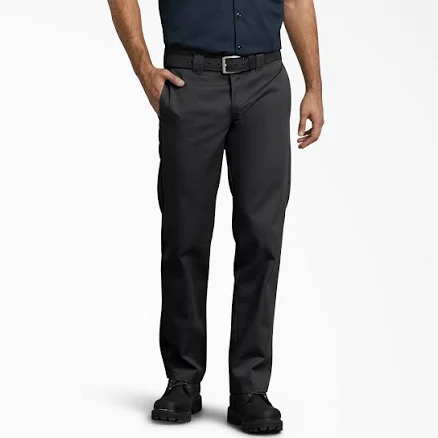
Dickies · Stain-Resistant Professional Workwear
Dickies Men's Slim Straight Work Pants
Lower concern, standard work pants without water/stain treatments.
Dickies work pants are typically untreated cotton-polyester twill without waterproof or stain-resistant finishes, which reduces PFAS risk. Verify product label for any water-repellent coating applied since brand discloses nothing about PFAS.
Still want this one anyway? Check the price on Amazon. We’d swap it.
Material
cotton/polyester blend twill
Brand disclosure
Brand is silent on PFAS
Lab data
No public lab test
What Dickies Men's Slim Straight Work Pants is made of, ingredients and materials
Dickies Slim Straight Work Pants are a cotton-polyester twill blend, typically 65% polyester and 35% cotton or similar ratio. Twill construction (diagonal weave) is durable and resists wrinkles, which means less frequent washing and lower wear-and-tear on fibers. The polyester component adds stretch and shape retention; the cotton provides breathability and comfort. This blend is standard across workwear and does not inherently require chemical treatments that raise hazard flags.
What’s concerning
Category baseline
The starting point for this type of product, before anything specific to this product is counted.
No PFAS disclosure
No public statement from the brand about PFAS in this product.
Azo dyes and color fastness
Dark dyes (indigo, navy, black) on workwear may contain azo compounds; Dickies does not disclose dye chemistry. Risk is low during normal wear but loose dyes can transfer in first few washes, especially in hot water. Rinsing before wear mitigates this.
Formaldehyde / VOCs
Twill fabrics often receive wrinkle-resistant or sizing finishes that may contain formaldehyde-releasing compounds. No recalls or complaints are on record for Dickies workwear, and formaldehyde in clothing typically volatilizes during wearing and washing. Risk is low but not zero for sensitive individuals.
Source, ATSDR ↗Microplastic shedding
Polyester garments shed microfibers during washing and wear. The extent depends on construction durability; tight twill weaves shed less than loose knits. This is a laundry and environmental concern, not a direct wearer hazard, but relevant for households with aquatic ecosystems nearby.
What’s reassuring
Base material not linked to PFAS
The main material recorded for this product is not one associated with PFAS.
Antimony in polyester
Polyester production may use antimony as a catalyst, but residual antimony levels in finished garments are extremely low and migration into skin or sweat is not established as a health pathway. No specific data exists for Dickies pants on this parameter.
Flame retardants
Workwear is not typically treated with added flame retardants unless marketed as flame-resistant. Dickies Slim Straight Work Pants carry no FR claim and show no record of intentional flame-retardant application.
Source, EPA ↗The full breakdown
The brand's record and disclosure
Dickies has not published detailed chemical-use or sustainability disclosure documents in the public domain, and the brand has not been associated with significant chemical-safety recalls or scandals in workwear. The company maintains industry-standard manufacturing practices but remains largely silent on specific flame-retardant, dye, or finishing chemical use. Absence of public disclosure does not indicate a problem, but it reflects a typical workwear brand posture of minimal transparency.
How it compares in its category
Dickies work pants sit in the mainstream industrial-casual segment and are chemically comparable to competitors like Carhartt and Lee. Prices and durability are competitive; chemical hazard profiles are similar to other mass-market cotton-polyester work trousers. If chemical minimalism is a priority, heritage organic-cotton workwear brands (e.g., Patagonia) offer alternatives, but Dickies carry no established elevated risk relative to the category norm.
If you buy it
Wash in cool water before first wear to reduce loose dyes and finish residues. Avoid hot dryers (high heat can degrade polyester fibers prematurely and set any residual chemical finishes); air-dry or low heat extends life. Watch for pilling on the seat and thighs after repeated wear; this is normal for poly-blend twill and does not indicate a safety issue. Replace when seams fail or crotch wear becomes pronounced, typically after 1-2 years of heavy use.
What we don’t know
- Basis
- Model estimate, 72% confidence, not a lab result
- Lab test
- None on record for this exact product
- Brand statement
- Dickies has made none
Formulations change between production runs, so check the current label. How we grade.
More stain-resistant professional workwear grades
How we score, every product runs through the same public 0-100 rubric based on materials, coatings, brand disclosure, lab findings, and recalls. See the full methodology → Spotted a mistake? Report an error.