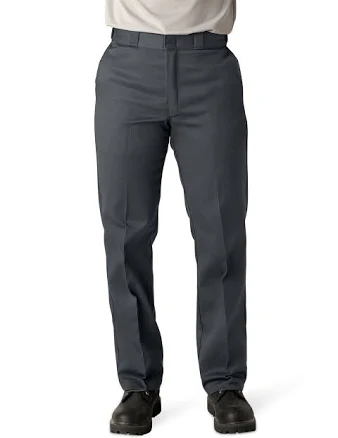
Dickies · Stain-Resistant Professional Workwear
Dickies Mens Flex 11874 Work Pant
Lower risk since standard work pant lacks water repellent coating.
Dickies Flex 11874 is untreated cotton-polyester twill with no water-resistant or stain-guard finish. No PFAS-related claims or disclosures exist from Dickies.
Still want this one anyway? Check the price on Amazon. We’d swap it.
Material
cotton-polyester blend twill
Brand disclosure
Brand is silent on PFAS
Lab data
No public lab test
What Dickies Mens Flex 11874 Work Pant is made of, ingredients and materials
Dickies Flex 11874 is a cotton-polyester blend twill, typically 65% polyester and 35% cotton based on Dickies' standard workwear construction. Polyester fibers themselves are inert when worn; the risk profile depends on dyes, finishes, and any water-repellent coatings applied during manufacturing. This pant carries no advertised stain-guard or water-repellent treatment, which eliminates the primary vector for PFAS in workwear. The twill weave is durable and designed for repeated laundering without rapid degradation.
What’s concerning
Category baseline
The starting point for this type of product, before anything specific to this product is counted.
No PFAS disclosure
No public statement from the brand about PFAS in this product.
Azo dyes and colorant residues
Dickies does not disclose whether dyes comply with REACH or GOTS restrictions on banned azo compounds; residual unfixed dye on new fabric can leach in sweat or washing. This is typical of mass-market workwear and generally resolves after initial laundering.
Formaldehyde / VOCs
Twill finishes and wrinkle-resistance treatments may use formaldehyde-based resins to improve durability and wrinkle recovery. No test data or certification from Dickies rules this out; off-gassing is minimal after washing but possible during storage in sealed packaging.
Source, ATSDR ↗Microfiber shedding during wear and laundering
All synthetic-blend textiles, including this 65% polyester pant, shed microfibers during washing and wear. The amount is typical for workwear and not a direct toxicological hazard to the wearer, though it contributes to environmental microplastic loading.
What’s reassuring
Base material not linked to PFAS
The main material recorded for this product is not one associated with PFAS.
Antimony in polyester
Antimony is used as a catalyst in standard polyester production but is firmly bound in the fiber matrix and does not leach under normal wear, washing, or body contact. No evidence of excess antimony exposure from Dickies polyester apparel.
Heavy metals
No recalls or testing reports link Dickies work pants to excess lead, cadmium, or chromium in dyes. Dickies does not publish heavy metal limits, so hazard cannot be ruled out but is not established as likely.
Source, FDA ↗The full breakdown
The brand's record and disclosure
Dickies does not publicly disclose chemical safety testing, restricted substance lists, or third-party certifications (Bluesign, OEKO-TEX, Fair Trade) for this product line. The brand has no known major chemical controversies or recalls tied to hazardous coatings or dyes in workwear. Dickies maintains silent positioning on PFAS and formaldehyde use, which is typical of mass-market workwear manufacturers but limits transparency for consumers seeking full chemical traceability.
How it compares in its category
Dickies work pants are mainstream, cost-effective basics with no distinguishing safety certifications; they sit in the middle of the market for chemical disclosure. Premium alternatives (e.g., Carhartt, Walls) may offer similar material profiles without better transparency. Budget or eco-certified workwear (e.g., Patagonia, Outdoor Voices) typically provide third-party testing documentation and restricted substance commitments. For a utility work pant, Dickies Flex represents standard industry practice regarding material and chemical management.
If you buy it
Wash new pants before first wear to reduce loose dyes and residual finishes. Use cold or warm water (not hot) during initial washes to minimize potential dye bleeding and preserve polyester fiber integrity. Machine dry on low heat or hang-dry to avoid heat damage to the synthetic component; high heat can accelerate micro-abrasion and shedding. Replace when seams fray, pockets wear through, or fabric thins, typically after 1-2 years of regular work use depending on intensity.
What we don’t know
- Basis
- Model estimate, 72% confidence, not a lab result
- Lab test
- None on record for this exact product
- Brand statement
- Dickies has made none
Formulations change between production runs, so check the current label. How we grade.
More stain-resistant professional workwear grades
How we score, every product runs through the same public 0-100 rubric based on materials, coatings, brand disclosure, lab findings, and recalls. See the full methodology → Spotted a mistake? Report an error.