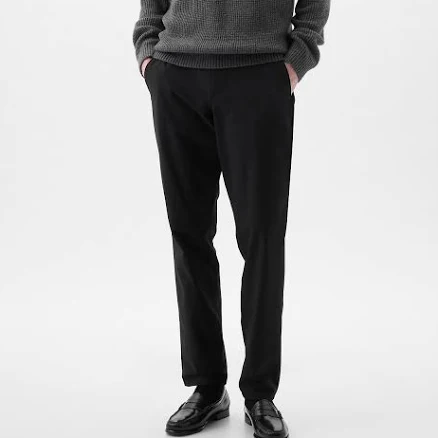
Gap · Stain-Resistant Professional Workwear
Gap Men's Hybrid Slim Khakis
Lower concern. Standard cotton blend with no water-repellent coating or stain treatment claimed.
Standard cotton-blend trousers with no waterproof or stain-resistant treatment disclosed. No PFAS warning signs detected, though lack of finish transparency creates minor uncertainty.
Still want this one anyway? Check the price on Amazon. We’d swap it.
Material
cotton blend, no stated special coatings
Brand disclosure
Brand is silent on PFAS
Lab data
No public lab test
What Gap Men's Hybrid Slim Khakis is made of, ingredients and materials
Gap Men's Hybrid Slim Khakis are a cotton blend (exact synthetic percentage not disclosed in public materials). Cotton blends used in casual menswear typically rely on conventional reactive or acid dyeing, finishing resins for wrinkle resistance or crease retention, and standard industrial laundering processes. The 'hybrid' label suggests a performance-oriented weave, likely incorporating polyester or elastane for stretch and durability. No water-repellent (water-repellent coating), antimicrobial, or stain-resistant coating is claimed, which reduces exposure to PFAS and related finishes.
What’s concerning
Category baseline
The starting point for this type of product, before anything specific to this product is counted.
No PFAS disclosure
No public statement from the brand about PFAS in this product.
Formaldehyde / VOCs
Cotton-blend casual khakis commonly use methylol or melamine-formaldehyde resins for durability and wrinkle-free properties. Gap does not disclose finish chemistry. Residual free formaldehyde is typically <75 ppm in finished apparel (well below US regulatory limits) but is detectable in some products. Washing before wear reduces exposure.
Source, ATSDR ↗Heavy metals
Neutral or earth-tone khakis (this product's likely color range) often use azo-based or chrome-complexed dyes. Certain azo dyes release carcinogenic amines under specific conditions (strong acid + reducing agent). Gap has no stated azo-dye ban for this line. Risk is low in normal use; washing removes loosely bound dye residues.
Source, FDA ↗Antimony in polyester (if synthetic content uses virgin resin)
If the blend includes polyester, it likely contains antimony trioxide (catalyst residue) at typical concentrations of 100-300 ppm. Antimony leaching from new textiles is minimal in normal contact but increases with sweat or acidic conditions. No Gap-specific data available; industry-standard for polyester.
Pesticide residue
Non-organic cotton can retain trace pesticide residues (e.g., DDT metabolites, organophosphates) from field treatment. Gap does not certify organic sourcing for this product. Residual levels in finished fabric are typically below health concern thresholds but are higher than in certified-organic garments. Washing reduces exposure.
Source, EPA ↗Volatile organic compounds (VOCs) in dyes and finishes
Off-gassing of residual solvents or volatile finish components may occur in new garments, particularly in sealed packaging. Odor is usually the only indicator; health effect at typical exposure is minimal. Airing the garment before wear or first wash eliminates this concern.
What’s reassuring
Base material not linked to PFAS
The main material recorded for this product is not one associated with PFAS.
The full breakdown
The brand's record and disclosure
Gap Inc. has not published detailed chemical disclosure policies for its core apparel lines comparable to transparency leaders like Patagonia or Uniqlo. The brand signed the Gap Inc. Responsibility Report addressing labor and environmental footprint but remains largely silent on restricted chemicals in finished garments. No recalls or public health incidents tied to Gap khakis specifically are on record. The brand's lack of third-party certifications (e.g., OEKO-TEX, GOTS) for this product line reflects standard mid-market retail practice rather than a red flag.
How it compares in its category
Standard cotton-blend casual trousers carry similar chemical load regardless of brand; Gap's pricing and construction are mid-market typical. Certified organic cotton khakis (e.g., Patagonia) would lower formaldehyde and pesticide residue risk. Budget basics from retailers with weaker supply-chain oversight may have higher heavy-metal dye or residual solvent content, though no public data differentiates Gap unfavorably. Gap's scale and US distribution suggest more consistent factory auditing than very-low-cost imports.
If you buy it
Wash before first wear in cool water to remove excess dyes and sizing agents. Standard home laundering (40°C / 104°F) poses no heat-release risk for the materials described. Dry cleaning is an option but unnecessary; machine wash on gentle cycle extends life and avoids perchloroethylene exposure. Replace when seams fail or fabric thinning occurs, typically after 2-4 years of regular wear. Store in a cool, dry place; no special precautions needed.
What we don’t know
- Basis
- Model estimate, 72% confidence, not a lab result
- Lab test
- None on record for this exact product
- Brand statement
- Gap has made none
Formulations change between production runs, so check the current label. How we grade.
More stain-resistant professional workwear grades
How we score, every product runs through the same public 0-100 rubric based on materials, coatings, brand disclosure, lab findings, and recalls. See the full methodology → Spotted a mistake? Report an error.