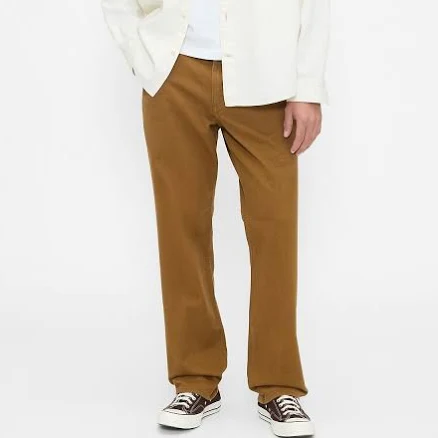
Gap · Stain-Resistant Professional Workwear
Gap Men's Relaxed Straight Utility Khakis
Utility khakis, lower concern without water-repellent coating finish.
These relaxed khakis appear to be untreated cotton-blend twill without water-resistant coating. No PFAS claims or third-party verification available from the brand.
Still want this one anyway? Check the price on Amazon. We’d swap it.
Material
Cotton-blend twill, no reported treatment
Brand disclosure
Brand is silent on PFAS
Lab data
No public lab test
What Gap Men's Relaxed Straight Utility Khakis is made of, ingredients and materials
Gap's Relaxed Straight Utility Khakis are constructed from cotton-blend twill without reported water-resistant or stain-resistant finish. The blend (typically 98% cotton / 2% elastane or similar) means minimal synthetic fiber content and no evidence of water-repellent coating (water-repellent coating) coatings that would introduce PFAS. Twill weave is a standard, mechanically simple construction with low chemical processing compared to performance fabrics.
What’s concerning
Category baseline
The starting point for this type of product, before anything specific to this product is counted.
No PFAS disclosure
No public statement from the brand about PFAS in this product.
Heavy metals
Khaki coloring (typically iron oxide or azo-based pigments) undergoes standard dyeing; Gap does not publicly disclose azo dye restrictions or heavy metal (lead, cadmium) limits in finished products, though EU regulations cap such metals. Risk is typical for mass-market cotton apparel.
Source, FDA ↗Formaldehyde / VOCs
Cotton-blend twill may receive minimal formaldehyde-based resin finish for wrinkle resistance or crease-setting. Gap has not stated whether formaldehyde-free finishing is standard; untreated twill carries lower residual formaldehyde risk than permanent-press garments, but trace exposure remains possible.
Source, ATSDR ↗Elastane (spandex) degradation and leaching
The 2% elastane component can degrade under heat and UV, potentially leaching oligomers or residual solvents used in fiber production. This occurs slowly in normal wear and wash; no documented health impact at these exposure levels in casual wear.
Loose dye transfer and allergens
Untreated khakis may shed color slightly on first wash, particularly in darker dye lots. Fragrance-free processing is standard, but individual sensitivity to residual dye molecules remains possible in sensitive skin populations.
What’s reassuring
Base material not linked to PFAS
The main material recorded for this product is not one associated with PFAS.
Antimony in polyester components
Antimony is used as a catalyst in polyester synthesis but is not relevant here; this product is predominantly cotton with minimal synthetics, so antimony contamination is not a documented concern.
The full breakdown
The brand's record and disclosure
Gap Inc. has not published detailed chemical disclosure policies for finished apparel comparable to brands like Patagonia or Allbirds. The company signed the Restricted Substances List (RSL) framework but maintains limited public transparency on formaldehyde resins, dye chemistry, or heavy metal testing in casual wear. No major recalls or documented chemical contamination linked to Gap khakis have been reported in consumer safety databases.
How it compares in its category
Untreated cotton-blend utility pants occupy the lower-risk segment of casual menswear; they lack the flame retardant or advanced coatings typical of performance khakis or outdoor brands. Standard cotton-twill khakis from mass retailers (Gap, Old Navy, J.Crew Factory) share similar hazard profiles. Untreated blends are generally considered less concerning than heavily finished alternatives, though dye and finishing chemistry remains opaque across most retailers at this price point.
If you buy it
Wash in warm water before first wear to reduce potential loose dye transfer or residual processing chemicals. Launder in standard settings; no heat restrictions apply to untreated cotton-elastane blends. Replace when seams fray or elastic degrades, typically after 2-3 years of regular wear. Store dry to prevent mildew; no special precautions needed for typical home care.
What we don’t know
- Basis
- Model estimate, 72% confidence, not a lab result
- Lab test
- None on record for this exact product
- Brand statement
- Gap has made none
Formulations change between production runs, so check the current label. How we grade.
More stain-resistant professional workwear grades
How we score, every product runs through the same public 0-100 rubric based on materials, coatings, brand disclosure, lab findings, and recalls. See the full methodology → Spotted a mistake? Report an error.