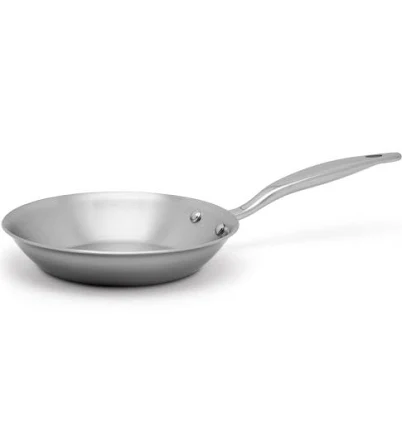
Heritage Steel Fry Pan 8.5", Is It Non-Toxic?
Uncoated stainless steel, with a brand PFAS statement we have not verified.
Heritage Steel says its cookware is made without PFAS of any kind and uses no chemical coatings. We record that as an unverified brand claim. The pan is recorded as uncoated clad stainless steel.
Brand says: “Heritage Steel says its cookware is made without PFAS of any kind and uses no chemical coatings.”
We flunk more products than we pass. This one earned its grade. How we grade
Material
Clad stainless steel, no coating
Brand disclosure
Brand claims PFAS-free
Lab data
No public lab test
You may also be interested in
Top-graded picks in the categories readers replace first, every one scored on the same rubric.

- polypropylene filter housing, carbon/sediment cartridge
- We found no PFAS statement from the brand
- Bacterial growth in spent cartridges
3 hazards checked on this product, all on its full breakdown.

Aquasure
Premier Series 75 GPD Under Sink Reverse Osmosis Water Filtration System
- RO membrane, carbon filters, stainless steel housing
- We found no PFAS statement from the brand
- Bacterial and microbial growth in housing and filters
4 hazards checked on this product, all on its full breakdown.

Avocado
Vegan Mattress
- organic cotton, natural latex, coconut coir, recycled steel coils
- The brand calls it PFAS-free, which we have not verified
- Heavy metals
2 hazards checked on this product, all on its full breakdown.
Is Heritage Steel Fry Pan 8.5" non-toxic? What it is made of
Heritage Steel Fry Pan uses clad stainless steel construction, which bonds an outer layer of stainless steel to a core (typically aluminum or copper-aluminum blend) for even heat distribution. Because it is uncoated, there is no synthetic polymer layer, ceramic enamel, or nonstick surface that can degrade, chip, or release particles over time. Stainless steel itself is highly resistant to leaching under normal cooking conditions, and the clad construction distributes heat without requiring reactive metal contact with food.
What’s concerning
Category baseline
The starting point for this type of product, before anything specific to this product is counted.
Metal ion release (nickel, chromium) from stainless steel
Stainless steel cookware can release trace amounts of nickel and chromium under acidic or salty conditions, particularly when new. Levels are typically well below regulatory concern for the general population, but individuals with nickel sensitivity should be aware. Heritage Steel does not publish nickel-release testing data on record.
What’s reassuring
Bare uncoated material
Recorded as a bare, uncoated material with no surface coating or treatment.
Brand-stated PFAS-free
The brand states this product is PFAS-free. We have not verified the claim.
Aluminum leaching (from clad core)
Clad construction encloses the aluminum core within stainless steel layers, preventing direct contact with food. No established cases of harmful aluminum leaching from properly maintained uncoated clad cookware have been documented in scientific literature.
Coating degradation and particle release
Because this pan has no nonstick or enamel coating, there is no coating to chip, peel, or degrade. Uncoated stainless steel is inherently stable and does not release particles under normal cooking or cleaning.
Teflon-type coating fume hazard
Uncoated stainless steel cookware does not use Teflon-type coating (Teflon) or other Teflon-family coating nonstick surfaces, eliminating fume emission risk even at high temperatures.
Lead
No enamel, glaze, or ceramic coating is present on this product. This hazard class is not applicable to uncoated clad stainless steel construction.
Source, ATSDR ↗How is this PFAS grade calculated?
The brand's record and disclosure
Heritage Steel has made explicit PFAS-free claims and positions itself in the premium cookware market segment emphasizing material transparency and chemical-free design. The brand has not been subject to major product recalls related to cookware safety in publicly available records. However, the PFAS-free claim has not been independently verified by third-party certification bodies (e.g., NSF, GOTS); it rests on the brand's material sourcing statement and the inherent properties of uncoated stainless steel.
How it compares in its category
Uncoated clad stainless steel cookware eliminates the primary failure modes of nonstick cookware (Teflon-type coating fume risk, coating flaking, manufacturing PFAS use) and enameled cast iron (lead/cadmium risk in vintage pieces, enamel chipping). It sits at a higher price point than mass-market nonstick but requires no coating maintenance and will outlast most alternatives. Trade-off, it has slower heat responsiveness than bare cast iron and requires proper seasoning-free cleaning technique to prevent spotting.
If you buy it
Use medium to medium-high heat; stainless clad cookware can warp if subjected to rapid temperature swings (e.g., hot pan into cold water). Hand-wash or use dishwasher according to manufacturer guidance; acidic foods (tomato, vinegar, wine) may cause minor discoloration but do not compromise safety. Replace only if structural damage (warping, separation of layers) occurs, which is uncommon with proper use. Store dry to avoid water spotting; polish with appropriate stainless steel cleaner if desired.
What is not known about PFAS in this product?
- Basis
- Model estimate, 35% confidence, not a lab result
- Lab test
- None on record for this exact product
- Brand statement
- Heritage Steel has made a specific claim
Formulations change between production runs, so check the current label. How we grade.
More cookware grades
How we score, every product runs through the same public 0-100 rubric based on materials, coatings, brand disclosure, lab findings, and recalls. See the full methodology → Spotted a mistake? Report an error.