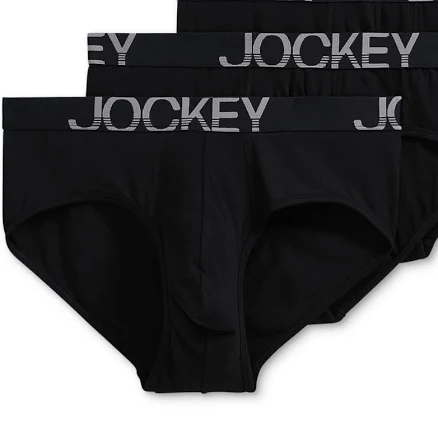
Jockey · Sports Performance Undergarments
Jockey Men's ActiveStretch Brief
Lower concern. No waterproofing or special finishes disclosed.
Jockey's nylon-elastane brief has no advertised water-resistant or stain-resistant treatment. The brand discloses nothing about PFAS, but the absence of performance finishes suggests lower risk.
Still want this one anyway? Check the price on Amazon. We’d swap it.
Material
Nylon/elastane blend, no disclosed finish
Brand disclosure
Brand is silent on PFAS
Lab data
No public lab test
What Jockey Men's ActiveStretch Brief is made of, ingredients and materials
This product is a nylon-elastane (spandex) blend, a common synthetic fiber pairing in stretch athletic underwear. Nylon itself is a stable polyamide plastic with no known leaching of regulated chemicals under normal wear conditions. Elastane (spandex) is a segmented polyurethane that provides stretch and recovery; neither component is known to release harmful chemicals during body contact or standard washing. The risk profile for this material class is dominated by manufacturing residues and dyes rather than the polymers themselves.
What’s concerning
Category baseline
The starting point for this type of product, before anything specific to this product is counted.
No PFAS disclosure
No public statement from the brand about PFAS in this product.
Azo dyes and aniline colorants
Nylon accepts synthetic dyes readily; Jockey does not disclose dye chemistry or banned-azo testing. Some azo dyes degrade to carcinogenic amines under sweat and friction, though risk to wearer is very low compared to dye workers. Pre-wash reduces residual dye load.
Heavy metals
Dark-colored nylon (black, navy) may contain trace lead or cadmium in synthetic dyes, depending on supplier and batch. Regulatory limits in EU and California exist but are rarely tested for basic apparel. Dermal absorption is negligible; concern is primarily occupational.
Source, FDA ↗Elastane degradation and microfiber shedding
Elastane fibers shed during washing and wear, particularly as the fabric ages. These microplastics enter wastewater; inhalation risk during wear is negligible. This is a use-phase environmental concern, not a direct health hazard, but relevant to product lifecycle.
What’s reassuring
Base material not linked to PFAS
The main material recorded for this product is not one associated with PFAS.
Formaldehyde / VOCs
Elastane-nylon blends typically require minimal formaldehyde-based finishes (unlike cotton wrinkle-resist). No finish is disclosed for this product, suggesting standard hydrophobic treatment without heavy resin loading. No reports of formaldehyde issues in Jockey underwear.
Source, ATSDR ↗Antimony catalyst residues in polyester blend
This product is nylon-elastane, not polyester-based, so antimony from polymerization catalysts is not a concern. Nylon uses different catalysts (titanium, tin compounds) that do not bioaccumulate and are used at trace levels.
The full breakdown
The brand's record and disclosure
Jockey is a privately held heritage brand with a 160-year history and no public record of product safety recalls or chemical violations in underwear lines. The company does not publish comprehensive chemical-use transparency reports or third-party sustainability certifications (e.g., bluesign, OEKO-TEX). Their silence on PFAS use in non-waterproofed apparel is typical for the category, as regulatory requirements are limited to water-resistant and performance fabrics. No established health controversies exist for Jockey men's basics.
How it compares in its category
Men's briefs in nylon-elastane are the industry standard and carry lower hazard profiles than synthetic technical apparel (which may use durable water repellents). Cotton-blend alternatives reduce azo dye exposure slightly but offer no meaningful chemical safety advantage for an underwear product that contacts skin briefly during wear. Jockey's positioning is mid-market; quality control is consistent with mass manufacturers, neither premium-certified nor discount-tier.
If you buy it
Wash before first wear to remove manufacturing residues and excess dyes (standard for all new apparel). Use warm or cold water; hot water provides no safety benefit for this material and accelerates elastic degradation. Dry on low heat or air-dry to extend elastane lifespan (typically 50-100 wash cycles before noticeable loss of stretch). Replace when elastic waistband no longer recovers or seams show wear; degraded elastane does not pose a chemical hazard, only comfort loss.
What we don’t know
- Basis
- Model estimate, 72% confidence, not a lab result
- Lab test
- None on record for this exact product
- Brand statement
- Jockey has made none
Formulations change between production runs, so check the current label. How we grade.
More sports performance undergarments grades
How we score, every product runs through the same public 0-100 rubric based on materials, coatings, brand disclosure, lab findings, and recalls. See the full methodology → Spotted a mistake? Report an error.