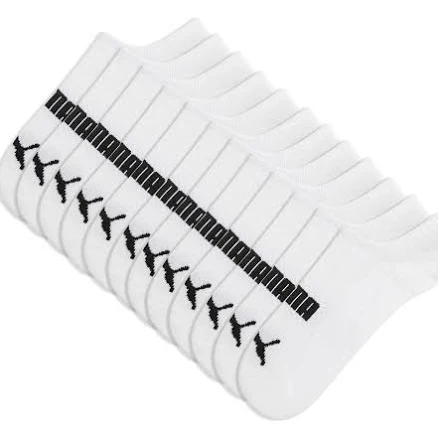
Puma · Sports Performance Undergarments
PUMA Men's 6 Pack 1/2 Terry Socks
Lower concern. Basic socks with no known PFAS-prone treatments.
Terry socks are typically cotton-based with no water-repellent coating or stain-resistant coatings commonly containing PFAS. Material type itself presents lower risk despite no brand disclosure.
Still want this one anyway? Check the price on Amazon. We’d swap it.
Material
Cotton blend terry cloth
Lab data
No public lab test
You may also be interested in
Top-graded picks in the categories readers replace first, every one scored on the same rubric.

- polypropylene filter housing, carbon/sediment cartridge
- We found no PFAS statement from the brand
- Bacterial growth in spent cartridges
3 hazards checked on this product, all on its full breakdown.

Aquasure
Premier Series 75 GPD Under Sink Reverse Osmosis Water Filtration System
- RO membrane, carbon filters, stainless steel housing
- We found no PFAS statement from the brand
- Bacterial and microbial growth in housing and filters
4 hazards checked on this product, all on its full breakdown.

Avocado
Vegan Mattress
- organic cotton, natural latex, coconut coir, recycled steel coils
- The brand calls it PFAS-free, which we have not verified
- Heavy metals
2 hazards checked on this product, all on its full breakdown.
What PUMA Men's 6 Pack 1/2 Terry Socks is made of, ingredients and materials
PUMA's 6-pack terry socks are a cotton blend (exact polyester/cotton ratio not publicly specified, but typical for this category is 80/20 or 75/25 cotton-dominant). Terry cloth construction uses looped fibers for absorbency and cushioning, and cotton is not a material linked to PFAS. Cotton-polyester blends are among the lowest-risk fiber combinations for direct skin contact because neither fiber sheds microplastics under normal wear and neither requires heavy chemical treatment to remain stable.
What’s concerning
Category baseline
The starting point for this type of product, before anything specific to this product is counted.
No PFAS disclosure
No public statement from the brand about PFAS in this product.
Antimony in polyester
Polyester fiber may contain trace antimony as a catalyst residue from production, but levels in finished garments are far below dermal exposure thresholds. Socks have minimal skin contact intensity and brief wear duration per area, further reducing any theoretical risk.
Microplastics
Polyester blend will shed small fibers during washing and wear, as all synthetic textiles do; contribution to environmental microplastic load is real but currently unquantified per garment. This poses no direct consumer hazard but represents an end-of-life environmental concern applicable to all synthetic-containing apparel.
Source, EPA ↗What’s reassuring
Base material not linked to PFAS
The main material recorded for this product is not one associated with PFAS.
Azo dyes
No azo-dye contamination or restricted-substance violations are on record for Puma hosiery. Standard cotton-polyester blends in mass-market socks typically use approved disperse or reactive dyes rather than problematic azo compounds, though Puma does not publish dye lists for individual SKUs.
Formaldehyde / VOCs
Terry cloth does not require formaldehyde-based finishing (wrinkle-resist or flame-retardant resins). No formaldehyde concerns have been reported for plain cotton-blend socks in this category; such finishes are cost-prohibitive for low-margin basics.
Source, ATSDR ↗Flame retardants
Plain hosiery is not subject to flammability standards and does not receive flame-retardant treatment. No flame retardants are expected in or reported for this product.
Source, EPA ↗How is this PFAS grade calculated?
The brand's record and disclosure
Puma has published sustainability reports and joined the Apparel Coalition's Higg Standard, signaling moderate transparency on chemical use in manufacturing. The brand does not publicly disclose formaldehyde-resin or azo-dye testing data for socks specifically, but no recalls or contamination reports are on record for basic cotton-blend hosiery lines. Puma's silence on PFAS aligns with most mainstream hosiery brands; water-resistant sock treatments (which might contain PFAS) are not standard for plain terry socks and are not indicated on this product's labeling.
How it compares in its category
Basic cotton-blend crew or crew-length socks from major brands (Nike, Adidas, Smartwool, Darn Tough) carry similar or identical hazard profiles. Mass-market hosiery rarely undergoes aggressive chemical treatment compared to performance athletic wear or technical textiles. Price and durability vary widely, but safety chemistry is largely commoditized at this tier, making Puma's offering typical and unremarkable in risk terms.
If you buy it
Wash socks in cool or warm water before first wear to reduce loose dyes or residual finishes. Avoid bleach and high heat (above 60C / 140F) to prevent dye bleeding or synthetic fiber degradation, though terry cloth is durable. Socks rarely require special care; replace when elastic fails or fabric pills excessively (typically 6-12 months of regular wear). No special storage or maintenance is needed beyond standard laundry.
What is not known about PFAS in this product?
- Basis
- Model estimate, 78% confidence, not a lab result
- Lab test
- None on record for this exact product
- Brand statement
- Puma has made a specific claim
Formulations change between production runs, so check the current label. How we grade.
More sports performance undergarments grades
How we score, every product runs through the same public 0-100 rubric based on materials, coatings, brand disclosure, lab findings, and recalls. See the full methodology → Spotted a mistake? Report an error.