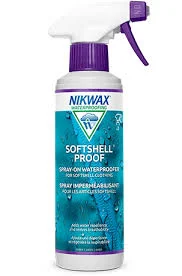
Nikwax · Fabric Stain Guard Sprays
Nikwax Softshell Proof Spray-On Waterproofing
A water-repellent or grease-resistant treatment of unstated chemistry, with a brand PFAS statement we have not verified.
Nikwax says it has never used PFAS in any of its products. We record that as an unverified brand claim. Its record describes a water-repellent or grease-resistant treatment of unstated chemistry, which is still counted.
Brand says: “Nikwax says it has never used PFAS in any of its products.”
Still want this one anyway? Check the price on Amazon. We’d swap it.
Material
Wax-based water-repellent coating (water-repellent coating) spray coating
Brand disclosure
Brand claims PFAS-free
Lab data
No public lab test
What Nikwax Softshell Proof Spray-On is made of, ingredients and materials
Nikwax Softshell Proof is a wax-based water-repellent coating (water-repellent coating) spray designed to hydrophobic-coat synthetic and natural fabrics. Unlike legacy fluorinated DWRs (which contain PFAS), this formulation relies on hydrocarbon waxes to repel water and light stains. The spray is applied topically to fabric surfaces and does not permanently bond; it gradually wears off with laundering and abrasion, requiring reapplication. Wax-based coatings do not release volatile organic compounds (VOCs) at room temperature during or after application, though the spray itself may contain solvent carriers.
What’s concerning
Category baseline
The starting point for this type of product, before anything specific to this product is counted.
Waterproof / stain-resistant treatment
Water-repellent coating treatments have historically used PFAS.
Solvent inhalation from spray application
The product is delivered as a pressurized spray; carrier solvents (likely hydrocarbons or water-based) are present but not fully disclosed. Acute inhalation risk during application is low if used outdoors, but poorly ventilated indoor use may cause transient respiratory or eye irritation.
Wax residue or film on skin or eyes
Direct contact with the spray during application may deposit wax particles on skin or mucous membranes. Skin contact is not known to cause irritation or systemic toxicity; eye contact should be rinsed. This is an application hazard rather than a long-term fabric safety concern.
What’s reassuring
Brand-stated PFAS-free
The brand states this product is PFAS-free. We have not verified the claim.
Microplastic shedding from coating degradation
Wax coatings degrade through mechanical wear and laundering rather than breaking down into microplastics. No evidence links Nikwax wax-based sprays to microplastic release during wear or washing.
Allergens or sensitizers in wax or additives
Hydrocarbon waxes are not inherently allergenic. The product has no known history of contact dermatitis or delayed hypersensitivity reactions, though undisclosed additives cannot be fully ruled out without a complete ingredient list.
Heavy metals
Wax-based repellents do not require toxic metals for function. No lead, cadmium, or antimony has been reported in Nikwax softshell treatments or the brand's product line.
Source, FDA ↗The full breakdown
The brand's record and disclosure
Nikwax has publicly committed to PFAS-free product chemistry and markets this line as such; however, independent verification of this claim is not on public record. The brand does not disclose the full ingredient list for this spray, limiting third-party assessment of carrier solvents or additives. Nikwax has no known safety recalls, product litigation, or regulatory warnings tied to this product or its parent line. The company holds no major third-party certifications (such as Oeko-Tex or Bluesign) for this specific waterproofing spray.
How it compares in its category
Wax-based repellent sprays occupy the lower-toxicity end of the water-repellent coating market, distinct from the majority of commercial softshell treatments which still use fluorinated polymers (PFCs/PFAS). They are less durable than fluorinated coatings and require more frequent reapplication (typically every 2-3 months of wear). Compared to silicone-based repellents, wax formulas are more environmentally benign but may leave a visible residue or matte finish on some fabrics. For consumers avoiding PFAS, wax or silicone sprays are the primary alternatives.
If you buy it
Apply outdoors or in a well-ventilated space; although not a high-VOC product, inhalation of spray mist should be minimized. Test on an inconspicuous area first to ensure compatibility with your fabric (some synthetics may darken slightly or feel waxy). Reapply every 2-3 months if the garment is in frequent use; loss of water beading is the signal to retreat. Washing and drying the garment before reapplication improves coating adhesion; heat from drying does not degrade wax-based DWRs.
What we don’t know
- Basis
- Model estimate, 55% confidence, not a lab result
- Lab test
- None on record for this exact product
- Brand statement
- Nikwax has made a specific claim
Formulations change between production runs, so check the current label. How we grade.
More fabric stain guard sprays grades
How we score, every product runs through the same public 0-100 rubric based on materials, coatings, brand disclosure, lab findings, and recalls. See the full methodology → Spotted a mistake? Report an error.