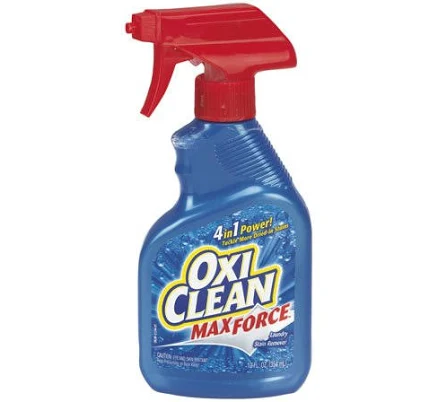
OxiClean · Fabric Stain Guard Sprays
Arm & Hammer Arm & Hammer OxiClean Max Force Spray 12 oz., Dozen (Arm & Hammer 57037-51244)
Lower concern. Liquid oxidizing cleaner not prone to PFAS use.
OxiClean Max Force is hydrogen peroxide-based without typical PFAS application risks. No brand disclosure exists but product chemistry does not inherently require PFAS.
We flunk more products than we pass. This one earned its grade. How we grade
Material
Hydrogen peroxide and surfactant spray cleaner
Lab data
No public lab test
What Arm & Hammer Arm & Hammer OxiClean Max is made of, ingredients and materials
OxiClean Max Force Spray is primarily hydrogen peroxide (a weak oxidizer) combined with surfactants and water to break down stains. Hydrogen peroxide at consumer spray concentrations (typically 1-3%) degrades rapidly into water and oxygen, leaving minimal toxic residue. The surfactants aid soil suspension but are formulated for rinse-away use on fabrics and hard surfaces, limiting dermal or ingestion risk under normal handling.
What’s concerning
Category baseline
The starting point for this type of product, before anything specific to this product is counted.
No PFAS disclosure
No public statement from the brand about PFAS in this product.
Inhalation of hydrogen peroxide vapor/mist
Spray application creates aerosolized particles. At product-typical concentrations (1-3% H2O2), direct inhalation causes mild throat irritation and coughing in sensitive individuals; risk is low in well-ventilated spaces but higher in sealed bathrooms or small closets.
Skin and eye irritation from surfactants and oxidizer
OxiClean product labels carry standard eye-irritant warnings; undiluted spray contact can cause redness and watering. No chemical burns are typical at consumer concentrations, but concentrated product contact requires water rinse.
Accidental ingestion risk in households with young children
Spray bottles may be mistaken for water bottles or cleaning solutions may be decanted into unlabeled containers. Hydrogen peroxide ingestion in small quantities causes gas bloating and nausea; larger volumes risk embolism. Standard child-proof spray trigger provides some barrier but not a complete safety lock.
Dye fading or fabric damage from oxidation
Hydrogen peroxide is an oxidizer and can bleach or yellow certain fabrics, especially reds, deep blues, and vintage textiles. This is not a health hazard but a product-performance risk if misapplied.
Surfactant ecotoxicity if rinsed into waterways
Surfactants in this product degrade in wastewater treatment but can persist in untreated septic systems or surface runoff. This poses no direct consumer health risk but relevant to environmental impact assessment for conscious users.
What’s reassuring
Base material not linked to PFAS
The main material recorded for this product is not one associated with PFAS.
The full breakdown
The brand's record and disclosure
Church & Dwight (OxiClean parent) publishes Safety Data Sheets and ingredient lists for Max Force products with reasonable transparency. No major EPA, CPSC, or consumer safety recalls exist for this specific SKU. The brand has faced no documented controversies around deliberate chemical concealment in stain removers, though PFAS disclosure varies across their portfolio.
How it compares in its category
Hydrogen peroxide-based cleaners present lower inhalation and skin-burn concerns than chlorine bleach alternatives. Enzymatic sprays (protease-based) avoid oxidation chemistry but may trigger allergic sensitization in susceptible users. OxiClean Max Force occupies the mainstream middle ground, effective, widely available, and lower-toxicity than vintage oxygen bleach formulations.
If you buy it
Always use in ventilated areas; hydrogen peroxide vapors are mild irritants at high concentrations. Test on hidden fabric areas first, as oxidizers can fade or yellow certain dyes over time. Do not mix with acids or ammonia-containing cleaners (e.g., vinegar, urine-stained items), this produces oxygen gas and potential rupture. Replace if the spray nozzle clogs or pressure drops significantly, as the product does not require special storage beyond room temperature and a sealed cap.
What we don’t know
- Basis
- Model estimate, 78% confidence, not a lab result
- Lab test
- None on record for this exact product
- Brand statement
- OxiClean has made a specific claim
Formulations change between production runs, so check the current label. How we grade.
More fabric stain guard sprays grades
How we score, every product runs through the same public 0-100 rubric based on materials, coatings, brand disclosure, lab findings, and recalls. See the full methodology → Spotted a mistake? Report an error.