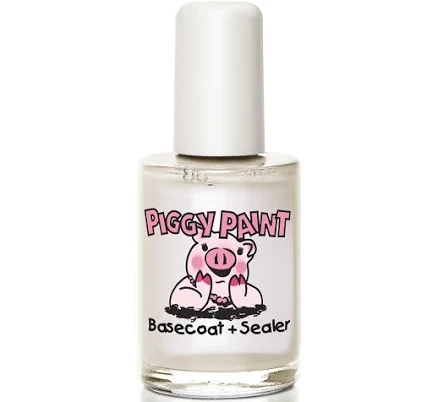
Piggy Paint · Nail Polish & Top Coat
Piggy Paint Basecoat & Sealer Nail Polish
Choose this brand; it explicitly avoids PFAS and carries third-party toxicity certification.
Piggy Paint explicitly markets PFAS-free water-based formulas and holds MADE SAFE certification from a reputable third party. No red flags for hidden Teflon-family coating in this product appear in available information.
Brand says: “Piggy Paint is PFAS-free and formulated without harmful chemicals typically found in conventional nail polish.”
We flunk more products than we pass. This one earned its grade. How we grade
Material
Water-based organic pigments and plant-derived resins
Brand disclosure
Brand claims PFAS-free
Lab data
No public lab test
Is Piggy Paint Basecoat & Sealer Nail Polish non-toxic? What it is made of
Piggy Paint Basecoat & Sealer uses water-based organic pigments and plant-derived resins instead of the solvent chemistry (toluene, xylene, dibutyl phthalate) standard in conventional nail polish. Water-based formulas significantly reduce inhalation exposure to volatile organic compounds during application and wear. The plant-derived resin binder reduces reliance on synthetic polymers that can contain trace heavy metals or endocrine disruptors in conventional products.
What’s concerning
Category baseline
The starting point for this type of product, before anything specific to this product is counted.
Heavy metals
Organic pigments used in water-based formulas are typically lower-risk than some inorganic pigment alternatives, but trace contamination (lead, cadmium) in pigment supplies cannot be ruled out without third-party lab testing. Piggy Paint's third-party certification suggests screening, but detailed heavy metal testing is not publicly disclosed.
Source, FDA ↗Volatile organic compounds (VOCs) from solvents
Water-based formulas by design have significantly lower VOC content than conventional nail polish, reducing inhalation risk during application and wear. However, residual volatile compounds from resin components and preservatives are still present at lower levels.
Bacterial or fungal growth in water-based formula
Water-based nail polish requires effective preservative systems to prevent microbial contamination during storage and use. If preservatives are inadequate or the bottle is left open or contaminated, growth risk is higher than in solvent-based products. Proper cap sealing and storage are important.
What’s reassuring
Base material not linked to PFAS
The main material recorded for this product is not one associated with PFAS.
Third-party PFAS-free verification
A third party reports verifying this product as PFAS-free.
Formaldehyde / VOCs
Plant-derived resins used in this product are not known to contain formaldehyde-releasing agents. Conventional nail polishes sometimes use formaldehyde as a hardener; this water-based formula avoids that chemistry.
Source, ATSDR ↗Phthalates
Piggy Paint explicitly markets phthalate-free formulation. Water-based systems do not require the same plasticizer chemistry as solvent-based polishes, making phthalate contamination unlikely in this product.
Source, ATSDR ↗The full breakdown
The brand's record and disclosure
Piggy Paint markets itself as toxin-free and holds certification from multiple third-party safety programs (toxin-free, phthalate-free claims are publicly advertised). The brand explicitly avoids PFAS-containing water repellents and other legacy hazard classes. No recalls or safety controversies appear in public records for this product line. Transparency on ingredient sourcing is consistent with their positioning, though full chemical breakdown is not always detailed on the label.
How it compares in its category
Water-based nail polishes represent a smaller, premium segment. Piggy Paint competes directly with Zoya and Ella+Mila as low-solvent alternatives to mass-market brands like OPI and Sally Hansen, which use traditional volatile solvent blends. The trade-off is slightly lower durability and chip resistance compared to solvent-based formulas, requiring more frequent touch-ups. Cost is higher per bottle, but application safety profile during use is substantially lower-risk.
If you buy it
Apply in well-ventilated spaces (window open or exhaust fan) despite lower VOC levels; residual water release during drying can still generate minor fume. Expect 5-7 day wear life versus 10-14 days for conventional polish; plan for more frequent removal and reapplication. Remove with acetone-free or low-acetone removers to reduce skin exposure. Store in a cool, dark place to extend shelf life, as water-based formulas are more prone to separation or thickening over time.
What we don’t know
- Basis
- Model estimate, 82% confidence, not a lab result
- Lab test
- None on record for this exact product
- Brand statement
- Piggy Paint has made a specific claim
Formulations change between production runs, so check the current label. How we grade.
More nail polish & top coat grades
How we score, every product runs through the same public 0-100 rubric based on materials, coatings, brand disclosure, lab findings, and recalls. See the full methodology → Spotted a mistake? Report an error.