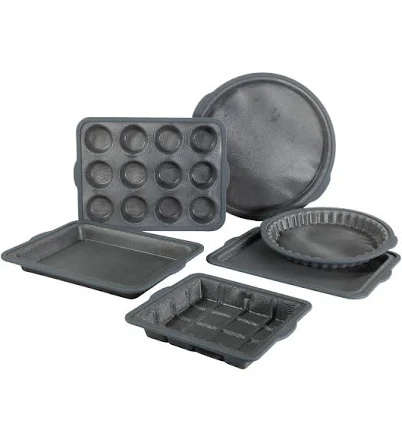
Calphalon Omni Exclusive Technology 6 Piece Ultra Air Flow Bakeware Set, Is It Non-Toxic?
Avoid. Nonstick cookware demands open ingredient disclosure.
This hard-anodized pan has Calphalon's mystery nonstick layer, and the brand refuses to say if Teflon-family coating or PFAS are in it. Better options like stainless steel or cast iron exist.
The better-graded swap
Nordic Ware
Heritage Bundt Pan 10 Cup
85/100 safety
Same rubric that flunked this product. The swap earned Excellent.
Still want this one anyway? Check the price on Amazon. We’d swap it.
Material
Hard-anodized aluminum with proprietary nonstick coating (unspecified)
Lab data
No public lab test
You may also be interested in
Top-graded picks in the categories readers replace first, every one scored on the same rubric.

- polypropylene filter housing, carbon/sediment cartridge
- We found no PFAS statement from the brand
- Bacterial growth in spent cartridges
3 hazards checked on this product, all on its full breakdown.

Aquasure
Premier Series 75 GPD Under Sink Reverse Osmosis Water Filtration System
- RO membrane, carbon filters, stainless steel housing
- We found no PFAS statement from the brand
- Bacterial and microbial growth in housing and filters
4 hazards checked on this product, all on its full breakdown.

Avocado
Vegan Mattress
- organic cotton, natural latex, coconut coir, recycled steel coils
- The brand calls it PFAS-free, which we have not verified
- Heavy metals
2 hazards checked on this product, all on its full breakdown.
Is Calphalon Omni Exclusive Bakeware Set non-toxic? What it is made of
This bakeware set uses hard-anodized aluminum, a electrochemically treated form that creates a dense oxide layer making aluminum harder and more corrosion-resistant than bare aluminum. The proprietary nonstick coating is not chemically identified by Calphalon, which is the core transparency issue. Hard-anodized aluminum itself does not leach aluminum into food under normal baking conditions because the oxide layer acts as a barrier, but coating degradation over repeated heating cycles could eventually expose the base metal.
What’s concerning
Category baseline
The starting point for this type of product, before anything specific to this product is counted.
No PFAS disclosure
No public statement from the brand about PFAS in this product.
Non-stick, chemistry undisclosed
Marketed as non-stick without stating the coating chemistry.
Nonstick coating degradation over time
Hard-anodized aluminum bakeware coatings can degrade with repeated heating cycles and mechanical wear, potentially releasing coating particles into food. No degradation rate is specified by Calphalon; this risk is common across unspecified nonstick formulations.
Aluminum leaching (secondary to coating failure)
If the oxide barrier and nonstick coating both fail significantly, bare aluminum could contact acidic or salt-laden batter. This is not a primary risk under normal use but becomes relevant if pans are used well past visible coating wear.
Teflon-type coating fume risk (if Teflon-type coating is present)
If Calphalon uses traditional Teflon-type coating-based nonstick, overheating above manufacturer limits (rare in baking but possible in broiler or convection settings) could release Teflon-type coating fumes. Calphalon has not ruled this in or out.
Unspecified coating chemistry (transparency gap)
Calphalon markets this set with 'proprietary' coating language but does not state whether it contains PFAS, Teflon-type coating, or alternative polymers. This disclosure gap is the primary distinguishing hazard compared to transparent competitors.
What’s reassuring
Lead
No documented lead or cadmium contamination in Calphalon hard-anodized bakeware. Hard-anodized production in established facilities typically does not introduce these metals, but coating pigments remain unspecified by the brand.
Source, ATSDR ↗How is this PFAS grade calculated?
The brand's record and disclosure
Calphalon has not publicly disclosed whether their cookware coatings contain PFOA, PFAS, or replacements like GenX or Teflon-type coating. The company has faced no documented recalls for nonstick coating hazards on this specific product line, but their silence on coating chemistry is inconsistent with brands (e.g.brands (including GreenPan, Caraway) that explicitly state their formulations contain no PFAS Calphalon's parent company Groupe SEB has made no category-wide commitment to PFAS elimination in nonstick cookware.
How it compares in its category
Standard hard-anodized aluminum bakeware competes with ceramic-coated options (GreenPan, Our Place), silicone molds, and stainless steel. Calphalon's unspecified nonstick coating positions it as mid-market convenience without mid-market transparency; ceramic alternatives offer explicit PFAS-free claims at similar price points. For baking specifically (lower heat than stovetop cooking), the risk profile is lower than for frying pans, but coating integrity still matters over years of use.
If you buy it
Avoid temperatures above 400 degrees Fahrenheit to minimize coating stress; hand wash rather than dishwash to extend coating life. Inspect pans annually for peeling, flaking, or discoloration and retire them if damage appears. Store without stacking or use pan separators to prevent scratching. Do not use metal utensils on the nonstick surface. If Calphalon ever publicly clarifies their coating chemistry, revisit that information to confirm whether PFAS or alternatives with lower concern are used
What is not known about PFAS in this product?
- Basis
- Model estimate, 35% confidence, not a lab result
- Lab test
- None on record for this exact product
- Brand statement
- Calphalon has made a specific claim
Formulations change between production runs, so check the current label. How we grade.
What are the PFAS-free alternatives to Calphalon Omni Exclusive Technology 6 Piece Ultra Air Flow Bakeware Set?
- Cast iron with natural seasoning
- Coating degradation over time
2 hazards checked on this product, all on its full breakdown.
- Cast aluminum with non-stick coating
- Non-stick coating degradation and particle release
3 hazards checked on this product, all on its full breakdown.
- Enameled cast iron (enamel coating over cast iron body)
- Enamel coating degradation and metal exposure
2 hazards checked on this product, all on its full breakdown.
Find an alternative on AmazonMore bundt pans grades
How we score, every product runs through the same public 0-100 rubric based on materials, coatings, brand disclosure, lab findings, and recalls. See the full methodology → Spotted a mistake? Report an error.