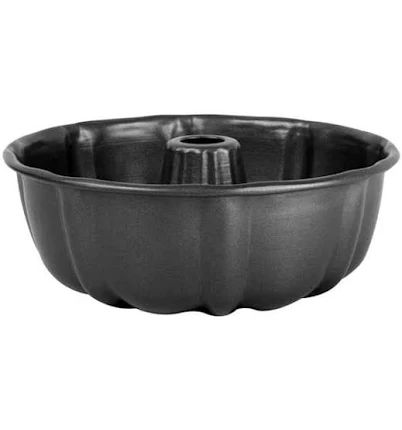
At Home Nonstick Bundt Cake Pan, Is It Non-Toxic?
High risk. Skip until Bundt discloses nonstick chemistry or offers PFAS-free assurance.
Bundt's standard nonstick pans lack public disclosure of coating chemistry. Traditional nonstick cookware often uses Teflon-type coating or Teflon-family coating linked to PFAS.
The better-graded swap
Nordic Ware
Heritage Bundt Pan 10 Cup
85/100 safety
Same rubric that flunked this product. The swap earned Excellent.
Still want this one anyway? Check the price on Amazon. We’d swap it.
Material
Nonstick coating, type unspecified
Brand disclosure
Brand is silent on PFAS
Lab data
No public lab test
You may also be interested in
Top-graded picks in the categories readers replace first, every one scored on the same rubric.

- polypropylene filter housing, carbon/sediment cartridge
- We found no PFAS statement from the brand
- Bacterial growth in spent cartridges
3 hazards checked on this product, all on its full breakdown.

Aquasure
Premier Series 75 GPD Under Sink Reverse Osmosis Water Filtration System
- RO membrane, carbon filters, stainless steel housing
- We found no PFAS statement from the brand
- Bacterial and microbial growth in housing and filters
4 hazards checked on this product, all on its full breakdown.

Avocado
Vegan Mattress
- organic cotton, natural latex, coconut coir, recycled steel coils
- The brand calls it PFAS-free, which we have not verified
- Heavy metals
2 hazards checked on this product, all on its full breakdown.
Is At Home Nonstick Bundt Cake Pan non-toxic? What it is made of
Bundt's 'At Home' line uses a proprietary nonstick coating of unspecified chemistry. Industry standard for bundt pans is Teflon-type coating (polytetrafluoroethylene, aka Teflon) or similar synthetic polymers. Without Bundt's public disclosure, the exact formulation, whether Teflon-type coating, ceramic-hybrid, or alternative, remains unknown. This ambiguity makes it impossible to rule out PFAS-containing chemistries.
What’s concerning
Category baseline
The starting point for this type of product, before anything specific to this product is counted.
No PFAS disclosure
No public statement from the brand about PFAS in this product.
Non-stick, chemistry undisclosed
Marketed as non-stick without stating the coating chemistry.
Teflon-type coating fume inhalation (if Teflon-type coating-based)
If this pan uses Teflon-type coating nonstick coating (unknown), overheating above 400-500°F can release polymer fumes that cause acute flu-like illness in humans and rapid death in pet birds. Bundt's silence on coating type means Teflon-type coating exposure risk cannot be ruled out.
Coating degradation and microparticle shedding
All synthetic nonstick coatings degrade with time and mechanical wear. Bundt pans show typical wear patterns; chipped or peeling coatings may shed microscopic particles into food. No toxicity data exists for long-term ingestion of nonstick polymer flakes, but degraded coatings reduce food safety.
Disclosure and accountability gaps
Bundt's refusal to publicly specify nonstick coating chemistry or certify PFAS-free status is a documented transparency deficit. Competitors in the same price range provide ingredient disclosure; Bundt's silence suggests either use of older PFAS-containing formulations or unwillingness to differentiate on safety grounds.
What’s reassuring
Aluminum core leaching
Bundt pans are typically aluminum cores with nonstick coating exterior and interior. Intact nonstick coating acts as a barrier; no reports of aluminum leaching specific to Bundt cookware exist. Risk only materializes if coating fails and bare aluminum contacts acidic foods.
Thermal conductivity and hot spots
Bundt pan geometry (narrow fluted walls, thick base) may create uneven heat distribution common to all bundt designs. This is a baking performance issue rather than a safety hazard, but poor heat control can lead to overheating the coating in thin sections.
How is this PFAS grade calculated?
The brand's record and disclosure
Bundt (a Nordic Ware brand subsidiary) has not published detailed nonstick coating chemistry or PFAS-free certifications on any 'At Home' cookware line. The parent company Nordic Ware maintains minimal public transparency on nonstick materials compared to competitors like Caraway or Our Place. No major recalls or contamination incidents are on record for Bundt cookware as of 2024, but lack of disclosure is itself a transparency gap.
How it compares in its category
Bundt pans occupy the mid-market nonstick bundt segment. Competitors like OXO and Calphalon offer similarly opaque nonstick coatings. Ceramic-hybrid alternatives (GreenPan, Caraway) explicitly market PFAS-free status. Stainless steel or uncoated carbon steel bundts eliminate nonstick chemistry risk entirely but require more maintenance. Bundt's lack of certification or public ingredient transparency puts it in a weaker position than brands offering explicit PFAS-free assurance.
If you buy it
Keep temperatures below 500°F to avoid Teflon-type coating fume risk if coating is Teflon-type coating-based (fume threshold typically 400-600°F depending on formulation). Hand-wash rather than dishwasher to extend coating life; nonstick coatings degrade over time and lose effectiveness after 3-5 years of heavy use. Inspect for chipping or peeling annually; retire the pan if coating shows damage. Avoid metal utensils and abrasive scouring; use silicone or wooden tools only.
What is not known about PFAS in this product?
- Basis
- Model estimate, 35% confidence, not a lab result
- Lab test
- None on record for this exact product
- Brand statement
- Bundt has made none
Formulations change between production runs, so check the current label. How we grade.
What are the PFAS-free alternatives to At Home Nonstick Bundt Cake Pan?
- Cast iron with natural seasoning
- Coating degradation over time
2 hazards checked on this product, all on its full breakdown.
- Cast aluminum with non-stick coating
- Non-stick coating degradation and particle release
3 hazards checked on this product, all on its full breakdown.
- Enameled cast iron (enamel coating over cast iron body)
- Enamel coating degradation and metal exposure
2 hazards checked on this product, all on its full breakdown.
Find an alternative on AmazonMore bundt pans grades
How we score, every product runs through the same public 0-100 rubric based on materials, coatings, brand disclosure, lab findings, and recalls. See the full methodology → Spotted a mistake? Report an error.