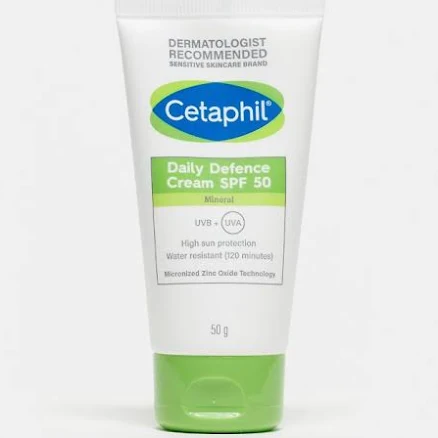
Cetaphil Daily Defence Cream SPF50
Sunscreen with no fluorinated ingredient on record, and no PFAS statement from the brand.
Cetaphil has no PFAS statement on record for this sunscreen. Our record does not include an ingredient-level check, so look for fluorinated ingredients such as Teflon-type coating on the label.
We flunk more products than we pass. This one earned its grade. How we grade
Material
Water-resistant cream base with SPF filters
Brand disclosure
Brand is silent on PFAS
Lab data
No public lab test
You may also be interested in
Top-graded picks in the categories readers replace first, every one scored on the same rubric.

- polypropylene filter housing, carbon/sediment cartridge
- We found no PFAS statement from the brand
- Bacterial growth in spent cartridges
3 hazards checked on this product, all on its full breakdown.

Aquasure
Premier Series 75 GPD Under Sink Reverse Osmosis Water Filtration System
- RO membrane, carbon filters, stainless steel housing
- We found no PFAS statement from the brand
- Bacterial and microbial growth in housing and filters
4 hazards checked on this product, all on its full breakdown.

Avocado
Vegan Mattress
- organic cotton, natural latex, coconut coir, recycled steel coils
- The brand calls it PFAS-free, which we have not verified
- Heavy metals
2 hazards checked on this product, all on its full breakdown.
What Cetaphil Daily Defence Cream SPF50 is made of, ingredients and materials
Cetaphil Daily Defence Cream SPF50 is a water-resistant cream formulation built on an emulsified base (water and oils) with organic and/or inorganic UV filters. The specific filter chemistry is not published on the product label in detail, but Cetaphil typically uses a combination of ingredients such as avobenzone, octinoxate, or titanium dioxide, which are all established UV absorbers approved by regulatory bodies. Water resistance is achieved through the emulsion structure and waxes, not through a separate synthetic coating. The cream base itself carries typical cosmetic formulation concerns, preservatives, fragrance components, and emulsifiers that require standard oversight.
What’s concerning
Category baseline
The starting point for this type of product, before anything specific to this product is counted.
No PFAS disclosure
No public statement from the brand about PFAS in this product.
UV filter allergens and skin sensitization
Organic sunscreen filters (avobenzone, octinoxate) and fragrances in cream formulations are documented skin sensitizers in a small subset of users. Exact filter ingredients are not fully listed on typical product labels, making pre-purchase identification of personal trigger chemicals difficult.
Fragrance components and fragrance allergens
Cetaphil Daily Defence Cream lists fragrance as an ingredient. Fragrance blends can contain undisclosed allergens (limonene, linalool, etc.) and are a common cause of cosmetic contact dermatitis, especially on sun-exposed skin.
Formaldehyde / VOCs
Water-based cream formulations require preservatives to prevent microbial growth. Some preservative systems (e.g., DMDM hydantoin, imidazolidinyl urea) release trace formaldehyde; Cetaphil's full preservative roster is not always disclosed on packaging, requiring label review or inquiry.
Source, ATSDR ↗What’s reassuring
Base material not linked to PFAS
The main material recorded for this product is not one associated with PFAS.
Heavy metals
This product is marketed as a clear or translucent cream, not a tinted formula, so iron oxides or other pigments containing heavy metals are not expected. No contamination concerns are on record for Cetaphil's mineral sunscreen ingredients.
Source, FDA ↗Microplastics
Cetaphil Daily Defence Cream is a traditional emulsified cream with no exfoliating beads or synthetic microparticles listed. Modern Cetaphil formulations have phased out plastic microbeads in line with regulatory bans and consumer pressure.
Source, EPA ↗How is this PFAS grade calculated?
The brand's record and disclosure
Cetaphil is owned by Galderma and has a long market history (since 1945) as a dermatologist-recommended brand with emphasis on gentle, minimal-irritant formulations. The brand does not publicly issue a dedicated PFAS statement, which is typical for legacy skincare lines that predate widespread PFAS scrutiny in cosmetics. No major safety recalls or undisclosed hazard controversies are on public record for this specific product line. Ingredient transparency is standard for cosmetics under FDA and international labeling rules, though full proprietary details are not always disclosed.
How it compares in its category
Daily-use sunscreen creams occupy a middle ground, they carry lower hazard burden than spray sunscreens (which pose inhalation risk) or aerosol formats. Cetaphil's water-resistant cream is comparable in hazard profile to other major brands (Neutrogena, CeraVe, La Roche-Posay) in the same price and dermatologist-recommended segment. The absence of PFAS on record is increasingly standard for cream sunscreens, as PFAS use in cosmetics is now rare and restricted in many jurisdictions. Formulations relying on mineral filters (titanium dioxide, zinc oxide) present a lower chemical load than purely organic filter blends, but Cetaphil's exact mix is not fully disclosed on the packaging.
If you buy it
Apply sunscreen generously and reapply every two hours, or immediately after water exposure, to maintain SPF protection. Store in a cool, dry place away from direct sunlight to prevent degradation of UV filters. Check the expiration date before use; sunscreen efficacy declines over time, especially once opened. Discontinue use and rinse thoroughly if any irritation or sensitization occurs; patch test if you have sensitive skin or a history of cosmetic reactions, as some individuals react to specific UV filter chemicals (notably oxybenzone or fragrance components).
What is not known about PFAS in this product?
- Basis
- Model estimate, 42% confidence, not a lab result
- Lab test
- None on record for this exact product
- Brand statement
- Cetaphil has made none
Formulations change between production runs, so check the current label. How we grade.
What are the PFAS-free alternatives to Cetaphil Daily Defence Cream SPF50?
- Mineral sunscreen, zinc oxide base
- A third party reports verifying it as PFAS-free
- 1,4-dioxane (non-intentional contaminant from surfactants/emulsifiers)
2 hazards checked on this product, all on its full breakdown.
- mineral sunscreen (zinc oxide or titanium dioxide base)
- The brand calls it PFAS-free, which we have not verified
- Synthetic fragrance allergens
More sunscreen grades
How we score, every product runs through the same public 0-100 rubric based on materials, coatings, brand disclosure, lab findings, and recalls. See the full methodology → Spotted a mistake? Report an error.