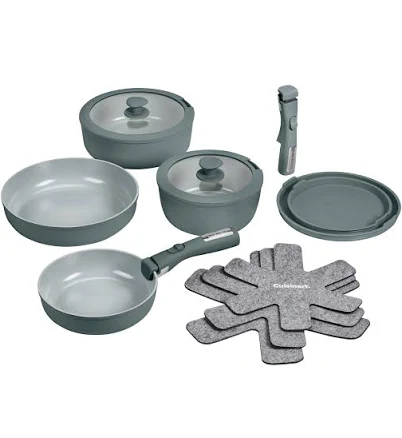
Cuisinart · Non-Stick Kitchen Gadgets
Cuisinart ClickSmart Nonstick Detachable Handle Cookware, Is It Non-Toxic?
Skip until coating type is disclosed, nonstick raises PFAS concern.
Cuisinart doesn't specify the nonstick coating type on this cookware. Standard nonstick coatings commonly contain PFAS, and the brand lacks disclosure.
The better-graded swap

Our Place
Our Place Utensil Essentials Set
90/100 safety
Same rubric that flunked this product. The swap earned Excellent.
Still want this one anyway? Check the price on Amazon. We’d swap it.
Material
Nonstick coating, type unspecified
Lab data
No public lab test
You may also be interested in
Top-graded picks in the categories readers replace first, every one scored on the same rubric.

- polypropylene filter housing, carbon/sediment cartridge
- We found no PFAS statement from the brand
- Bacterial growth in spent cartridges
3 hazards checked on this product, all on its full breakdown.

Aquasure
Premier Series 75 GPD Under Sink Reverse Osmosis Water Filtration System
- RO membrane, carbon filters, stainless steel housing
- We found no PFAS statement from the brand
- Bacterial and microbial growth in housing and filters
4 hazards checked on this product, all on its full breakdown.

Avocado
Vegan Mattress
- organic cotton, natural latex, coconut coir, recycled steel coils
- The brand calls it PFAS-free, which we have not verified
- Heavy metals
2 hazards checked on this product, all on its full breakdown.
Is Cuisinart ClickSmart Handle Cookware non-toxic? What it is made of
Cuisinart ClickSmart uses a nonstick coating of unspecified chemistry. The brand does not publicly disclose whether the coating is Teflon-type coating (Teflon-based), ceramic, or proprietary polymer. This opacity is the core safety issue, Teflon-type coating nonstick coatings can degrade and release fumes if overheated, while ceramic coatings present different durability trade-offs. Without material transparency, you cannot assess the specific thermal and wear risks.
What’s concerning
Category baseline
The starting point for this type of product, before anything specific to this product is counted.
No PFAS disclosure
No public statement from the brand about PFAS in this product.
Non-stick, chemistry undisclosed
Marketed as non-stick without stating the coating chemistry.
Teflon-type coating thermal degradation and fume release
If the coating is Teflon-type coating-based (unconfirmed), heating above 500 degrees F can release perfluorooctanoic acid and other volatile compounds. No recalls on this model, but risk depends on undisclosed composition.
Coating wear and metal leaching
Any nonstick coating degrades over time. Once compromised, aluminum or steel substrate may contact food. No aluminum leaching hazard has been reported for this line, but poor coating durability increases this pathway.
Bacterial growth in detachable handle mechanism
Removable handles create a joint where food particles, oils, and moisture can accumulate if not cleaned thoroughly. No design flaw has been reported, but the feature introduces a hygiene maintenance burden.
What’s reassuring
Lead
No recalls or warnings on record for this product. Cuisinart cookware handles and accents are typically metal or phenolic resin; ceramic or enamel trim is minimal. This is a low-probability hazard for this design.
Source, ATSDR ↗Brittleness or detachment of handle under thermal stress
The ClickSmart mechanism has not faced widespread reports of failure. However, repeated attachment and detachment, plus oven heat exposure, can stress polymeric or welded joints over time. No specific design recall exists.
How is this PFAS grade calculated?
The brand's record and disclosure
Cuisinart has no known public commitment to PFAS-free manufacturing or detailed nonstick-coating ingredient disclosure. The brand has not faced major safety recalls related to this cookware line, but the silent stance on coating chemistry is a red flag in an industry where competitors increasingly specify materials. Cuisinart's general reputation is solid, but transparency lags behind leaders in the category.
How it compares in its category
Most major cookware brands now disclose coating type (Teflon-type coating, ceramic, or proprietary PFOA-free formulations). Cuisinart's refusal to specify puts it in the middle-of-the-road tier. Ceramic nonstick cookware (e.g., GreenPan, Our Place) and Teflon-type coating brands with full PFAS documentation (e.g., T-fal) offer clearer safety profiles. Stainless steel or cast iron eliminate nonstick risk entirely but require different technique.
If you buy it
Never exceed 500 degrees Fahrenheit; Teflon-type coating degrades rapidly above that and can emit toxic fumes. Hand-wash only; dishwasher detergent and heat accelerate coating wear. Inspect the surface monthly for flaking, pitting, or discoloration; discontinue use if coating shows damage, as metal exposure becomes possible. Replace every 3-5 years depending on use frequency. Contact Cuisinart directly to request coating composition before purchase if nonstick fume risk is a concern.
What is not known about PFAS in this product?
- Basis
- Model estimate, 35% confidence, not a lab result
- Lab test
- None on record for this exact product
- Brand statement
- Cuisinart has made a specific claim
Formulations change between production runs, so check the current label. How we grade.
What are the PFAS-free alternatives to Cuisinart ClickSmart Nonstick Detachable Handle Cookware?

- Silicone utensils, no coating
- The brand calls it PFAS-free, which we have not verified
- Microplastic generation
2 hazards checked on this product, all on its full breakdown.

- Stainless steel utensils
- The brand calls it PFAS-free, which we have not verified
- Nickel leaching from stainless steel
2 hazards checked on this product, all on its full breakdown.
- Stainless steel utensils, material unclear
- The brand calls it PFAS-free, which we have not verified
- Handle material degradation (if present)
2 hazards checked on this product, all on its full breakdown.
More non-stick kitchen gadgets grades
How we score, every product runs through the same public 0-100 rubric based on materials, coatings, brand disclosure, lab findings, and recalls. See the full methodology → Spotted a mistake? Report an error.