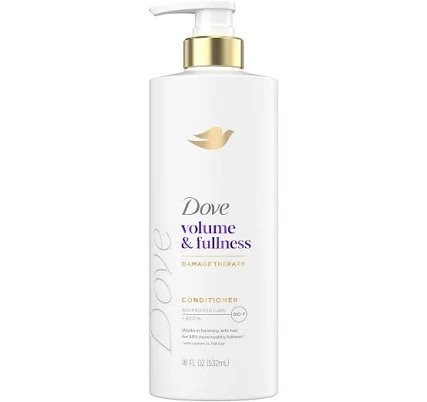
Dove Volume & Fullness Conditioner
Lower concern. Rinse-off formula with no obvious PFAS triggers, but brand makes no public commitment.
Water-based rinse-off product with no Teflon-family coating coatings, nonstick treatments, or waterproofing typical of PFAS use. Standard silicone-based conditioning agents aren't inherently PFAS-linked, though Dove hasn't publicly disclosed PFAS testing.
We flunk more products than we pass. This one earned its grade. How we grade
Material
aqueous conditioner with silicones, emulsifiers, surfactants
Lab data
No public lab test
You may also be interested in
Top-graded picks in the categories readers replace first, every one scored on the same rubric.

- polypropylene filter housing, carbon/sediment cartridge
- We found no PFAS statement from the brand
- Bacterial growth in spent cartridges
3 hazards checked on this product, all on its full breakdown.

Aquasure
Premier Series 75 GPD Under Sink Reverse Osmosis Water Filtration System
- RO membrane, carbon filters, stainless steel housing
- We found no PFAS statement from the brand
- Bacterial and microbial growth in housing and filters
4 hazards checked on this product, all on its full breakdown.

Avocado
Vegan Mattress
- organic cotton, natural latex, coconut coir, recycled steel coils
- The brand calls it PFAS-free, which we have not verified
- Heavy metals
2 hazards checked on this product, all on its full breakdown.
What Dove Volume & Fullness Conditioner is made of, ingredients and materials
Dove Volume & Fullness Conditioner is an aqueous rinse-off formula built on silicones (likely dimethicone or cyclomethicone), emulsifiers, and mild surfactants typical of mainstream conditioners. Silicones are not systemically absorbed through skin or scalp and wash out completely with water; they coat hair to reduce frizz and add shine. The formula contains no known harsh sulfates or heavy-metal pigments typical of colorants, and no heat-application step concentrates residues.
What’s concerning
Category baseline
The starting point for this type of product, before anything specific to this product is counted.
No PFAS disclosure
No public statement from the brand about PFAS in this product.
1,4-dioxane (TDMH impurity)
Conditioners using ethoxylated emulsifiers may contain trace 1,4-dioxane, a rinse-off product with minimal dermal absorption risk but listed as a probable carcinogen by IARC. Dove does not publish supplier testing data for this specific impurity; typical rinse-off exposure is considered low-priority by EPA and FDA.
Fragrance allergens (undisclosed components)
The product lists 'fragrance' as a catch-all ingredient under FDA rules; individual sensitizers (limonene, linalool, etc.) are not itemized on the label. Scalp dermatitis or contact reaction is rare but possible in fragrance-sensitive individuals; patch test on inner forearm first if history of cosmetic sensitivity.
Silicone buildup on hair and scalp
Heavy or frequent use of silicone conditioners can layer on hair shaft and scalp, leading to cosmetic dullness, weight, or perceived itching; this is cosmetic rather than toxic. Rotating with chelating or clarifying shampoos every 2-4 weeks mitigates this entirely.
What’s reassuring
Base material not linked to PFAS
The main material recorded for this product is not one associated with PFAS.
Formaldehyde / VOCs
No formaldehyde-releasing preservative systems (DMDM hydantoin, imidazolidinyl urea) are listed in publicly available Dove Volume conditioner ingredient databases. Standard modern Dove lines use preservatives like phenoxyethanol or methylisothiazolinone, which are not materials linked to PFAS.
Source, ATSDR ↗Heavy metals
Dove Volume conditioner contains no color agents, mica, iron oxides, or pigments; lead and cadmium risks are absent in this colorless formulation.
Source, FDA ↗How is this PFAS grade calculated?
The brand's record and disclosure
Dove (Unilever subsidiary) has a moderate disclosure posture, the brand publishes ingredient lists openly and participates in some chemical transparency initiatives, but makes no explicit public commitment to PFAS avoidance or third-party safety certification (e.g., EWG Verified, USDA Organic). No major recalls or regulatory warnings are on record for this specific product. The brand has faced historical scrutiny over microbeads (removed from formulas in 2015) but does not use microplastics in current conditioner lines.
How it compares in its category
This is a mass-market silicone conditioner, typical of drugstore offerings. It sits midway between ultra-minimal (water plus a few plant oils) and heavy-duty (extended silicone buildup products). Formulations like this are standard across Pantene, Garnier, and store brands; Dove's version is neither notably cleaner nor notably laden compared to peers. No botanical or protein claims differentiate the safety profile meaningfully from commodity alternatives.
If you buy it
Use as directed, apply to damp hair, leave for 1-2 minutes, rinse thoroughly with water to prevent silicone accumulation over weeks. If scalp irritation or itching develops, discontinue and switch; scalp sensitivity is individual and unrelated to product age. Store at room temperature; no heat exposure needed before use. Replace every 6-12 months (typical shelf life for aqueous cosmetics is 1-3 years); discard if separation, odor change, or mold appear.
What is not known about PFAS in this product?
- Basis
- Model estimate, 72% confidence, not a lab result
- Lab test
- None on record for this exact product
- Brand statement
- Dove has made a specific claim
Formulations change between production runs, so check the current label. How we grade.
What are the PFAS-free alternatives to Dove Volume & Fullness Conditioner?
- Water, conditioning agents, organic plant extracts
- We found no PFAS statement from the brand
- Heavy metals
3 hazards checked on this product, all on its full breakdown.
- water-based conditioner, typical surfactants and botanical extracts
- We found no PFAS statement from the brand
- Heavy metals
3 hazards checked on this product, all on its full breakdown.
More conditioner grades
How we score, every product runs through the same public 0-100 rubric based on materials, coatings, brand disclosure, lab findings, and recalls. See the full methodology → Spotted a mistake? Report an error.