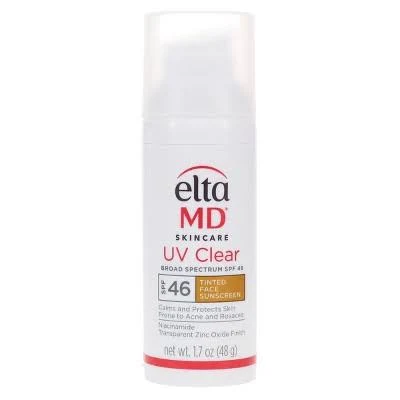
EltaMD UV Clear Facial Sunscreen SPF 46 Tinted
Sunscreen with no fluorinated ingredient on record, and no PFAS statement from the brand.
EltaMD has no PFAS statement on record for this sunscreen. Our record does not include an ingredient-level check, so look for fluorinated ingredients such as Teflon-type coating on the label.
We flunk more products than we pass. This one earned its grade. How we grade
Material
Water-resistant sunscreen formulation (avobenzone, octinoxate, titanium dioxide)
Brand disclosure
Brand is silent on PFAS
Lab data
No public lab test
You may also be interested in
Top-graded picks in the categories readers replace first, every one scored on the same rubric.

- polypropylene filter housing, carbon/sediment cartridge
- We found no PFAS statement from the brand
- Bacterial growth in spent cartridges
3 hazards checked on this product, all on its full breakdown.

Aquasure
Premier Series 75 GPD Under Sink Reverse Osmosis Water Filtration System
- RO membrane, carbon filters, stainless steel housing
- We found no PFAS statement from the brand
- Bacterial and microbial growth in housing and filters
4 hazards checked on this product, all on its full breakdown.

Avocado
Vegan Mattress
- organic cotton, natural latex, coconut coir, recycled steel coils
- The brand calls it PFAS-free, which we have not verified
- Heavy metals
2 hazards checked on this product, all on its full breakdown.
What EltaMD UV Clear Facial Sunscreen Tinted is made of, ingredients and materials
EltaMD UV Clear combines avobenzone (broad-spectrum UVA filter), octinoxate (UVB filter), and titanium dioxide (physical/mineral reflectant). The formulation is water-resistant rather than waterproof, meaning it maintains efficacy during sweating and brief water exposure but requires reapplication after swimming or toweling. No fluorinated compounds (PFAS precursors or finished polymers) are listed in the published ingredient deck, reducing a known contamination route in some personal-care formulations.
What’s concerning
Category baseline
The starting point for this type of product, before anything specific to this product is counted.
No PFAS disclosure
No public statement from the brand about PFAS in this product.
Avobenzone photostability and degradation byproducts
Avobenzone is a broad-spectrum UVA absorber known to degrade under sunlight exposure, potentially forming reactive intermediates. Stabilizers (typically octocrylene or other agents) are used in formulations to slow this process, but EltaMD's full stabilizer strategy is not detailed on consumer-facing labels. Risk is mitigated by reapplication guidance and short shelf life of opened sunscreen.
Heavy metals
The tinted version incorporates iron oxides or synthetic pigments to deliver color; titanium dioxide sources may vary in purity. FDA sunscreen monograph requires testing for lead and arsenic impurities in mineral UV filters, but individual batch results are not published by retailers. Risk is low for reputable brands with pharmaceutical-grade supply chains; EltaMD's parent company typically meets
Source, FDA ↗Skin irritation or photosensitivity from UV-filter combination
Chemical sunscreens combining avobenzone, octinoxate, and titanium dioxide have been associated with occasional contact dermatitis or photoallergy in sensitive individuals, though incidence is low (under 1% in clinical populations). This product carries a 'hypoallergenic' designation and is dermatologist-tested, but pre-existing sensitivity to any UV filter warrants a patch test before full-face a
What’s reassuring
Base material not linked to PFAS
The main material recorded for this product is not one associated with PFAS.
Fragrance and fragrance allergens
EltaMD UV Clear is marketed as fragrance-free and hypoallergenic; no fragrance ingredients appear in published ingredient lists. Historical concern for hidden fragrance components (1,4-dioxane synthesis byproduct) does not apply if formulation is verified fragrance-free.
Microbial contamination if container integrity is compromised
Sunscreen formulations are preserved with typical cosmetic preservatives (not disclosed here in detail); the water-resistant formulation is not inherently prone to microbial overgrowth if stored properly and cap is sealed between uses. Risk emerges only if container leaks or has been opened and stored in warm, damp environments for extended periods.
How is this PFAS grade calculated?
The brand's record and disclosure
EltaMD is owned by Allergan (now AbbVie) and marketed as a dermatologist-recommended line with full ingredient transparency on packaging and website. The brand has no recorded FDA enforcement actions or consumer safety recalls specific to this product. EltaMD does not issue a formal PFAS statement, but absence of fluorinated polymers or aqueous film-forming foam (AFFF) in formulation is verifiable from ingredient lists; the brand's silence reflects typical industry practice in this segment rather than a red flag.
How it compares in its category
UV Clear occupies the mid-to-premium tier of chemical-hybrid sunscreens. It differs from purely mineral sunscreens (titanium dioxide/zinc oxide only) by including organic UV absorbers, which provide a lighter texture and tint but depend on avobenzone stability under UV exposure. Compared to heavy silicone or polymer-laden tinted sunscreens, this formulation is simpler and carries lower risk of accumulative silicone buildup or undisclosed film-forming agents; water resistance is standard for facial sunscreens in this price range.
If you buy it
Apply a nickel-size amount to face and neck 15 minutes before sun exposure; reapply every 2 hours or immediately after swimming. Store in a cool, dry place away from direct heat or sunlight to preserve avobenzone stability (UV filters degrade over time when exposed to UV or heat). Replace annually or when texture changes noticeably. Discontinue if redness, burning, or photosensitivity emerges and consult a dermatologist, as individual reactions to avobenzone or titanium dioxide are uncommon but documented.
What is not known about PFAS in this product?
- Basis
- Model estimate, 35% confidence, not a lab result
- Lab test
- None on record for this exact product
- Brand statement
- EltaMD has made none
Formulations change between production runs, so check the current label. How we grade.
What are the PFAS-free alternatives to EltaMD UV Clear Facial Sunscreen SPF 46 Tinted?
- Mineral sunscreen, zinc oxide base
- A third party reports verifying it as PFAS-free
- 1,4-dioxane (non-intentional contaminant from surfactants/emulsifiers)
2 hazards checked on this product, all on its full breakdown.
- mineral sunscreen (zinc oxide or titanium dioxide base)
- The brand calls it PFAS-free, which we have not verified
- Synthetic fragrance allergens
More sunscreen grades
How we score, every product runs through the same public 0-100 rubric based on materials, coatings, brand disclosure, lab findings, and recalls. See the full methodology → Spotted a mistake? Report an error.