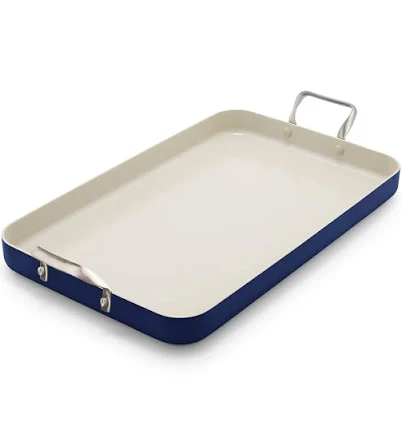
GreenPan Rio Double Griddle, Is It Non-Toxic?
A non-stick coating of unstated type, with a brand PFAS statement we have not verified.
GreenPan says its Thermolon coated food contact surface is free of PFAS, including Teflon-type coating and PFOA. We record that as an unverified brand claim. Its record describes a non-stick coating of unstated type, which is still counted.
Brand says: “GreenPan says its Thermolon coated food contact surface is free of PFAS, including PTFE and PFOA.”
The better-graded swap
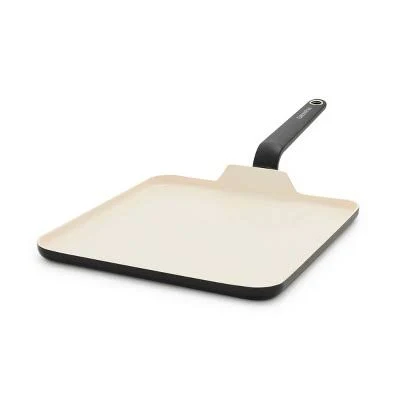
GreenPan
GreenPan Rio Advanced Ceramic Nonstick Griddle
70/100 safety
Same rubric that flunked this product. The swap earned Good.
Still want this one anyway? Check the price on Amazon. We’d swap it.
Material
Nonstick coating (composition not disclosed)
Brand disclosure
Brand claims PFAS-free
Lab data
No public lab test
You may also be interested in
Top-graded picks in the categories readers replace first, every one scored on the same rubric.

- polypropylene filter housing, carbon/sediment cartridge
- We found no PFAS statement from the brand
- Bacterial growth in spent cartridges
3 hazards checked on this product, all on its full breakdown.

Aquasure
Premier Series 75 GPD Under Sink Reverse Osmosis Water Filtration System
- RO membrane, carbon filters, stainless steel housing
- We found no PFAS statement from the brand
- Bacterial and microbial growth in housing and filters
4 hazards checked on this product, all on its full breakdown.

Avocado
Vegan Mattress
- organic cotton, natural latex, coconut coir, recycled steel coils
- The brand calls it PFAS-free, which we have not verified
- Heavy metals
2 hazards checked on this product, all on its full breakdown.
Is GreenPan Rio Double Griddle non-toxic? What it is made of
GreenPan Rio Double Griddle uses a nonstick coating of unspecified composition. The brand markets it as PFAS-free, but the exact polymer or replacement chemistry is not publicly disclosed. Without transparency on coating type (e.g., ceramic-reinforced, hydrocarbon-based, or silicone-derived), independent assessment of chemical stability and leaching risk is not possible. This opacity is the primary safety concern for a product designed for repeated food contact at elevated temperatures.
What’s concerning
Category baseline
The starting point for this type of product, before anything specific to this product is counted.
Disclosed non-fluorinated coating
Coating is named and the brand states it is made without PFAS.
Nonstick coating composition (unknown chemistry)
The undisclosed coating chemistry prevents assessment of thermal stability, leaching potential, or degradation byproducts. Unverified PFAS-free claims offer no independent confirmation. Risk depends entirely on actual formulation and manufacturing quality, both opaque to consumers.
Coating degradation and particle shedding
Nonstick cookware coatings, including those marketed as PFAS-free, can wear, flake, or shed particles with repeated use, particularly at high heat or with abrasive cleaning. Ingested coating particles are generally considered inert but their long-term effects are not established. No specific incidents are documented for GreenPan Rio, but coating wear is inherent to the product category.
Leaching from thermal stress (unknown risk level)
Heating an unknown polymer nonstick coating can cause migration of monomers or additives into food. Without disclosure of the coating's thermal stability window, maximum safe temperature, or chemical composition, leaching risk cannot be quantified. GreenPan has not published thermal stability data for this product.
Repeated heating cycle damage to coating seal
Thermal cycling (heating and cooling) stresses all nonstick coatings and can reduce adhesion and accelerate degradation. Unknown formulation compounds this risk. Regular inspection and low-to-medium heat use are the only practical mitigations with an undisclosed coating.
What’s reassuring
Brand-stated PFAS-free
The brand states this product is PFAS-free. We have not verified the claim.
Aluminum substrate corrosion (if aluminum body)
If the griddle body is aluminum, corrosion through coating damage or acidic food contact could cause aluminum leaching. GreenPan has not formally disclosed the substrate material, so this risk cannot be assessed. Typical griddle bodies are hard-anodized aluminum, which reduces but does not eliminate this pathway.
How is this PFAS grade calculated?
The brand's record and disclosure
GreenPan has made PFAS-free claims across its product line, but third-party verification of these claims is limited and not independently published. The brand has not disclosed the specific replacement chemistry for its nonstick coating. GreenPan has not reported major recalls related to coating degradation or leachate toxicity, but the lack of detailed material safety documentation limits accountability. Brand transparency on coating formulation and testing results remains below industry best practice for cookware marketed to health-conscious consumers.
How it compares in its category
GreenPan griddles occupy the mid-market nonstick segment, positioned as an alternative to conventional Teflon-type coating (Teflon) cookware with lower concern for certain PFAS risks. Competitors with greater disclosure include some cast iron and stainless steel griddles, which eliminate nonstick coating risk entirely but trade non-stick performance. Other nonstick brands (e.g., T-fal, Calphalon) have similar unverified PFAS-free claims; GreenPan does not stand out in disclosure. Ceramic-coated alternatives exist but perform differently and degrade faster with use.
If you buy it
Use on medium heat or lower; avoid preheating above 400°F to reduce coating stress and potential degradation. Hand-wash only and avoid metal utensils and abrasive scrubbing, which accelerate coating wear and particle shedding. Inspect the surface regularly for flaking, scratching, or discoloration; discontinue use if coating integrity is visibly compromised. Store separately from acidic foods and do not use for prolonged simmering of liquids, which can increase leaching risk from an unknown coating polymer.
What is not known about PFAS in this product?
- Basis
- Model estimate, 35% confidence, not a lab result
- Lab test
- None on record for this exact product
- Brand statement
- GreenPan has made a specific claim
Formulations change between production runs, so check the current label. How we grade.
More griddle pans grades
How we score, every product runs through the same public 0-100 rubric based on materials, coatings, brand disclosure, lab findings, and recalls. See the full methodology → Spotted a mistake? Report an error.