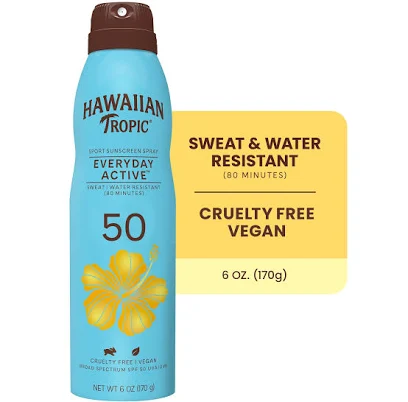
Hawaiian Tropic Island Sport SPF Sunscreen Spray
Sunscreen with no fluorinated ingredient on record, and no PFAS statement from the brand.
Hawaiian Tropic has no PFAS statement on record for this sunscreen. Our record does not include an ingredient-level check, so look for fluorinated ingredients such as Teflon-type coating on the label.
We flunk more products than we pass. This one earned its grade. How we grade
Material
spray emulsion with water-resistant coating
Brand disclosure
Brand is silent on PFAS
Lab data
No public lab test
You may also be interested in
Top-graded picks in the categories readers replace first, every one scored on the same rubric.

- polypropylene filter housing, carbon/sediment cartridge
- We found no PFAS statement from the brand
- Bacterial growth in spent cartridges
3 hazards checked on this product, all on its full breakdown.

Aquasure
Premier Series 75 GPD Under Sink Reverse Osmosis Water Filtration System
- RO membrane, carbon filters, stainless steel housing
- We found no PFAS statement from the brand
- Bacterial and microbial growth in housing and filters
4 hazards checked on this product, all on its full breakdown.

Avocado
Vegan Mattress
- organic cotton, natural latex, coconut coir, recycled steel coils
- The brand calls it PFAS-free, which we have not verified
- Heavy metals
2 hazards checked on this product, all on its full breakdown.
What Hawaiian Tropic Island Sunscreen Spray is made of, ingredients and materials
Hawaiian Tropic Island Sport is a spray-applied emulsion sunscreen, typically containing UV-blocking mineral or organic filters (avobenzone, octocrylene, oxybenzone, or titanium dioxide depending on formulation), along with water and alcohol as carriers. The 'water-resistant coating' refers to the emulsion's ability to form a continuous film on skin rather than a chemical barrier coating; the resistance comes from the formulation chemistry, not a Teflon-type coating or other synthetic coating. Spray delivery introduces inhalation risk if applied near the face, though the product is meant for body use. No PFAS-based water resistance agent appears on the ingredient list or in brand statements.
What’s concerning
Category baseline
The starting point for this type of product, before anything specific to this product is counted.
No PFAS disclosure
No public statement from the brand about PFAS in this product.
Inhalation risk from spray delivery
Aerosol application can deliver fine particles and volatile organic compounds (alcohol carrier) to the respiratory tract if sprayed near the face or in enclosed spaces. Risk is reduced by applying to hands first or spraying only on exposed limbs outdoors.
UV filter skin sensitization or photosensitivity
Oxybenzone and avobenzone, common in Hawaiian Tropic formulations, have been reported to trigger contact dermatitis or photoallergic reactions in sensitive individuals. Incidence is low but documented in dermatological literature.
Fragrance allergens
Hawaiian Tropic Island Sport contains fragrance compounds; 'Island Sport' scent is typically synthetic fragrance blends. No specific allergen list is disclosed; fragrance can trigger contact sensitization or respiratory irritation in perfume-sensitive users.
Volatile organic compounds (VOC) from alcohol carriers
Spray sunscreens rely on isopropyl alcohol or similar volatile carriers to deliver UV filters; these evaporate during and after application, contributing to indoor air VOC if used in enclosed spaces. Exposure is temporary and typically minimal outdoors but worth noting for indoor or poorly ventilated use.
What’s reassuring
Base material not linked to PFAS
The main material recorded for this product is not one associated with PFAS.
Heavy metals
If the product contains tinted or colored agents, these are typically cosmetic-grade iron oxides or mica. No recall or testing data on record indicates contamination with lead, cadmium, or arsenic in this product line.
Source, FDA ↗How is this PFAS grade calculated?
The brand's record and disclosure
Hawaiian Tropic is owned by Edgewell Personal Care (formerly Energizer Holdings). The brand has not issued a public PFAS policy or transparency statement, though the product itself contains no fluorinated ingredients on record. Hawaiian Tropic does not hold EWG Verified or similar third-party safety certification. There are no established major product safety recalls or lawsuits tied to this specific sunscreen formulation in public health databases.
How it compares in its category
Spray sunscreens as a category carry higher inhalation risk than lotions or creams; this product is no exception and is typical of mass-market UV protection sprays. It avoids PFAS-based water resistance (a concern in some competing brands), and uses conventional chemical UV filters rather than novel nanomaterials. Mineral sunscreen alternatives (zinc oxide, titanium dioxide) exist but are less common in spray format. The formulation is broadly aligned with FDA-approved active ingredients.
If you buy it
Apply by spraying onto exposed skin at least 15 minutes before sun exposure; avoid inhalation by not spraying directly toward the face and applying to hands first if needed. Reapply every two hours or after swimming or sweating. Store in a cool, dry place away from direct heat to prevent aerosol canister pressure buildup. Discontinue use if skin irritation or sensitization develops. Check expiration date; sunscreen efficacy degrades over time, typically within 3 years of manufacture.
What is not known about PFAS in this product?
- Basis
- Model estimate, 45% confidence, not a lab result
- Lab test
- None on record for this exact product
- Brand statement
- Hawaiian Tropic has made none
Formulations change between production runs, so check the current label. How we grade.
What are the PFAS-free alternatives to Hawaiian Tropic Island Sport SPF Sunscreen Spray?
- Mineral sunscreen, zinc oxide base
- A third party reports verifying it as PFAS-free
- 1,4-dioxane (non-intentional contaminant from surfactants/emulsifiers)
2 hazards checked on this product, all on its full breakdown.
- mineral sunscreen (zinc oxide or titanium dioxide base)
- The brand calls it PFAS-free, which we have not verified
- Synthetic fragrance allergens
More sunscreen grades
How we score, every product runs through the same public 0-100 rubric based on materials, coatings, brand disclosure, lab findings, and recalls. See the full methodology → Spotted a mistake? Report an error.