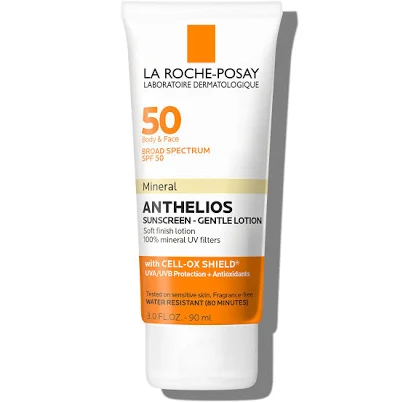
La Roche-Posay Anthelios Gentle Lotion Mineral Sunscreen
Lower concern. Mineral sunscreen lacks typical PFAS risk factors.
La Roche-Posay Anthelios Gentle uses mineral filters (zinc oxide, titanium dioxide) instead of synthetic coatings tied to PFAS. Mineral sunscreens typically avoid water-resistant treatments containing fluorochemicals.
We flunk more products than we pass. This one earned its grade. How we grade
Material
mineral sunscreen (zinc oxide, titanium dioxide)
Brand disclosure
Brand is silent on PFAS
Lab data
No public lab test
You may also be interested in
Top-graded picks in the categories readers replace first, every one scored on the same rubric.

- polypropylene filter housing, carbon/sediment cartridge
- We found no PFAS statement from the brand
- Bacterial growth in spent cartridges
3 hazards checked on this product, all on its full breakdown.

Aquasure
Premier Series 75 GPD Under Sink Reverse Osmosis Water Filtration System
- RO membrane, carbon filters, stainless steel housing
- We found no PFAS statement from the brand
- Bacterial and microbial growth in housing and filters
4 hazards checked on this product, all on its full breakdown.

Avocado
Vegan Mattress
- organic cotton, natural latex, coconut coir, recycled steel coils
- The brand calls it PFAS-free, which we have not verified
- Heavy metals
2 hazards checked on this product, all on its full breakdown.
What La Roche-Posay Anthelios Gentle Sunscreen is made of, ingredients and materials
This sunscreen uses zinc oxide and titanium dioxide as UV filters, which are physical blockers that sit on skin rather than being absorbed. These minerals are recognized by the FDA as approved active ingredients and do not metabolize in the body. The formulation is labeled 'gentle lotion,' indicating a hydrating base designed to minimize irritation, which is relevant for sensitive-skin applications where chemical sunscreens might trigger reactions.
What’s concerning
Category baseline
The starting point for this type of product, before anything specific to this product is counted.
No PFAS disclosure
No public statement from the brand about PFAS in this product.
Fragrance allergens or irritants
Product labeling does not indicate fragrance-free formulation. Some users with sensitive skin may react to fragrance components; patch-test recommended for atopic or reactive skin types.
Parabens
Lotion formulations require preservatives to prevent bacterial growth. Exact preservative system not detailed on standard labels; individuals with known sensitivities should verify full ingredient list on brand website or contact customer service.
Source, FDA ↗What’s reassuring
Base material not linked to PFAS
The main material recorded for this product is not one associated with PFAS.
Titanium dioxide inhalation (powder form)
This product is a lotion, not a powder or spray, so inhalation risk is not applicable. Concern is relevant only for powder or spray mineral sunscreens, not this formulation.
Heavy metals
Zinc oxide and titanium dioxide are well-regulated ingredients with no established cadmium, lead, or arsenic contamination issues at cosmetic concentrations. La Roche-Posay sources from established suppliers; no contamination incidents are on record.
Source, FDA ↗Photoinstability or degradation under UV/heat
Zinc oxide and titanium dioxide are photochemically stable and do not break down into harmful byproducts under sun exposure. Lotion base may separate if stored in extreme heat, but active ingredients remain stable.
How is this PFAS grade calculated?
The brand's record and disclosure
La Roche-Posay is owned by L'Oreal and has a history of transparent ingredient labeling and dermatology partnerships. The brand does not make explicit public commitments on PFAS avoidance, though the product itself shows no typical PFAS indicators. No major safety recalls or ingredient controversies are on record for this specific sunscreen product.
How it compares in its category
Mineral sunscreens like this one are considered lower-risk than chemical alternatives (avobenzone, oxybenzone) because they do not require skin absorption to work. This product is in the mainstream tier alongside brands like CeraVe and EltaMD mineral lines. The trade-off is slightly heavier texture and whiter cast compared to chemical sunscreens, which some users find less cosmetically elegant.
If you buy it
Apply generously (about one-quarter teaspoon per face) and reapply every two hours or after water exposure, as with all sunscreens. Store at room temperature away from direct heat to maintain lotion stability. Check the expiration date annually; mineral sunscreens do not typically degrade faster than chemical ones, but efficacy can decline over 2-3 years. If skin irritation develops, discontinue and patch-test on inner arm first.
What is not known about PFAS in this product?
- Basis
- Model estimate, 78% confidence, not a lab result
- Lab test
- None on record for this exact product
- Brand statement
- La Roche-Posay has made none
Formulations change between production runs, so check the current label. How we grade.
What are the PFAS-free alternatives to La Roche-Posay Anthelios Gentle Lotion Mineral Sunscreen?
- Mineral sunscreen, zinc oxide base
- A third party reports verifying it as PFAS-free
- 1,4-dioxane (non-intentional contaminant from surfactants/emulsifiers)
2 hazards checked on this product, all on its full breakdown.
- mineral sunscreen (zinc oxide or titanium dioxide base)
- The brand calls it PFAS-free, which we have not verified
- Synthetic fragrance allergens
More sunscreen grades
How we score, every product runs through the same public 0-100 rubric based on materials, coatings, brand disclosure, lab findings, and recalls. See the full methodology → Spotted a mistake? Report an error.