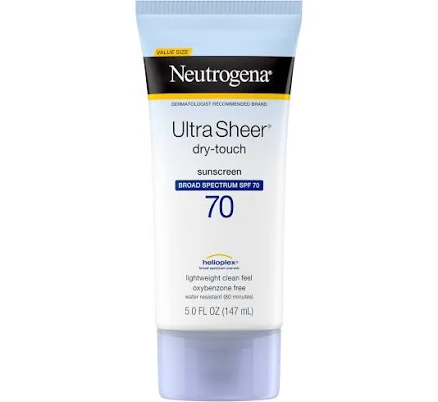
Neutrogena Ultra Sheer Dry Touch Spf Sunscreen
Sunscreen with no fluorinated ingredient on record, and no PFAS statement from the brand.
Neutrogena has no PFAS statement on record for this sunscreen. Our record does not include an ingredient-level check, so look for fluorinated ingredients such as Teflon-type coating on the label.
We flunk more products than we pass. This one earned its grade. How we grade
Material
water-resistant cosmetic emulsion, likely silicone or polymer-based
Lab data
No public lab test
You may also be interested in
Top-graded picks in the categories readers replace first, every one scored on the same rubric.

- polypropylene filter housing, carbon/sediment cartridge
- We found no PFAS statement from the brand
- Bacterial growth in spent cartridges
3 hazards checked on this product, all on its full breakdown.

Aquasure
Premier Series 75 GPD Under Sink Reverse Osmosis Water Filtration System
- RO membrane, carbon filters, stainless steel housing
- We found no PFAS statement from the brand
- Bacterial and microbial growth in housing and filters
4 hazards checked on this product, all on its full breakdown.

Avocado
Vegan Mattress
- organic cotton, natural latex, coconut coir, recycled steel coils
- The brand calls it PFAS-free, which we have not verified
- Heavy metals
2 hazards checked on this product, all on its full breakdown.
What Neutrogena Ultra Sheer Dry Spf Sunscreen is made of, ingredients and materials
Neutrogena Ultra Sheer Dry Touch is a water-resistant UV-blocking emulsion, likely built on silicone or acrylate polymer bases to achieve its non-greasy feel and rapid drying. The active sunscreen ingredients (typically avobenzone, octinoxate, or octocrylene in older formulations; reformulations may use newer UV filters) are dispersed in this polymer matrix to remain on skin during water exposure. The 'dry touch' texture indicates minimal oil and high silica or talc-alternative loading to absorb moisture; this formulation choice reduces greasy residue but requires verification that talc itself is not present in current batches.
What’s concerning
Category baseline
The starting point for this type of product, before anything specific to this product is counted.
No PFAS disclosure
No public statement from the brand about PFAS in this product.
Fragrance allergens and preservative sensitivizers
Neutrogena Ultra Sheer Dry Touch contains fragrance and preservatives (exact blend not always fully disclosed on label); these are common contact allergens in sunscreens and may trigger dermatitis in sensitive individuals. Incidence is not rare in cosmetic use but depends on individual skin reactivity.
Talc contamination risk
The 'dry touch' formulation likely uses silica, talc, or talc alternatives to absorb moisture; if talc is present (not always stated clearly), inhalation risk exists during application. Current product labeling does not consistently disclose talc versus silica substitutes, requiring direct brand inquiry for definitive status.
UV filter photostability and degradation
Chemical sunscreen actives like avobenzone and octinoxate degrade under UV and heat exposure; degraded products offer reduced protection but do not typically produce acute toxins. Efficacy decline, not hazard escalation, is the primary concern; reapplication mitigates this.
What’s reassuring
Base material not linked to PFAS
The main material recorded for this product is not one associated with PFAS.
1,4-dioxane as manufacturing contaminant
This product shows no reported 1,4-dioxane contamination on public records, and Neutrogena has not disclosed known levels in this sunscreen; however, cosmetic emulsifiers and surfactants can introduce trace 1,4-dioxane during synthesis, and independent testing is rare for mass-market sunscreens.
Heavy metals
Ultra Sheer Dry Touch does not list colorants or tinted agents on standard ingredient decks, reducing heavy metal pigment risk; if a tinted variant exists, iron oxide content would require verification for lead or cadmium impurities.
Source, FDA ↗How is this PFAS grade calculated?
The brand's record and disclosure
Neutrogena (owned by Johnson & Johnson) does not publish a dedicated PFAS transparency statement for sunscreens, though J&J has committed to phasing PFAS from certain product lines. The brand has a long history of FDA compliance for sunscreen actives and does not list fluorinated compounds on published ingredient decks for this product. No major recalls or formaldehyde-releaser controversies are on public record for this specific sunscreen line, though standard cosmetic allergen labeling (fragrance, preservatives) applies.
How it compares in its category
Ultra Sheer Dry Touch sits in the mass-market, non-mineral sunscreen segment; it competes with CeraVe, Coppertone, and store brands by prioritizing texture over active ingredient novelty. Polymer-based dry-touch formulas are standard in this price tier and do not carry documented hazards beyond those inherent to chemical UV filters and standard cosmetic allergens. Mineral alternatives (zinc oxide, titanium dioxide) are thicker; this product's advantage is cosmetic elegance, not a safety distinction.
If you buy it
Apply generously and reapply every two hours or after water exposure; the 'water resistant' claim (typically 80 minutes per FDA label) is not indefinite. Store below 30 degrees Celsius away from direct sun; degradation of UV actives can occur in heat, reducing efficacy rather than creating a new hazard. Discontinue use if rash, stinging, or persistent redness occurs; fragrance and preservatives are common irritants in sunscreens. Patch test if you have sensitive skin or known fragrance/preservative allergies before full-face application.
What is not known about PFAS in this product?
- Basis
- Model estimate, 45% confidence, not a lab result
- Lab test
- None on record for this exact product
- Brand statement
- Neutrogena has made a specific claim
Formulations change between production runs, so check the current label. How we grade.
What are the PFAS-free alternatives to Neutrogena Ultra Sheer Dry Touch Spf Sunscreen?
- Mineral sunscreen, zinc oxide base
- A third party reports verifying it as PFAS-free
- 1,4-dioxane (non-intentional contaminant from surfactants/emulsifiers)
2 hazards checked on this product, all on its full breakdown.
- mineral sunscreen (zinc oxide or titanium dioxide base)
- The brand calls it PFAS-free, which we have not verified
- Synthetic fragrance allergens
More sunscreen grades
How we score, every product runs through the same public 0-100 rubric based on materials, coatings, brand disclosure, lab findings, and recalls. See the full methodology → Spotted a mistake? Report an error.