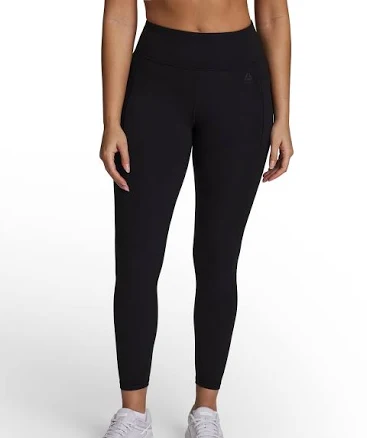
Reebok Women's Move High Rise Legging
Lower concern. No water-resistant coating disclosed.
Standard polyester/nylon legging with no water-repellent coating or stain treatment mentioned. Reebok provides no PFAS disclosure, but absence of water-resistant claims reduces typical risk.
Still want this one anyway? Check the price on Amazon. We’d swap it.
Material
polyester/nylon blend, no specified water-resistant treatment
Lab data
No public lab test
You may also be interested in
Top-graded picks in the categories readers replace first, every one scored on the same rubric.

- polypropylene filter housing, carbon/sediment cartridge
- We found no PFAS statement from the brand
- Bacterial growth in spent cartridges
3 hazards checked on this product, all on its full breakdown.

Aquasure
Premier Series 75 GPD Under Sink Reverse Osmosis Water Filtration System
- RO membrane, carbon filters, stainless steel housing
- We found no PFAS statement from the brand
- Bacterial and microbial growth in housing and filters
4 hazards checked on this product, all on its full breakdown.

Avocado
Vegan Mattress
- organic cotton, natural latex, coconut coir, recycled steel coils
- The brand calls it PFAS-free, which we have not verified
- Heavy metals
2 hazards checked on this product, all on its full breakdown.
What Reebok Women's Move High Rise Legging is made of, ingredients and materials
This legging is a polyester/nylon blend, a common base for athletic wear. Polyester itself is thermoplastic and chemically stable at normal wear temperatures, but the dyes and finishing agents applied during manufacturing are where chemical risks live. Nylon blends add durability and stretch but can hold onto synthetic dyes and processing chemicals. No water-resistant coating is claimed, which eliminates a major source of PFAS exposure in performance apparel.
What’s concerning
Category baseline
The starting point for this type of product, before anything specific to this product is counted.
No PFAS disclosure
No public statement from the brand about PFAS in this product.
Azo dyes and colorant residue
Polyester/nylon athletic wear is typically dyed with synthetic azo dyes. While manufacturers must exclude restricted azo dyes (those that release aromatic amines), residual dye and processing chemicals can remain in the fabric. Reebok has not disclosed independent dye testing for this product line.
Formaldehyde / VOCs
Polyester/nylon blends may undergo resin finishing for wrinkle resistance or shape retention. Reebok does not disclose finishing agent chemistry for this legging, so low-level formaldehyde exposure during manufacturing and early wear cannot be ruled out, though it is unlikely to exceed safety thresholds.
Source, ATSDR ↗Microplastics
Synthetic fiber leggings shed microplastic fibers with washing, contributing to aquatic pollution. This is an environmental rather than direct consumer health hazard, but users should be aware that laundering this product releases plastic particles into wastewater.
Source, EPA ↗What’s reassuring
Base material not linked to PFAS
The main material recorded for this product is not one associated with PFAS.
Heavy metals
No recalls or public testing have identified heavy metals (lead, cadmium, chromium) in Reebok athletic apparel. Industry regulations under REACH (EU) and state laws restrict these, but third-party certification would provide assurance absent here.
Source, FDA ↗Antimony in polyester
Antimony is a catalyst used in polyester production. Finished fabric typically contains negligible antimony, and no safety concerns are documented for wearing polyester garments. This is a theoretical chemical residue rather than an established product hazard.
How is this PFAS grade calculated?
The brand's record and disclosure
Reebok (owned by Authentic Brands Group as of 2022) has not published detailed chemical transparency reports or independent third-party certifications (like Oeko-Tex, GOTS, or BlueSign) for mainstream athletic lines. The brand's stance on PFAS and restricted substance lists is not widely publicized. No major recalls or safety violations specific to this product line are on record with the CPSC or consumer safety databases.
How it compares in its category
Most mid-market athletic leggings (Nike, Adidas, Lululemon, Athleta) use similar polyester/nylon bases. Reebok's lack of disclosed certifications puts it in a middle-ground position, lower concern than budget fast-fashion basics (which often lack dye testing), but less transparent than premium or certified-sustainable brands. No water-resistant treatment is actually an advantage here, as it sidesteps PFAS-heavy finishes common in higher-end performance gear.
If you buy it
Wash in cool water with like colors to minimize dye bleed, especially on first few wears. Avoid tumble drying at high heat, which can degrade the fibers and potentially release volatile compounds. Inspect the waistband and seams after 6-12 months of regular use for pilling or degradation; replace if elastic loses integrity or fabric shows significant wear. Standard laundry practices are sufficient; no special precautions needed.
What is not known about PFAS in this product?
- Basis
- Model estimate, 72% confidence, not a lab result
- Lab test
- None on record for this exact product
- Brand statement
- Reebok has made a specific claim
Formulations change between production runs, so check the current label. How we grade.
More activewear grades
How we score, every product runs through the same public 0-100 rubric based on materials, coatings, brand disclosure, lab findings, and recalls. See the full methodology → Spotted a mistake? Report an error.