Rug Doctor · Fabric Stain Guard Sprays
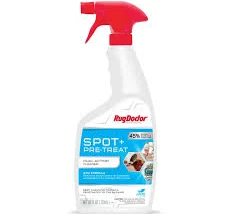
Rug Doctor Spot & Pre-Treat Dual Action Carpet Cleaner
Liquid cleaner with no known PFAS risk, no public disclosure either way.
Rug Doctor's spot cleaner is a water-based liquid product unlikely to contain PFAS, as fabric cleaners typically do not require fluorinated coatings. No brand PFAS statement appears.
We flunk more products than we pass. This one earned its grade. How we grade
Material
aqueous cleaning solution, surfactants
Brand disclosure
Brand is silent on PFAS
Lab data
No public lab test
You may also be interested in
Top-graded picks in the categories readers replace first, every one scored on the same rubric.

- polypropylene filter housing, carbon/sediment cartridge
- We found no PFAS statement from the brand
- Bacterial growth in spent cartridges
3 hazards checked on this product, all on its full breakdown.

Aquasure
Premier Series 75 GPD Under Sink Reverse Osmosis Water Filtration System
- RO membrane, carbon filters, stainless steel housing
- We found no PFAS statement from the brand
- Bacterial and microbial growth in housing and filters
4 hazards checked on this product, all on its full breakdown.

Avocado
Vegan Mattress
- organic cotton, natural latex, coconut coir, recycled steel coils
- The brand calls it PFAS-free, which we have not verified
- Heavy metals
2 hazards checked on this product, all on its full breakdown.
What Rug Doctor Spot & Pre-Treat Carpet Cleaner is made of, ingredients and materials
Rug Doctor Spot & Pre-Treat is an aqueous solution built primarily on surfactants, water, and likely optical brighteners or enzymes for stain lifting. Aqueous cleaners carry lower volatile off-gassing risk than solvent-based alternatives because they lack organic solvents; the concern shifts instead to residue left on carpet fibers after application and potential skin or respiratory irritation from surfactant aerosol if sprayed directly near face or inhaled. No formaldehyde releasers or intentional antimicrobial additives have been disclosed for this product line.
What’s concerning
Category baseline
The starting point for this type of product, before anything specific to this product is counted.
No PFAS disclosure
No public statement from the brand about PFAS in this product.
Surfactant residue and skin/respiratory irritation
Aqueous surfactant cleaners can leave residue on carpet fibers that may contact skin (particularly for infants, pets, or those with sensitive skin) during or after drying. Inhalation of surfactant aerosol during spray application is a minor risk if applied in enclosed spaces without ventilation.
Volatile organic compound (VOC) off-gassing
While described as aqueous, this product may contain minor volatile components (e.g., isopropanol or fragrance carriers) not disclosed on the label. Off-gassing from carpet treated with this product is expected to be minimal compared to solvent-based alternatives, but full VOC content is not published.
Carpet fiber degradation if applied repeatedly or excessively
Repeated or excessive application of any aqueous surfactant solution can over-saturate carpet, delay drying, and weaken fiber structure or backing glue over time. Rug Doctor does not specify maximum application frequency, so user error is a primary risk vector.
What’s reassuring
Base material not linked to PFAS
The main material recorded for this product is not one associated with PFAS.
Heavy metals
No public record of lead, cadmium, or other heavy metals in Rug Doctor pre-treat formulations. Aqueous cleaners do not typically require metal-based pigments or stabilizers, but Rug Doctor does not disclose full additive lists.
Source, FDA ↗Formaldehyde / VOCs
No evidence of intentional formaldehyde releasers or preservatives that generate formaldehyde in this product line. Aqueous formulas may use weak preservatives, but none on public record for this brand.
Source, ATSDR ↗How is this PFAS grade calculated?
The brand's record and disclosure
Rug Doctor does not publicly disclose full ingredient lists or third-party certifications (e.g., EPA Safer Choice, Green Seal) for this product, which is typical for consumer carpet cleaners but limits transparency. The brand has no established public safety recalls or regulatory actions tied to this specific product. Rug Doctor's parent company and manufacturing practices are not prominently documented in independent safety databases, meaning long-term safety data relies on lack of reported harm rather than proactive certification.
How it compares in its category
Spray-on carpet pre-treatments typically fall into two types, aqueous surfactant blends (lower VOC, this product) and solvent-based or silicone-enhanced formulas (higher off-gas risk, stronger stain barrier). This product's aqueous formula places it at the lower end of inhalation and residual chemical concern within the category. Many competitors do not disclose PFAS status either, making Rug Doctor's absence of known PFAS risk roughly equivalent to peers, though third-party certified alternatives (e.g., plant-based or EPA Safer Choice products) offer more transparency if that is a priority.
If you buy it
Apply in a well-ventilated space and avoid spraying directly into the face or near children and pets during application; surfactant aerosol can irritate airways if concentrated. Allow treated carpet to dry fully (typically 24 hours) before foot traffic to minimize residue transfer and skin contact. Do not heat the treated carpet (e.g., with steam or hot water cleaning immediately after) until dry, as this can degrade fibers and potentially release surfactant vapors. Store in a cool, dry place away from direct sunlight and ensure the spray nozzle does not leak; if nozzle or seal fails, replace the bottle to prevent surfactant residue buildup on storage surfaces.
What is not known about PFAS in this product?
- Basis
- Model estimate, 62% confidence, not a lab result
- Lab test
- None on record for this exact product
- Brand statement
- Rug Doctor has made none
Formulations change between production runs, so check the current label. How we grade.
More fabric stain guard sprays grades
How we score, every product runs through the same public 0-100 rubric based on materials, coatings, brand disclosure, lab findings, and recalls. See the full methodology → Spotted a mistake? Report an error.