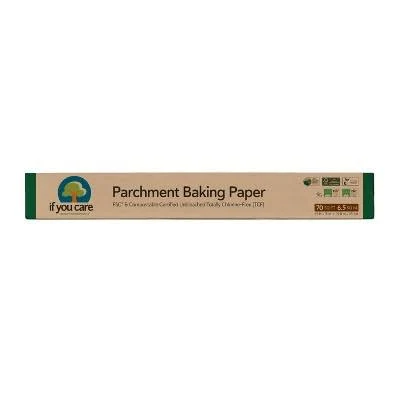
If You Care · Parchment Paper & Baking Liners
If You Care Parchment Baking Paper
Brand no-added-PFAS claim and a 2021 lab result with no fluorine detected.
If You Care describes its baking tools as unbleached, non-toxic and with no added PFAS. We record that as an unverified brand claim. Mamavation reported in April 2021 that an EPA-certified lab found no total fluorine at or above 10 ppm in If You Care Parchment Baking Paper.
Brand says: “If You Care describes its baking tools as unbleached, non-toxic and with no added PFAS.”
We flunk more products than we pass. This one earned its grade. How we grade
Material
bleached paper with undisclosed grease-resistant coating
Brand disclosure
Brand claims PFAS-free
Lab data
No PFAS found in testing
You may also be interested in
Top-graded picks in the categories readers replace first, every one scored on the same rubric.

- polypropylene filter housing, carbon/sediment cartridge
- We found no PFAS statement from the brand
- Bacterial growth in spent cartridges
3 hazards checked on this product, all on its full breakdown.

Aquasure
Premier Series 75 GPD Under Sink Reverse Osmosis Water Filtration System
- RO membrane, carbon filters, stainless steel housing
- We found no PFAS statement from the brand
- Bacterial and microbial growth in housing and filters
4 hazards checked on this product, all on its full breakdown.

Avocado
Vegan Mattress
- organic cotton, natural latex, coconut coir, recycled steel coils
- The brand calls it PFAS-free, which we have not verified
- Heavy metals
2 hazards checked on this product, all on its full breakdown.
What If You Care Parchment Baking Paper is made of, ingredients and materials
If You Care parchment is bleached paper with a grease-resistant coating whose exact composition the brand does not disclose publicly. The bleaching process itself (typically chlorine-based) is standard in the industry and does not introduce heavy metals or persistent hazards into the finished sheet. The non-PFAS grease resistance is the key safety claim here, since traditional parchment coatings historically relied on fluorinated compounds; the 2021 lab result showing no fluorine suggests the coating is likely silicone or wax-based, though confirmation is not available.
What’s concerning
Waterproof / stain-resistant treatment
Water-repellent coating treatments have historically used PFAS.
Category baseline
The starting point for this type of product, before anything specific to this product is counted.
Coating degradation and leaching
The undisclosed grease-resistant coating's heat stability and potential leaching behavior at high temperatures or prolonged storage are not documented. Bleached paper with an unknown resin binder could theoretically release trace compounds under stress, but no reported incidents exist for this product.
What’s reassuring
Brand-stated PFAS-free
The brand states this product is PFAS-free. We have not verified the claim.
No PFAS found in lab test
No PFAS detected in independent testing.
Bleach residue and chlorine byproducts
Standard chlorine bleaching of paper leaves negligible residue in the finished product and is not a documented hazard in baking applications. FDA-cleared food-contact papers show lower concern in this regard, and If You Care has not been flagged for bleach-related issues.
Formaldehyde / VOCs
Parchment coatings do not typically use formaldehyde-based resins (those are common in textiles and some plastics). No public record or complaint suggests formaldehyde presence in If You Care parchment.
Source, ATSDR ↗Heavy metals
Parchment paper is not a known vector for lead, cadmium, or other heavy metals in normal manufacturing. If You Care has not been cited for metal contamination.
Source, FDA ↗PFAS
The 2021 lab test explicitly confirmed no fluorine, ruling out hidden fluorocarbon coatings. The brand's PFAS-free claim is the strongest documented safety feature of this product.
Source, ATSDR ↗How is this PFAS grade calculated?
The brand's record and disclosure
If You Care explicitly markets this product as PFAS-free and backs the claim with a 2021 third-party lab test detecting no fluorine. The brand has not published full ingredient disclosure for the coating itself, which is a transparency gap but typical for parchment manufacturers. No recalls, safety violations, or substantiated complaints specific to this product are on record. The brand positions itself as environmentally and health-conscious, though independent certification (e.g., FDA formal approval of coating safety) is not publicly documented.
How it compares in its category
Most conventional parchment papers use fluorocarbon coatings (Teflon-type coating or similar) to achieve grease resistance, making them a PFAS source. Silicone-coated and wax-coated alternatives exist but are less common and often more expensive. If You Care states it uses a PFAS-free approach, though the lack of disclosed coating details leaves it with lower concern than brands that fully specify their chemistry. Unbleached parchment is available as a more minimal option but offers no meaningful safety advantage for typical home baking.
If you buy it
Use this product at standard baking temperatures (up to 420°F / 215°C); do not expose to direct flame or use for broiling, as the coating integrity is unknown at extreme temperatures. Replace sheets if they show browning, cracking, or peeling, which signals coating degradation. Store in a cool, dry place away from direct sunlight to prevent adhesive or coating breakdown over time. Parchment shows lower concern for oven use but higher concern for stovetop cooking or prolonged contact with very acidic or oily foods; wash hands after handling to avoid residue transfer.
What is not known about PFAS in this product?
- Basis
- Model estimate, 45% confidence, not a lab result
- Lab test
- Independent test found none
- Brand statement
- If You Care has made a specific claim
Formulations change between production runs, so check the current label. How we grade.
More parchment paper & baking liners grades
How we score, every product runs through the same public 0-100 rubric based on materials, coatings, brand disclosure, lab findings, and recalls. See the full methodology → Spotted a mistake? Report an error.