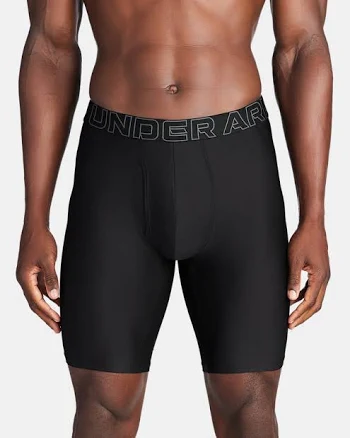
Under Armour · Sports Performance Undergarments
Under Armour Men's Performance Tech Mesh Boxer Briefs
Lower concern; no water-repellent coating treatment typical for mesh briefs.
These polyester-nylon mesh boxer briefs typically use untreated fabric. Under Armour discloses no PFAS-related treatments, and standard athletic mesh poses minimal PFAS risk.
Still want this one anyway? Check the price on Amazon. We’d swap it.
Material
polyester/nylon mesh blend, no water-resistant treatment disclosed
Brand disclosure
Brand is silent on PFAS
Lab data
No public lab test
What Under Armour Men's Performance Tech Mesh is made of, ingredients and materials
Performance Tech Mesh Boxer Briefs are a polyester and nylon blend engineered for moisture-wicking and stretch. Polyester is a synthetic polymer that does not leach monomers or plasticizers into skin under normal wear conditions, and nylon similarly has a stable structure at body temperature. The mesh construction means minimal dye load and no water-repellent coatings that would introduce additional chemical treatments. This material class is among the lowest-risk synthetic fibers for direct skin contact.
What’s concerning
Category baseline
The starting point for this type of product, before anything specific to this product is counted.
No PFAS disclosure
No public statement from the brand about PFAS in this product.
Formaldehyde / VOCs
Not disclosed by Under Armour. Mesh briefs typically receive minimal finish (mostly elastic and flatlock stitching treatments rather than whole-garment formaldehyde resin). If present, levels are expected to be low; pre-wash eliminates most residual formaldehyde before skin contact.
Source, ATSDR ↗Microplastics
Polyester mesh sheds fine fibers in washing; volume increases with age and abrasion. This is not a hazard to the wearer but contributes to environmental microplastics. Replacement after 1-2 years of regular use reduces this impact.
Source, EPA ↗What’s reassuring
Base material not linked to PFAS
The main material recorded for this product is not one associated with PFAS.
Azo dyes (synthetic dyes, colorfast rating)
No recalls or complaints on record for Under Armour mesh briefs. Polyester and nylon accept azo dyes with lower concern when properly fixed; loose dyes rinse out in first wash and do not migrate to skin during wear.
Antimony (polyester catalyst residue)
Antimony is used as a catalyst in polyester synthesis and can remain as trace residue. No health concern at wear level in finished garments; no reported cases linked to briefs or base-layer apparel.
Flame retardants
Men's underwear is exempt from CPSC flammability standards and does not require added flame retardants. No flame retardant treatment is expected in this product.
Source, EPA ↗The full breakdown
The brand's record and disclosure
Under Armour does not publicly disclose detailed chemical composition, restricted substance lists, or third-party textile certifications (such as Bluesign, OEKO-TEX, or GOTS) for this product line. The brand has no documented recalls or legal settlements related to formaldehyde, azo dyes, or heavy metal contamination in their men's basics. Under Armour maintains compliance with US Consumer Product Safety Commission standards but does not voluntarily exceed them in communications.
How it compares in its category
Performance mesh briefs across brands (Nike, Adidas, Tommy John) share similar polyester/nylon blends and carry equivalent chemical profiles. Unlike cotton basics, synthetic athletic wear eliminates mold and mildew risk and requires less chemical finishing. Under Armour's positioning as a performance brand means dye and finish stability is prioritized, though this is industry-standard rather than a premium differentiator. No major competitor in this segment achieves certifications that would meaningfully reduce already-low risk.
If you buy it
Wash in cool to warm water before first wear to remove loose dye and residual processing agents. Line-dry or use low heat; high-temperature dryers can degrade elastic without creating chemical hazards. Replace when elastic loses recovery or mesh develops pilling, which signals fiber breakdown rather than chemical degradation. No special care is needed beyond standard laundry; these are designed for frequent washing and do not accumulate chemical burden over time.
What we don’t know
- Basis
- Model estimate, 72% confidence, not a lab result
- Lab test
- None on record for this exact product
- Brand statement
- Under Armour has made none
Formulations change between production runs, so check the current label. How we grade.
More sports performance undergarments grades
How we score, every product runs through the same public 0-100 rubric based on materials, coatings, brand disclosure, lab findings, and recalls. See the full methodology → Spotted a mistake? Report an error.