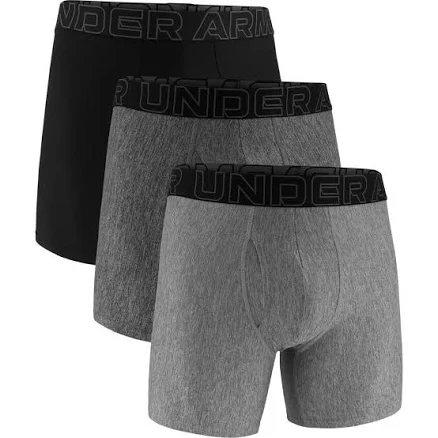
Under Armour · Sports Performance Undergarments
Under Armour Men's Underwear & Socks Under Armour 3 6" Performance Boxerjock Boxer Briefs
Lower concern. No waterproof or stain treatment typical for boxers.
These polyester-spandex boxer briefs lack typical water-repellent coating coatings. Under Armour makes no PFAS disclosures, and basic athletic underwear poses lower PFAS risk than treated outerwear.
Still want this one anyway? Check the price on Amazon. We’d swap it.
Material
polyester, spandex blend, no reported treatment
Brand disclosure
Brand is silent on PFAS
Lab data
No public lab test
What Under Armour Men's Underwear & Socks is made of, ingredients and materials
These boxers are a polyester-spandex (elastane) blend, a common performance fabric choice that prioritizes stretch and moisture-wicking over durability or chemical treatment. Polyester itself is a stable synthetic polymer with low inherent toxicity, but the spandex component can shed microfibers during wash and wear. Unlike treated performance outerwear, underwear typically receives no water-repellent, flame-retardant, or antimicrobial coatings, which substantially reduces chemical exposure risk in this application.
What’s concerning
Category baseline
The starting point for this type of product, before anything specific to this product is counted.
No PFAS disclosure
No public statement from the brand about PFAS in this product.
Antimony in polyester
Antimony trioxide is a common polyester catalyst; trace residues may remain in finished fabric. Skin contact with underwear poses negligible exposure risk, but not quantified in public literature for this brand.
Azo dyes and color fastness
Dark polyester boxers may use azo dyes, which can release aromatic amines under prolonged sweat or UV exposure. Risk is low in underwear (minimal sun exposure, brief wear cycles) but not eliminated; color bleeding in first wash suggests poor dye fixation and potential leaching.
Microplastic shedding
Polyester-spandex blends shed microfibers during washing and normal wear. Quantity per garment is not disclosed by Under Armour; studies estimate 100-10,000 fibers per wash cycle depending on fabric age and abrasion. Environmental concern outweighs direct health risk to wearer.
Spandex degradation and sweat interaction
Elastic degrades with heat, sweat acidity, and chlorine; degraded spandex may release oligomers or uncrosslinked polymers. No known toxicological threshold in skin contact, but prolonged wear of worn-out elastic is not recommended.
What’s reassuring
Base material not linked to PFAS
The main material recorded for this product is not one associated with PFAS.
Formaldehyde / VOCs
No waterproof, wrinkle-resistant, or antimicrobial treatment typical for this product category; dyes themselves are not inherently formaldehyde releasers in standard polyester apparel, and no recalls or disclosures flag this for Under Armour boxers.
Source, ATSDR ↗The full breakdown
The brand's record and disclosure
Under Armour does not publicly disclose detailed chemical or PFAS policies for basic apparel lines like this boxer brief. The company has faced no major recalls or safety scandals specific to underwear products. Their silence on treatment chemicals is typical for mainstream athletic brands selling commodity items; absence of claims (waterproof, stain-resist, odor-control) suggests minimal proprietary finishing.
How it compares in its category
Performance boxers in this price and brand tier are indistinguishable in material composition from competitors (Nike, Adidas, department-store brands). The polyester-spandex blend is the industry standard for moisture management. Risk differentiation emerges only in specialty subcategories, antimicrobial-treated boxers (copper/silver compounds), flame-retardant versions (rare in underwear), or organic cotton alternatives (higher cost, lower performance).
If you buy it
Wash in cool to warm water (not hot, which accelerates spandex degradation) and air-dry to preserve elasticity; tumble drying shortens lifespan to 12-18 months. Do not bleach or use fabric softener, which can damage moisture-wicking coatings if present. Replace when elastic loses snap or seams fray. Microfiber shedding is unavoidable but minimal in quantity; standard laundry does not concentrate risk.
What we don’t know
- Basis
- Model estimate, 72% confidence, not a lab result
- Lab test
- None on record for this exact product
- Brand statement
- Under Armour has made none
Formulations change between production runs, so check the current label. How we grade.
More sports performance undergarments grades
How we score, every product runs through the same public 0-100 rubric based on materials, coatings, brand disclosure, lab findings, and recalls. See the full methodology → Spotted a mistake? Report an error.