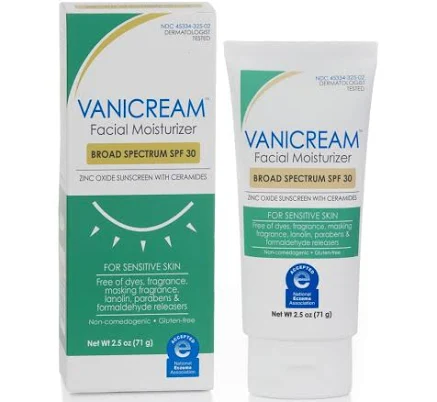
Vanicream Facial Moisturizer SPF 30
Low concern; sunscreen moisturizers rarely need PFAS water-repellent coatings.
This water-based moisturizer with mineral UV filters shows no evidence of Teflon-family coating or water-resistant coatings. Vanicream avoids complex formulas, though no lab testing exists.
We flunk more products than we pass. This one earned its grade. How we grade
Material
water-based emulsion with mineral UV filters (titanium dioxide/zinc oxide typical for SPF 30)
Lab data
No public lab test
You may also be interested in
Top-graded picks in the categories readers replace first, every one scored on the same rubric.

- polypropylene filter housing, carbon/sediment cartridge
- We found no PFAS statement from the brand
- Bacterial growth in spent cartridges
3 hazards checked on this product, all on its full breakdown.

Aquasure
Premier Series 75 GPD Under Sink Reverse Osmosis Water Filtration System
- RO membrane, carbon filters, stainless steel housing
- We found no PFAS statement from the brand
- Bacterial and microbial growth in housing and filters
4 hazards checked on this product, all on its full breakdown.

Avocado
Vegan Mattress
- organic cotton, natural latex, coconut coir, recycled steel coils
- The brand calls it PFAS-free, which we have not verified
- Heavy metals
2 hazards checked on this product, all on its full breakdown.
What Vanicream Facial Moisturizer SPF 30 is made of, ingredients and materials
Vanicream Facial Moisturizer SPF 30 uses titanium dioxide and/or zinc oxide as physical UV blockers, which sit on skin surface rather than absorb into it. The water-based emulsion vehicle minimizes penetration of other ingredients and avoids the chemical sunscreen actives (avobenzone, oxybenzone) that some dermatologists flag for potential hormone-like activity. Mineral filters are associated with lower concern for sensitive skin and have decades of use history.
What’s concerning
Category baseline
The starting point for this type of product, before anything specific to this product is counted.
No PFAS disclosure
No public statement from the brand about PFAS in this product.
Titanium dioxide or zinc oxide nanoparticle concerns
Modern mineral sunscreens often use micronized (not nano-scale) titanium dioxide and zinc oxide. While non-nano forms are generally recognized as safe by FDA, particle size specifications are not always disclosed on consumer labels; contact manufacturer if nanoparticle status is a concern for you.
What’s reassuring
Base material not linked to PFAS
The main material recorded for this product is not one associated with PFAS.
Fragrance allergens
Vanicream explicitly formulates fragrance-free products across its line. No fragrance allergens are known to be present in this moisturizer.
Lead
Titanium dioxide and zinc oxide are regulated mineral pigments with long safety histories; no heavy metal contamination has been reported in Vanicream formulations or this product specifically.
Source, ATSDR ↗Parabens
Vanicream is marketed as paraben-free and avoids common formaldehyde-releasing preservatives. Specific preservative systems used (if any) are not routinely flagged in dermatological literature.
Source, FDA ↗Emulsion stability and ingredient separation over time
Water-based mineral sunscreen emulsions can separate or thicken with age. No specific stability complaints are on record for this product, but inspect for visible separation or hard consistency before use.
How is this PFAS grade calculated?
The brand's record and disclosure
Vanicream is owned by Colgate-Palmolive and positions itself explicitly as a hypoallergenic, dermatologist-recommended line free from common irritants (dyes, fragrance, parabens, sulfates). The brand does not actively market PFAS-free status, but ingredient lists are readily available online and show no aqueous film-forming Teflon-family coating. No recalls or safety controversies are on record for this product line.
How it compares in its category
Mineral sunscreens like this are considered lower-risk than chemical sunscreen alternatives (oxybenzone, octinoxate) in terms of systemic absorption and bioaccumulation concerns. Vanicream's formulation is typical of the hypoallergenic sunscreen segment and carries fewer red flags than budget or heavily fragranced competitors. Water-based moisturizer-sunscreen hybrids avoid the occlusive wax or silicone bases that can trigger issues in acne-prone or sensitive skin.
If you buy it
Apply generously (about 1/4 teaspoon for face) and reapply every two hours or after water contact; mineral filters do not degrade in sunlight the way chemical ones do. Store in a cool, dry place away from direct heat to preserve emulsion stability, though water-based formulas are more stable than oil-based alternatives. Discontinue if redness, stinging, or unusual reactions emerge; patch-test on inner arm first if you have reactive skin.
What is not known about PFAS in this product?
- Basis
- Model estimate, 78% confidence, not a lab result
- Lab test
- None on record for this exact product
- Brand statement
- Vanicream has made a specific claim
Formulations change between production runs, so check the current label. How we grade.
What are the PFAS-free alternatives to Vanicream Facial Moisturizer SPF 30?
- Mineral sunscreen, zinc oxide base
- A third party reports verifying it as PFAS-free
- 1,4-dioxane (non-intentional contaminant from surfactants/emulsifiers)
2 hazards checked on this product, all on its full breakdown.
- mineral sunscreen (zinc oxide or titanium dioxide base)
- The brand calls it PFAS-free, which we have not verified
- Synthetic fragrance allergens
More sunscreen grades
How we score, every product runs through the same public 0-100 rubric based on materials, coatings, brand disclosure, lab findings, and recalls. See the full methodology → Spotted a mistake? Report an error.