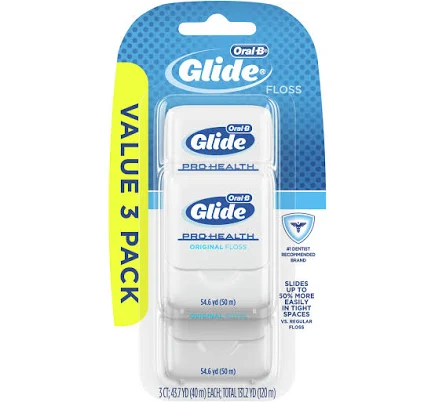
ORAL B Glide Pro-Health Floss
Oral-B says its floss is now made without Teflon-type coating or PFAS, a claim we have not verified.
Oral-B says its Glide floss is no longer formulated with Teflon-type coating and that none of its floss products are formulated with Teflon-type coating or any type of PFAS. We record that as an unverified brand claim. Glide was made with Teflon-type coating for decades, so older packs still on some shelves may predate the change.
Brand says: “Oral-B says its Glide floss is no longer formulated with PTFE and that none of its floss products are formulated with PTFE or any type of PFAS.”
We flunk more products than we pass. This one earned its grade. How we grade
Material
nylon monofilament
Brand disclosure
Brand claims PFAS-free
Lab data
No public lab test
You may also be interested in
Top-graded picks in the categories readers replace first, every one scored on the same rubric.

- polypropylene filter housing, carbon/sediment cartridge
- We found no PFAS statement from the brand
- Bacterial growth in spent cartridges
3 hazards checked on this product, all on its full breakdown.

Aquasure
Premier Series 75 GPD Under Sink Reverse Osmosis Water Filtration System
- RO membrane, carbon filters, stainless steel housing
- We found no PFAS statement from the brand
- Bacterial and microbial growth in housing and filters
4 hazards checked on this product, all on its full breakdown.

Avocado
Vegan Mattress
- organic cotton, natural latex, coconut coir, recycled steel coils
- The brand calls it PFAS-free, which we have not verified
- Heavy metals
2 hazards checked on this product, all on its full breakdown.
What ORAL B Glide Pro-Health Floss is made of, ingredients and materials
Oral-B Glide Pro-Health is a nylon monofilament floss, meaning it is a single continuous strand of synthetic polymer. Nylon itself is a stable, inert plastic that does not leach chemicals under normal oral use, and monofilament construction avoids the shredding risk of multi-strand flosses. The brand states this product is now PFAS-free, having removed Teflon-type coating (polytetrafluoroethylene, a Teflon-family coating often used to make floss slippery), though independent laboratory confirmation of this claim is not yet publicly available.
What’s concerning
Category baseline
The starting point for this type of product, before anything specific to this product is counted.
Microplastics
Vigorous flossing or exposure to heat can cause nylon monofilament to shed tiny fragments. The quantity released during typical daily flossing is not quantified, and intestinal or systemic uptake risk is unknown; this is a general concern for all plastic floss products, not unique to Oral-B.
Source, EPA ↗Gum trauma from improper use
This is a user-behavior hazard, not a material hazard. Monofilament nylon has higher tensile strength than some alternatives, raising the risk of gum cuts if forced between teeth or applied with excessive pressure.
What’s reassuring
Brand-stated PFAS-free
The brand states this product is PFAS-free. We have not verified the claim.
Base material not linked to PFAS
The main material recorded for this product is not one associated with PFAS.
PFAS
Oral-B claims removal of Teflon-type coating, but no public data confirms the absence of other fluorine-based additives or residual fluorine traces in the nylon itself. Independent verification would be required to rule out this possibility entirely.
Source, ATSDR ↗Wax additives (if present)
If this formulation includes wax for glide, typical options are food-grade paraffin or plant-based waxes, which are non-toxic. The product name does not specify wax composition, and Oral-B has not disclosed specific additive details in publicly available materials.
Colorants or dyes in nylon
If the floss is dyed (e.g. mint green or white), synthetic azo dyes are a theoretical concern in textiles; however, no safety incidents have been reported for dental floss colorants, and the material is not ingested.
How is this PFAS grade calculated?
The brand's record and disclosure
Oral-B, owned by Procter & Gamble, has made a public commitment to remove PFAS from its dental care products. The company's PFAS-free claim for this floss represents a shift from earlier formulations that did contain Teflon-type coating. No significant safety recalls, heavy metal contamination, or formaldehyde-release issues have been reported for Oral-B floss products. The brand does not hold third-party certifications specific to dental floss safety (such as Nordic Swan or EU Ecolabel), but this is typical for the category.
How it compares in its category
Most traditional flosses contain Teflon-type coating or similar Teflon-family coating to improve glide and durability. Alternatives include unwaxed nylon, silk, or plant-based flosses, which typically lack the slipperiness but avoid fluorinated compounds. Oral-B's reformulation to remove PFAS aligns it with an emerging category of PFAS-free flosses, though the market still contains many Teflon-type coating-coated products. From a chemical hazard perspective, plain nylon monofilament (with or without wax) has lower concern compared to other floss options.
If you buy it
Store floss in a cool, dry place away from direct sunlight to maintain nylon integrity; nylon does not degrade under normal indoor conditions. Replace the container if the floss becomes discolored, frayed, or loses its glide, typically every 6-12 months depending on usage frequency. Use normal gentle pressure when flossing to avoid cuts to gums. Floss is a single-use disposable product and should not be reused across multiple applications.
What is not known about PFAS in this product?
- Basis
- Model estimate, 78% confidence, not a lab result
- Lab test
- None on record for this exact product
- Brand statement
- Oral-B has made a specific claim
Formulations change between production runs, so check the current label. How we grade.
More dental floss grades
How we score, every product runs through the same public 0-100 rubric based on materials, coatings, brand disclosure, lab findings, and recalls. See the full methodology → Spotted a mistake? Report an error.