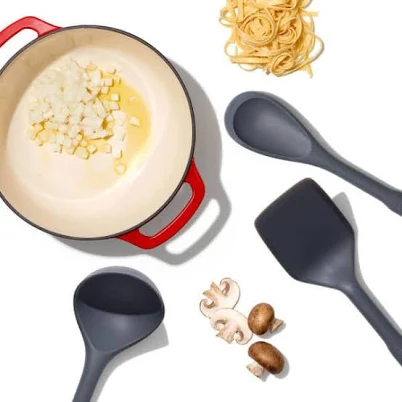
OXO · Non-Stick Kitchen Gadgets
OXO Good Grips 3-Piece Silicone Utensil Set
Lower concern. Silicone utensils pose minimal PFAS risk.
Food-grade silicone utensil heads need no nonstick coating or water-repellent treatment. Silicone resists PFAS-based additives by design.
The better-graded swap
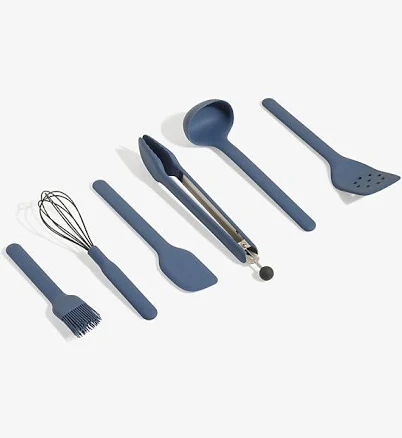
Our Place
Our Place Utensil Essentials 6-Piece Silicone Utensil Set
90/100 safety
Same rubric that flunked this product. The swap earned Excellent.
Still want this one anyway? Check the price on Amazon. We’d swap it.
Material
Food-grade silicone utensil heads
Lab data
No public lab test
Is OXO Good Grips 3-Piece Silicone Utensil non-toxic? What it is made of
These utensils feature heads molded from food-grade silicone, a synthetic rubber polymer that does not naturally contain lead, cadmium, BPA, or phthalates. Silicone is chemically inert at typical cooking temperatures and does not leach into food under normal use. The handles appear to be thermoplastic or elastomer, also non-reactive materials. Silicone's main advantage over traditional nonstick coatings (Teflon-type coating) is the absence of fume risk at high heat, though silicone utensils are typically recommended for temperatures below 600F.
What’s concerning
Category baseline
The starting point for this type of product, before anything specific to this product is counted.
No PFAS disclosure
No public statement from the brand about PFAS in this product.
Silicone degradation and microparticle shedding
Over years of use, especially with heat cycling and abrasion, silicone can degrade and shed microscopic particles into food. This is not a known acute toxicant, but long-term exposure to silicone microparticles has not been extensively studied in humans.
Temperature limits and heat fume risk
Silicone is stable to approximately 600F but can degrade or release volatile organic compounds (VOCs) if exposed to prolonged high heat or direct flame. Exceeding manufacturer temperature guidance poses a low but real risk.
Bacterial colonization if not maintained
Silicone texture can trap food residue and bacteria in crevices if not thoroughly cleaned. Hand washing is recommended over extended dishwasher cycles to minimize biofilm formation.
What’s reassuring
Base material not linked to PFAS
The main material recorded for this product is not one associated with PFAS.
Heavy metals
Food-grade silicone is not known to contain lead or cadmium additives. No recalls or safety alerts for OXO silicone utensils for heavy metal contamination have been published.
Source, FDA ↗Coating degradation and leaching (not applicable to bulk silicone)
Unlike enameled or Teflon-type coating-coated cookware, these utensils are bulk silicone with no separate coating layer, eliminating coating-flake risk.
The full breakdown
The brand's record and disclosure
OXO has no major public safety recalls or controversies tied to silicone utensil products. The company does not publish detailed ingredient transparency or third-party safety certifications (e.g., FDA clearance letters) for this product line on available consumer-facing materials. OXO's parent company (Helen of Troy) maintains general food safety compliance but remains largely silent on PFAS and chemical sourcing policies. No independent testing of OXO silicone utensils for heavy metals or contaminants has been widely published.
How it compares in its category
Silicone utensils present lower concern than wooden spoons (splinter/bacterial harbor risk over time) and metal utensils (conductivity risk). They differ markedly from Teflon-type coating nonstick-coated tools, which carry Teflon-type coating fume risk above 570F and shed microparticles when damaged. Compared to other silicone utensil sets from brands like Oxo, GreenPan, and Calphalon, this OXO set is mid-range in price and carries similar material safety profiles; no brand in this segment has a clear chemical safety advantage.
If you buy it
Hand wash or use gentle machine cycles; avoid abrasive scrubbers that can degrade silicone texture over years. Do not use above 600F; most stovetop use (boiling, simmering, sauces) is well within the temperature range for this material. Replace utensils if silicone becomes cracked, discolored, or sticky, which signals potential polymer degradation. Store in a cool, dry place away from direct sunlight to extend silicone durability.
What we don’t know
- Basis
- Model estimate, 78% confidence, not a lab result
- Lab test
- None on record for this exact product
- Brand statement
- OXO has made a specific claim
Formulations change between production runs, so check the current label. How we grade.
Better-graded alternatives in Non-Stick Kitchen Gadgets
Our Place
Utensil Essentials 6-Piece Silicone Utensil Set
- Silicone utensils, no coating
- The brand calls it PFAS-free, which we have not verified
- Microplastic generation
2 hazards checked on this product. See all of them.
Our Place
Essential Utensil Set
- Stainless steel utensils
- The brand calls it PFAS-free, which we have not verified
- Nickel leaching from stainless steel
2 hazards checked on this product. See all of them.
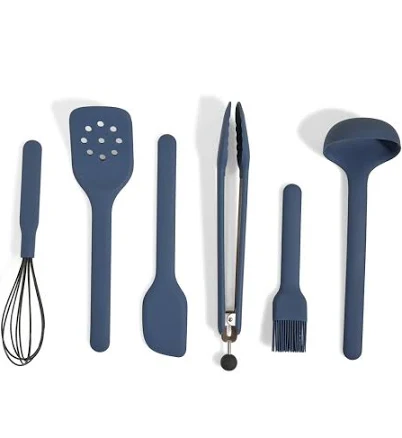
Our Place
Utensil Essentials Set
- Stainless steel utensils, material unclear
- The brand calls it PFAS-free, which we have not verified
- Handle material degradation (if present)
2 hazards checked on this product. See all of them.
More non-stick kitchen gadgets grades
How we score, every product runs through the same public 0-100 rubric based on materials, coatings, brand disclosure, lab findings, and recalls. See the full methodology → Spotted a mistake? Report an error.