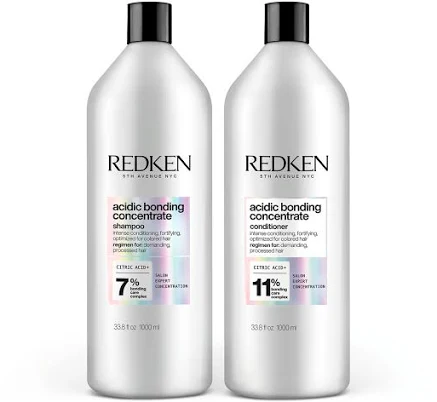
Redken - Acidic Bonding Concentrate Shampoo & Conditioner Set - 1 l / 33.8 fl oz
Lower PFAS concern for rinse-off products without brand transparency on PFAS.
These aqueous shampoo and conditioner formulations have no functional requirement for PFAS. Redken provides no public PFAS disclosure regarding intentional use or screening, leaving transparency gaps for consumers.
We flunk more products than we pass. This one earned its grade. How we grade
Material
aqueous shampoo and conditioner formulations
Brand disclosure
Brand is silent on PFAS
Lab data
No public lab test
You may also be interested in
Top-graded picks in the categories readers replace first, every one scored on the same rubric.

- polypropylene filter housing, carbon/sediment cartridge
- We found no PFAS statement from the brand
- Bacterial growth in spent cartridges
3 hazards checked on this product, all on its full breakdown.

Aquasure
Premier Series 75 GPD Under Sink Reverse Osmosis Water Filtration System
- RO membrane, carbon filters, stainless steel housing
- We found no PFAS statement from the brand
- Bacterial and microbial growth in housing and filters
4 hazards checked on this product, all on its full breakdown.

Avocado
Vegan Mattress
- organic cotton, natural latex, coconut coir, recycled steel coils
- The brand calls it PFAS-free, which we have not verified
- Heavy metals
2 hazards checked on this product, all on its full breakdown.
What Redken - Acidic Bonding Concentrate fl is made of, ingredients and materials
Redken Acidic Bonding Concentrate is an aqueous shampoo and conditioner set designed for bond-damaged hair, formulated with conditioning agents and humectants that remain in the hair briefly during use. As a rinse-off product, most ingredients wash away and do not absorb systemically; the critical concern is what stays on scalp and skin during the wash cycle. The 'acidic' formulation (lower pH around 3.5-4.5) is intentional to close hair cuticles and is within topical pH ranges associated with lower irritation concern.
What’s concerning
Category baseline
The starting point for this type of product, before anything specific to this product is counted.
No PFAS disclosure
No public statement from the brand about PFAS in this product.
1,4-dioxane (synthesis byproduct in ethoxylated ingredients)
Redken formulas typically contain ethoxylated surfactants or emulsifiers (e.g., ceteareth compounds) that can harbor trace 1,4-dioxane as a manufacturing contaminant. No independent testing of this specific product is on public record; L'Oreal-owned brands are not obligated to disclose 1,4-dioxane levels, and FDA does not set limits for cosmetics.
Fragrance allergens and undisclosed fragrance components
Redken Acidic Bonding contains fragrance (listed as 'parfum' in INCI), which can include 26+ allergenic compounds not individually named on the label. Individuals with fragrance sensitivity, asthma, or scalp dermatitis may experience irritation; no hypoallergenic or fragrance-free version of this product line is marketed.
Formaldehyde / VOCs
Some Redken formulas use DMDM hydantoin or imidazolidinyl urea, both formaldehyde-releasing preservatives, though the exact preservative system in this SKU is not fully disclosed. Exposure in rinse-off products is brief and systemic absorption minimal, but scalp contact may trigger contact dermatitis in sensitive individuals.
Source, ATSDR ↗Scalp irritation from alkaline buildup if rinsed inadequately
Although the Acidic Bonding formula is pH-buffered, incomplete rinsing can leave residual conditioning agents on the scalp, potentially causing itching, flaking, or folliculitis with repeated use. This is a user-practice risk, not a formulation defect.
What’s reassuring
Base material not linked to PFAS
The main material recorded for this product is not one associated with PFAS.
Heavy metals
This is a clear or lightly tinted shampoo/conditioner set without intentional colorants. No recalls or reports of lead, cadmium, or arsenic contamination in Redken hair care have been documented. Risk is low but unverified by third-party testing.
Source, FDA ↗How is this PFAS grade calculated?
The brand's record and disclosure
Redken, owned by L'Oreal, has not published a dedicated PFAS avoidance statement or transparency report for individual products. The brand does not independently certify products against EWG Verified, Clean Beauty, or similar standards that explicitly screen for PFAS and heavy metals. However, Redken has no recalled products for contamination in the shampoo/conditioner line and maintains basic ingredient disclosure via INCI labeling. Parent company L'Oreal has committed to phasing PFAS from cosmetics by 2025, though product-level implementation remains unclear.
How it compares in its category
Among professional hair care lines, Redken sits mid-tier for transparency; brands like Davines and Bumble and bumble publish more detailed safety claims, while drugstore alternatives (e.g., SheaMoisture, Cantu) often target natural-ingredient positioning without formal testing disclosure. The Acidic Bonding line is typical of bond-repairing shampoos in avoiding strong preservative loads and heavy silicones, with lower concern profiles compared to older sulfate-heavy formulas. No third-party testing results are publicly available for this specific SKU.
If you buy it
Apply to wet hair, massage gently into scalp and lengths, and rinse thoroughly with cool water to maximize cuticle closure. Avoid contact with eyes; if contact occurs, rinse immediately. Store in a cool, dry place away from direct sunlight to prevent preservative degradation. For sensitive scalp, perform a patch test on a small area behind the ear 24 hours before full use. Replace if the formula separates significantly, smells rancid, or causes persistent irritation.
What is not known about PFAS in this product?
- Basis
- Model estimate, 72% confidence, not a lab result
- Lab test
- None on record for this exact product
- Brand statement
- Redken has made none
Formulations change between production runs, so check the current label. How we grade.
More shampoo grades
How we score, every product runs through the same public 0-100 rubric based on materials, coatings, brand disclosure, lab findings, and recalls. See the full methodology → Spotted a mistake? Report an error.