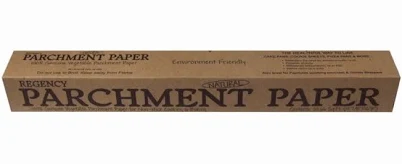
Regency · Parchment Paper & Baking Liners
Regency Wraps Parchment Paper Non-Stick Cake and Cookie Cooking and Baking
Skip until coating details are public; parchment non-stick coatings commonly use PFAS.
Regency doesn't disclose what non-stick coating is used on this parchment paper. Standard parchment non-stick treatments historically rely on silicone or Teflon-family coating, many containing legacy PFAS.
The better-graded swap
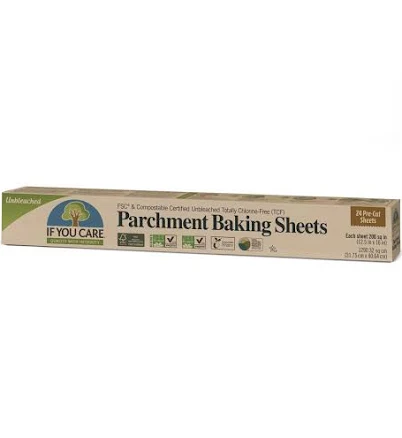
If You Care
If You Care Parchment Baking Sheets
90/100 safety
Same rubric that flunked this product. The swap earned Excellent.
Still want this one anyway? Check the price on Amazon. We’d swap it.
Material
Paper with non-stick coating (type unspecified)
Brand disclosure
Brand is silent on PFAS
Lab data
No public lab test
What Regency Wraps Parchment Paper Non-Stick is made of, ingredients and materials
Regency Parchment Paper is paper substrate coated with a proprietary non-stick silicone or fluorocarbon-based finish. The coating enables food release and heat distribution but its exact chemistry is not publicly disclosed by the brand. Non-stick parchment coatings commonly use PFAS or silicone compounds to achieve their functional properties. Without disclosure, the specific coating type and whether it contains PFAS cannot be independently verified.
What’s concerning
Category baseline
The starting point for this type of product, before anything specific to this product is counted.
No PFAS disclosure
No public statement from the brand about PFAS in this product.
Non-stick, chemistry undisclosed
Marketed as non-stick without stating the coating chemistry.
PFAS
Regency does not specify whether the non-stick coating contains PFAS. Non-stick parchment coatings historically use fluorinated compounds; the absence of any PFAS-free claim or third-party assurance suggests PFAS risk cannot be ruled out. See PFAS grade separately (20/100).
Source, ATSDR ↗Coating degradation and leaching at high heat
All non-stick parchment coatings can degrade under sustained high temperature (above 420F), potentially releasing coating microparticles or absorbed compounds into food. Regency provides no heat limit on packaging, leaving users to infer safe temperatures.
Silicone or polymer microparticles if coating fails
If the non-stick coating (whether silicone or fluorocarbon based) peels, cracks, or burns, small particles may transfer to food. No testing is public for Regency products on this risk.
Moisture absorption and mold if stored improperly
Parchment paper stored in humid conditions can absorb moisture, degrading the coating and creating conditions for microbial growth. This is a storage and maintenance issue, not a manufacturing defect, but relevant to proper use.
What’s reassuring
Chlorine residue from bleaching (paper component)
Bleached parchment paper may retain trace chlorine compounds; Regency does not specify whether this product is chlorine-free. Standard food-contact parchment undergoes safety processing, but unbleached alternatives pose less theoretical residue risk.
The full breakdown
The brand's record and disclosure
Regency Wraps does not publicly disclose non-stick coating chemistry, PFAS content, or third-party testing on their product labeling or website. No published recalls or safety controversies are on record for this parchment product. The brand has not sought certifications like GreenGuard or Ocean Wise that would signal transparency on chemical composition. This silence on coating details is typical across most mainstream parchment brands but leaves consumers without verification.
How it compares in its category
Regency parchment sits in the mainstream commercial tier; most competitors (Reynolds, If You Care, Parchment Cake) similarly do not disclose coating specifics. Unbleached or chlorine-free parchment options exist but do not eliminate non-stick coating uncertainty. Some brands market PFOA-free claims, but PFAS beyond PFOA (like GenX or PFPeA) are not ruled out. Regency's lack of any third-party certification or PFAS assurance positions it as a standard-risk option in a category where transparency is sparse industry-wide.
If you buy it
Use at temperatures below 420 degrees Fahrenheit to minimize any thermal degradation of the non-stick coating. Avoid direct high-heat contact (e.g., under a broiler) where coating breakdown is more likely. Replace sheets if they show peeling, discoloration, or wear; degraded coating may leach into food. Store in a cool, dry place; moisture exposure can reduce coating durability and increase leaching risk over time.
What we don’t know
- Basis
- Model estimate, 35% confidence, not a lab result
- Lab test
- None on record for this exact product
- Brand statement
- Regency has made none
Formulations change between production runs, so check the current label. How we grade.
Better-graded alternatives in Parchment Paper & Baking Liners
If You Care
Baking Paper, Parchment, 70 Square Feet
- silicone-coated parchment paper
- The brand calls it PFAS-free, which we have not verified
- Paper degradation and particulate shedding
If You Care
Parchment Baking Sheets
- unbleached paper with silicone coating
- The brand calls it PFAS-free, which we have not verified
- Silicone coating degradation at high heat
If You Care
Parchment Baking Sheets
- bleached paper with silicone coating
- The brand calls it PFAS-free, which we have not verified
- Paper degradation and fragmentation
More parchment paper & baking liners grades
How we score, every product runs through the same public 0-100 rubric based on materials, coatings, brand disclosure, lab findings, and recalls. See the full methodology → Spotted a mistake? Report an error.