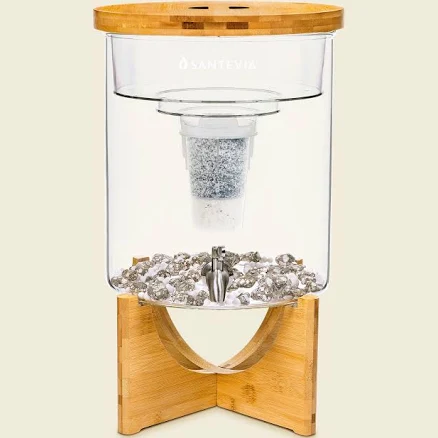
Santevia Glass Water System
Glass water system with no coating on record. The cartridge materials are not fully described.
Santevia's glass pitcher uses borosilicate glass as the main contact surface, a low-risk PFAS material. The internal filter cartridges using charcoal and minerals aren't transparently disclosed for PFAS-free composition.
We flunk more products than we pass. This one earned its grade. How we grade
Material
borosilicate glass, charcoal/mineral cartridge filters
Brand disclosure
Brand is silent on PFAS
Lab data
No public lab test
What Santevia Glass Water System is made of, ingredients and materials
The Santevia system uses borosilicate glass as its primary pitcher material, which is chemically inert and does not leach contaminants into water at room temperature or during typical use. The cartridge contains activated charcoal and mineral components (exact composition not fully disclosed by the brand), which perform mechanical and chemical filtration. Borosilicate glass is resistant to thermal shock and does not degrade or off-gas under normal pitcher storage conditions, presenting lower concern than plastic alternatives for long-term water contact.
What’s concerning
No PFAS disclosure
No public statement from the brand about PFAS in this product.
Cartridge filter media composition opacity
Santevia does not publicly disclose the full sourcing, processing, or material specification of its charcoal and mineral cartridge contents, leaving a gap in verification of potential trace contaminants or degradation byproducts that could leach into water over time.
Bacterial growth and biofilm in filter cartridge
All pitcher filters accumulate microorganisms if cartridges are not replaced on schedule; activated charcoal is a favorable medium for bacterial colonization. Santevia's guidance on replacement frequency is standard but non-specific, and customers must monitor independently for signs of slime or odor.
Housing gaskets or seals leachables
The pitcher lid or cartridge housing likely contains rubber or silicone gaskets; while borosilicate glass itself is inert, these components' material identity and long-term stability are not disclosed and could potentially off-gas or leach at margins of the system.
Inadequate contaminant removal verification
No published NSF/ANSI certification or independent lab testing results are available on Santevia's marketing materials. Customers cannot verify reduction rates for lead, chlorine, pesticides, or other common tap water contaminants that the cartridge claims to address.
What’s reassuring
Bare uncoated material
Recorded as a bare, uncoated material with no surface coating or treatment.
Glass pitcher thermal shock risk (minor)
Borosilicate glass is highly resistant to thermal stress, and no fracture incidents are on record for this product model. Risk is negligible with normal use, but rapid temperature changes or impact damage remain possible.
The full breakdown
The brand's record and disclosure
Santevia does not publish detailed third-party testing results or NSF certification on its website for the Santevia Glass Water System cartridges, and has maintained public silence on PFAS mitigation despite industry-wide scrutiny of filter media. The brand markets the product as a natural filtration solution but provides no independent lab verification of contaminant removal rates or cartridge material sourcing. No major safety recalls or contamination incidents have been publicly reported for this specific product model.
How it compares in its category
Santevia's glass pitcher design is a significant advantage over polycarbonate or polypropylene alternatives, which carry leaching risks under heat or UV. Most competing pitcher filters (Brita, PUR, ZeroWater) use plastic housings; Santevia avoids that hazard class entirely. However, competitors often publish NSF certifications or third-party contaminant reduction claims, which Santevia does not prominently feature, making relative performance harder to verify.
If you buy it
Replace the cartridge every 2-3 months or per manufacturer guidance to prevent bacterial biofilm buildup inside the filter media, which occurs if activated charcoal becomes saturated. Store the glass pitcher away from direct sunlight to avoid any potential algae growth in the water itself (not a Santevia-specific issue, but common to all water pitchers). Rinse the glass vessel regularly and do not expose it to extreme temperature swings, though borosilicate glass is forgiving. Do not use the pitcher for hot water storage, as the cartridge media is designed for room-temperature filtration only.
What we don’t know
- Basis
- Model estimate, 72% confidence, not a lab result
- Lab test
- None on record for this exact product
- Brand statement
- Santevia has made none
Formulations change between production runs, so check the current label. How we grade.
More water filters grades
How we score, every product runs through the same public 0-100 rubric based on materials, coatings, brand disclosure, lab findings, and recalls. See the full methodology → Spotted a mistake? Report an error.