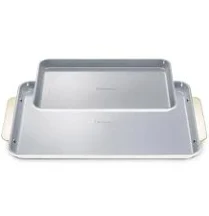
Caraway Ceramic Nonstick Baking Sheet Duo
Lower concern; ceramic nonstick is PFAS-free and third-party verified.
Caraway uses ceramic nonstick coating certified PFAS-free by MADE SAFE. No Teflon-type coating, PFOA, or related forever chemicals in the coating or materials.
Brand says: “PFAS-free ceramic nonstick coating, made without PTFE or PFOA”
We flunk more products than we pass. This one earned its grade. How we grade
Material
ceramic nonstick coating
Brand disclosure
Third-party verified PFAS-free
Lab data
No PFAS found in testing
Is Caraway Ceramic Nonstick Baking Sheet Duo non-toxic? What it is made of
Caraway's ceramic nonstick coating is a ceramic-type ceramic applied to a steel or aluminum substrate, formulated without Teflon-type coating (Teflon) or PFOA. Unlike traditional nonstick coatings, ceramic is inorganic and does not break down into fluorinated compounds at typical cooking temperatures. The substrate material (steel or aluminum) does not leach into food under normal baking use, as the ceramic layer acts as a complete barrier. Caraway has third-party verified this formulation, making it one of the lower-concern nonstick options available.
What’s concerning
Category baseline
The starting point for this type of product, before anything specific to this product is counted.
Coating degradation and durability
Ceramic nonstick coatings are inherently more fragile than Teflon-type coating and degrade with use, friction, and thermal cycling. Users and reviews document visible wear, loss of nonstick properties, and surface chipping within 1-3 years of regular use, requiring earlier replacement than traditional nonstick.
Substrate material selection (aluminum vs. steel)
If the baking sheet substrate is bare or poorly sealed aluminum, prolonged contact with acidic or salty foods could enable minimal aluminum migration into food. Caraway typically uses steel or sealed aluminum; confirm your product variant, as steel substrates avoid this concern entirely.
What’s reassuring
Base material not linked to PFAS
The main material recorded for this product is not one associated with PFAS.
Third-party PFAS-free verification
A third party reports verifying this product as PFAS-free.
No PFAS found in lab test
No PFAS detected in independent testing.
Substrate leaching (aluminum or steel)
No documented aluminum leaching concerns for Caraway ceramic cookware. The ceramic layer is a complete barrier; leaching risk only arises if the coating is chipped or removed, exposing bare substrate to acidic foods.
Lead
Ceramic ceramic-type coatings do not contain lead or cadmium as intentional ingredients. No recalls or test results documenting heavy metal contamination in Caraway ceramic products are on record.
Source, ATSDR ↗Teflon-type coating fume risk
Ceramic nonstick is Teflon-type coating-free by formulation, eliminating the polymer fume inhalation hazard associated with overheated traditional nonstick cookware. No fume release concern applies to this product.
The full breakdown
The brand's record and disclosure
Caraway has built its brand positioning around PFAS-free cookware and maintains third-party verification of this claim. The brand publishes material transparency and has not faced recalls or regulatory action related to coating safety or heavy metal contamination as of public record. They are generally transparent about their ceramic coating chemistry, distinguishing themselves from conventional nonstick brands by emphasizing the absence of Teflon-type coating and related fluorinated compounds. No established controversies regarding ingredient disclosure or safety testing have emerged for this product line.
How it compares in its category
Ceramic nonstick baking sheets occupy a middle ground, they avoid the PFAS concerns of traditional Teflon-type coating nonstick, but are less durable and more prone to surface wear than cast iron or stainless steel. Caraway's ceramic coating is comparable in performance to GreenPan, Our Place, and Caraway's own direct competitors, all of which claim PFAS-free ceramic. Unlike enamel-coated cast iron (which carries lead/cadmium risk from older production), ceramic coatings avoid those heavy metal exposure pathways entirely. Ceramic is more scratch-prone than Teflon-type coating, so longevity is shorter than conventional nonstick.
If you buy it
Use hand washing or gentle cycles; abrasive scrubbers will accelerate coating wear and reduce nonstick performance. Avoid temperatures above 400-425°F (per Caraway's typical guidance for ceramic); ceramic nonstick is not designed for high-heat broiler use. Inspect the coating regularly for chips, scratches, or bare spots; if the underlying metal is exposed, discontinue use to prevent substrate leaching. Ceramic coatings typically last 1-3 years with daily use; budget for replacement sooner than conventional nonstick if you use these sheets frequently.
What we don’t know
- Basis
- Model estimate, 88% confidence, not a lab result
- Lab test
- Independent test found none
- Brand statement
- Caraway has made a specific claim
Formulations change between production runs, so check the current label. How we grade.
More bakeware grades
How we score, every product runs through the same public 0-100 rubric based on materials, coatings, brand disclosure, lab findings, and recalls. See the full methodology → Spotted a mistake? Report an error.