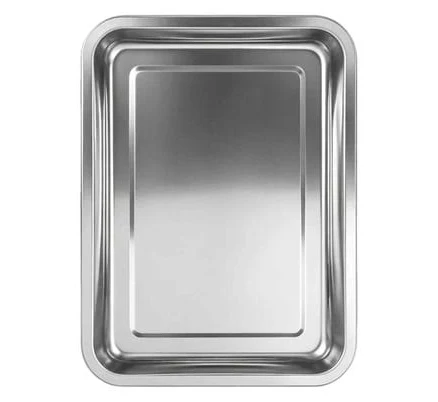
Stainless Steel Baking Tray with Mirror Finish, Is It Non-Toxic?
Stainless steel cookware typically carries minimal PFAS concern.
Stainless steel baking trays don't use Teflon-family coating coatings. The mirror finish comes from polishing, not PFAS-based treatment.
The better-graded swap
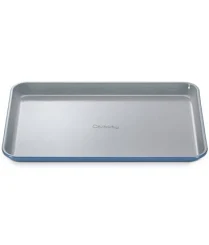
Caraway
Caraway Nonstick Ceramic Medium Baking Sheet
100/100 safety
Same rubric that flunked this product. The swap earned Excellent.
Still want this one anyway? Check the price on Amazon. We’d swap it.
Material
stainless steel
Brand disclosure
Brand is silent on PFAS
Lab data
No public lab test
You may also be interested in
Top-graded picks in the categories readers replace first, every one scored on the same rubric.

- polypropylene filter housing, carbon/sediment cartridge
- We found no PFAS statement from the brand
- Bacterial growth in spent cartridges
3 hazards checked on this product, all on its full breakdown.

Aquasure
Premier Series 75 GPD Under Sink Reverse Osmosis Water Filtration System
- RO membrane, carbon filters, stainless steel housing
- We found no PFAS statement from the brand
- Bacterial and microbial growth in housing and filters
4 hazards checked on this product, all on its full breakdown.

Avocado
Vegan Mattress
- organic cotton, natural latex, coconut coir, recycled steel coils
- The brand calls it PFAS-free, which we have not verified
- Heavy metals
2 hazards checked on this product, all on its full breakdown.
Is Stainless Steel Baking Tray Mirror Finish non-toxic? What it is made of
This product is constructed from stainless steel, a chromium-iron alloy that does not require non-stick coatings like Teflon-type coating and thus avoids fume risks from degraded polymer coatings at high temperatures. Stainless steel is inherently resistant to corrosion and does not leach problematic metals like aluminum or cadmium into food under normal baking conditions. The mirror finish is a polishing treatment applied during manufacturing and does not introduce additional chemical coatings that would degrade with use.
What’s concerning
Category baseline
The starting point for this type of product, before anything specific to this product is counted.
No PFAS disclosure
No public statement from the brand about PFAS in this product.
Surface finish contamination (chromium VI)
Stainless steel manufacturing may involve hexavalent chromium processes; however, the finished product is passivated and poses minimal ingestion risk. Minor scratches expose stable chromium III oxide beneath and do not create a food safety hazard in normal use.
Nickel sensitivity reactions
Stainless steel typically contains 8-12 percent nickel. Individuals with severe nickel contact dermatitis may experience skin irritation if handling unwashed trays with wet hands, though ingestion of trace nickel leached into food is not a documented health concern at typical exposure levels.
What’s reassuring
Bare uncoated material
Recorded as a bare, uncoated material with no surface coating or treatment.
Coating degradation / fume risk
Stainless steel baking trays have no polymer or ceramic non-stick coating and therefore carry no established risk of thermal decomposition fumes at standard baking temperatures.
Lead
Stainless steel is chemically stable and does not leach chromium, nickel, or other metals into acidic or alkaline foods under normal baking conditions; no recalls or test data suggest leaching from Mirro stainless trays.
Source, ATSDR ↗Warping and structural failure
No recalls or widespread reports document premature warping, cracking, or structural failure of Mirro stainless steel baking trays under normal home oven use; durability is comparable to other mid-market stainless bakeware.
How is this PFAS grade calculated?
The brand's record and disclosure
Mirro, owned by Groupe SEB, manufactures cookware primarily for the North American market and has no published PFAS reduction commitments or third-party safety certifications on file. The brand has not faced documented recalls related to leaching, coating failure, or heavy metal contamination in recent years. Their silence on PFAS and material transparency is typical of mid-market cookware brands but represents a missed opportunity for consumer communication.
How it compares in its category
Stainless steel baking trays present lower concern in bakeware compared to non-stick ceramic, aluminum, or cast iron alternatives, which carry higher risks of coating degradation or metal leaching. This product sits in the mainstream category without premium certifications (such as NSF or GOTS equivalents for cookware) but also without known quality control issues. Compared to budget aluminum trays, stainless steel offers better durability and lower leaching risk over the product's lifetime.
If you buy it
Use this tray at typical baking temperatures (up to 500F) without concern for coating failure or off-gassing. Wash by hand or dishwasher; avoid steel wool or abrasive scrubbers that may scratch the mirror finish, though minor scratches do not compromise safety. Do not use on direct stovetop heat. Replace only if visible deformation, rust spots (indicating compromised stainless finish), or warping occurs, which is uncommon with stainless steel over 5-10 years of typical use.
What is not known about PFAS in this product?
- Basis
- Model estimate, 78% confidence, not a lab result
- Lab test
- None on record for this exact product
- Brand statement
- Mirro has made none
Formulations change between production runs, so check the current label. How we grade.
What are the PFAS-free alternatives to Stainless Steel Baking Tray with Mirror Finish?
- ceramic nonstick coating
- A third party reports verifying it as PFAS-free
- Ceramic coating degradation over time
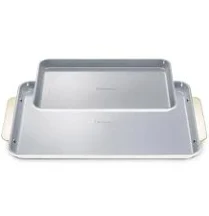
- ceramic nonstick coating
- A third party reports verifying it as PFAS-free
- Coating degradation and durability
2 hazards checked on this product, all on its full breakdown.
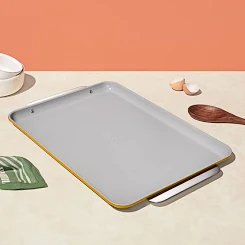
- ceramic nonstick coating
- The brand calls it PFAS-free, which we have not verified
- Ceramic coating degradation and particle shedding
3 hazards checked on this product, all on its full breakdown.
More bakeware grades
How we score, every product runs through the same public 0-100 rubric based on materials, coatings, brand disclosure, lab findings, and recalls. See the full methodology → Spotted a mistake? Report an error.