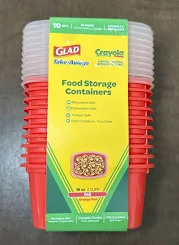
Limited Edition Crayola Retired Colors Glad Take-aways Orange Red
Skip; Glad does not disclose coating chemistry for food contact.
Glad's take-out containers use plastic film with unspecified water and grease-resistant treatments typical of food packaging. Brand makes no PFAS disclosure, and coating composition is not publicly detailed.
The better-graded swap
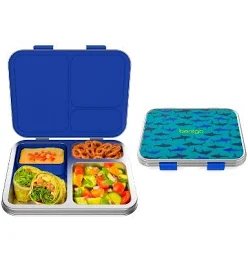
Bentgo
Bentgo Kids Prints Stainless Steel Lunch Box
80/100 safety
Same rubric that flunked this product. The swap earned Excellent.
Still want this one anyway? Check the price on Amazon. We’d swap it.
Material
plastic film with unspecified water/grease-resistant coating
Brand disclosure
Brand is silent on PFAS
Lab data
No public lab test
What Limited Edition Crayola Retired Colors is made of, ingredients and materials
This product is a plastic film take-out container with an unspecified water and grease-resistant coating. Glad has not publicly disclosed the chemistry of that coating, which is the critical unknown for food-contact safety. The coating's composition determines leaching risk under typical use (hot foods, oils, acidic items). Without transparency, you cannot know whether the coating contains legacy PFAS, newer PFAS alternatives, or other persistent chemicals.
What’s concerning
Waterproof / stain-resistant treatment
Water-repellent coating treatments have historically used PFAS.
Category baseline
The starting point for this type of product, before anything specific to this product is counted.
No PFAS disclosure
No public statement from the brand about PFAS in this product.
PFAS
The unspecified water/grease-resistant coating may contain Teflon-family coating, silicones, waxes, or other film-forming agents. Without Glad's disclosure, the specific leaching profile under heat or with acidic/fatty foods cannot be assessed. Risk is higher than for uncoated plastic.
Source, ATSDR ↗Microplastic migration under heat
Plastic film containers can shed microplastics when heated or repeatedly flexed. The unspecified coating may increase this risk if it degrades under temperature stress. Heating food in this container raises the likelihood of microplastic ingestion.
Coating adhesion and flaking
Disposable plastic food containers with coatings can degrade or flake over time, especially if scratched or washed. Flaking coating fragments entering food is a reported concern in this product category; Glad does not publish data on coating durability or replacement intervals.
What’s reassuring
BPA & bisphenols
No recalls or testing reports specific to this product indicate BPA or BPS contamination. However, Glad has not publicly committed to BPA-free formulations across all product lines, so baseline risk cannot be ruled out without third-party testing.
Source, FDA ↗Phthalates
No specific recalls or public test results document phthalates in this Glad product. However, many disposable food-packaging plastics still use phthalate plasticizers; Glad does not disclose its policies or material certifications.
Source, ATSDR ↗The full breakdown
The brand's record and disclosure
Glad has maintained silence on the specific chemical composition of its food-contact coatings. The company has not published commitments to phase out PFAS or adopt alternative coating chemistries, nor does it provide ingredient lists for its proprietary water/grease barrier formulations. This lack of transparency is standard across many disposable food-packaging manufacturers but reflects a low priority on consumer disclosure.
How it compares in its category
Single-use plastic takeout containers with durable grease barriers are among the most likely food-packaging items to contain PFAS or similar fluorinated coatings, because the water and oil repellency is difficult to achieve without them. Compostable alternatives (molded fiber, certified compostable plastic) typically have lower PFAS risk but are less grease-resistant. Uncoated plastic containers avoid the coating hazard entirely but offer no grease barrier.
If you buy it
Do not microwave or heat food in this container, as heat can accelerate any potential leaching from an unknown coating. Store room-temperature foods only. Do not reuse for storage; these are single-use items. If you must use it, transfer hot or greasy foods to ceramic or glass immediately after purchase. Consider uncoated or certified compostable alternatives if available for your use case.
What we don’t know
- Basis
- Model estimate, 35% confidence, not a lab result
- Lab test
- None on record for this exact product
- Brand statement
- Glad has made none
Formulations change between production runs, so check the current label. How we grade.
Better-graded alternatives in Lunch Boxes
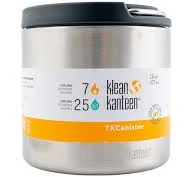
Klean Kanteen
Double Wall Vacuum Insulated Stainless Steel Food Canister Container with Leak Proof Lid
- Stainless steel body, silicone gasket lid seal
- The brand calls it PFAS-free, which we have not verified
- Silicone gasket degradation
3 hazards checked on this product. See all of them.
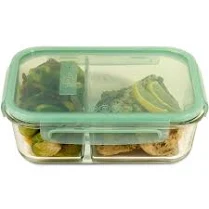
Snapware
Meal Box Glass
- borosilicate glass
- We found no PFAS statement from the brand
- Leaching from glass matrix or lid seals
2 hazards checked on this product. See all of them.
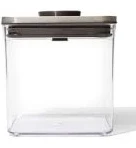
OXO
Steel Pop Big Square Short - 2.8 Qt/2.6 l
- Stainless steel container, no surface treatment
- Lid/gasket polymer leaching
3 hazards checked on this product. See all of them.
More lunch boxes grades
How we score, every product runs through the same public 0-100 rubric based on materials, coatings, brand disclosure, lab findings, and recalls. See the full methodology → Spotted a mistake? Report an error.