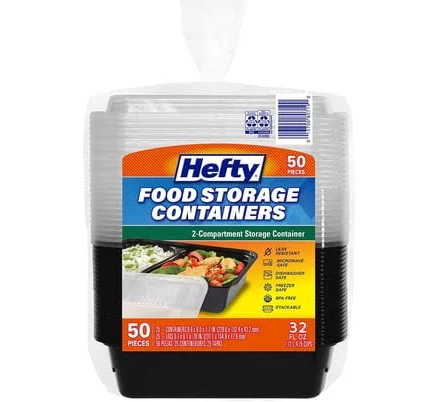
Hefty · Disposable Food Containers
Hefty Food Storage Containers with Lids
Lower concern, polypropylene containers unlikely to contain PFAS.
Hefty food storage containers are polypropylene, which doesn't inherently need PFAS to function. No brand PFAS disclosure appears, but material choice suggests lower risk than treated alternatives.
We flunk more products than we pass. This one earned its grade. How we grade
Material
Polypropylene (PP) plastic container with lids
Brand disclosure
Brand is silent on PFAS
Lab data
No public lab test
You may also be interested in
Top-graded picks in the categories readers replace first, every one scored on the same rubric.

- polypropylene filter housing, carbon/sediment cartridge
- We found no PFAS statement from the brand
- Bacterial growth in spent cartridges
3 hazards checked on this product, all on its full breakdown.

Aquasure
Premier Series 75 GPD Under Sink Reverse Osmosis Water Filtration System
- RO membrane, carbon filters, stainless steel housing
- We found no PFAS statement from the brand
- Bacterial and microbial growth in housing and filters
4 hazards checked on this product, all on its full breakdown.

Avocado
Vegan Mattress
- organic cotton, natural latex, coconut coir, recycled steel coils
- The brand calls it PFAS-free, which we have not verified
- Heavy metals
2 hazards checked on this product, all on its full breakdown.
What Hefty Food Storage Containers with Lids is made of, ingredients and materials
Hefty Food Storage Containers are injection-molded polypropylene (PP), a thermoplastic classified as #5 in the resin identification code. PP is chemically inert at room temperature and does not contain BPA, which was historically a concern in earlier polycarbonate (#7) and polyethylene terephthalate (#1) containers. The main exposure pathway for PP is leaching of residual oligomers or additives when exposed to heat, fatty foods, or solvents, though this risk is considered low for polypropylene relative to other plastics.
What’s concerning
Category baseline
The starting point for this type of product, before anything specific to this product is counted.
No PFAS disclosure
No public statement from the brand about PFAS in this product.
Phthalates
Phthalate plasticizers are occasionally used in PP compounds to improve flexibility, particularly in lids. Hefty does not publicly disclose whether phthalates are present; exposure risk is low at room temperature but increases with heating or contact with fatty foods.
Source, ATSDR ↗Microplastics
Repeated heating, freezing, or microwaving can cause surface cracking or particulate shedding over time. Clouding or embrittlement of lids after multiple cycles is a visible sign of polymer breakdown.
Source, EPA ↗Oligomer and monomer leaching
PP containers can release trace amounts of residual propylene oligomers or processing additives into food, especially at elevated temperatures or with fatty/acidic foods. Risk is considered low for refrigerated storage but increases with misuse (e.g., repeated microwave heating).
Lid seal failure and bacterial growth
Worn or warped lids may not seal properly, allowing bacterial contamination during storage. Hefty lids are not designed for long-term seal integrity and may degrade faster than glass-container lids under repeated use.
What’s reassuring
Base material not linked to PFAS
The main material recorded for this product is not one associated with PFAS.
BPA & bisphenols
Polypropylene does not require BPA or BPS in its formulation. Hefty containers are inherently BPA-free by material class, with no reports of these chemicals in PP food-storage products.
Source, FDA ↗How is this PFAS grade calculated?
The brand's record and disclosure
Hefty, owned by Reynolds Consumer Products, does not publicly disclose detailed chemical composition or third-party testing results for these containers. The brand has no published certifications (e.g., BPA-free claims) prominently visible on marketing materials reviewed in public sources, though PP inherently does not use BPA. No significant recalls or safety controversies specific to Hefty Food Storage Containers have been documented in FDA or CPSC databases. The company's silence on transparency is typical for mass-market plastic housewares but limits independent verification of additive safety.
How it compares in its category
Hefty containers occupy the mid-market segment; they are cheaper than glass alternatives and comparable in price to store-brand PP containers. PP-based storage shows lower concern than older polycarbonate or PVC options, and Hefty's injection-molded construction degrades more slowly than thin-film plastic wraps. Competitors like Rubbermaid and Pyrex glass containers may offer better traceability and durability, but Hefty containers meet basic food-contact material standards and are not regarded as higher-risk than typical grocery-store alternatives.
If you buy it
Do not microwave Hefty containers unless labeled microwave-safe; heat can increase leaching of plasticizers or residual monomers, especially with fatty or acidic foods. Store acidic foods (tomato sauce, vinegar, citrus) in glass instead, as acidity accelerates trace leaching. Replace containers if lids become warped, discolored, or cloudy, as these are signs of degradation. Hand wash rather than dishwasher wash when possible to extend lifespan and reduce thermal stress; if you dishwash, use the lower rack and avoid the heat-dry cycle.
What is not known about PFAS in this product?
- Basis
- Model estimate, 72% confidence, not a lab result
- Lab test
- None on record for this exact product
- Brand statement
- Hefty has made none
Formulations change between production runs, so check the current label. How we grade.
What are the PFAS-free alternatives to Hefty Food Storage Containers with Lids?
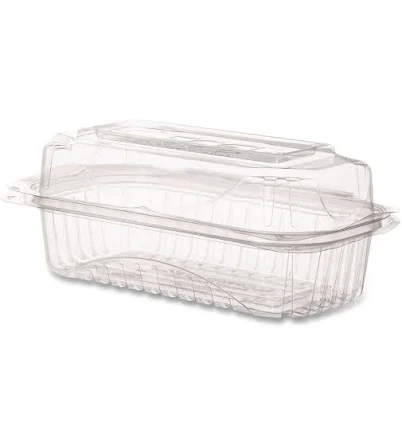
Eco-Products
Compostable Clear Clamshell Hinged Food
- Compostable resin (PLA/PBAT blend, plant-based)
- A third party reports verifying it as PFAS-free
- Thermal degradation and chemical release at use temperatures
More disposable food containers grades
How we score, every product runs through the same public 0-100 rubric based on materials, coatings, brand disclosure, lab findings, and recalls. See the full methodology → Spotted a mistake? Report an error.