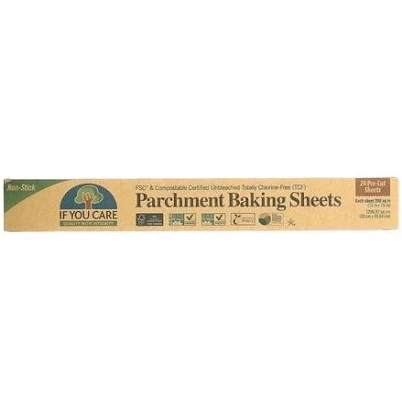
If You Care · Parchment Paper & Baking Liners
If You Care
Brand no-added-PFAS claim, unverified by us.
If You Care describes its baking tools as unbleached, non-toxic and with no added PFAS. We record that as an unverified brand claim. The paper's grease-resistant treatment is still counted, because its chemistry is not stated.
Brand says: “If You Care describes its baking tools as unbleached, non-toxic and with no added PFAS.”
The better-graded swap
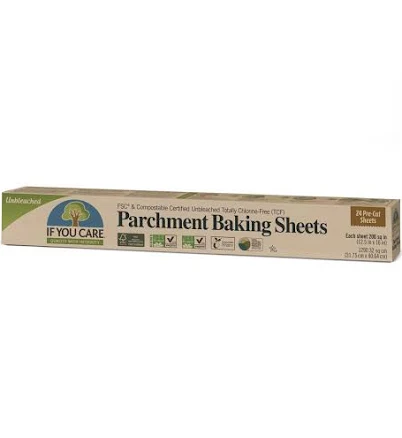
If You Care
If You Care Parchment Baking Sheets
90/100 safety
Same rubric that flunked this product. The swap earned Excellent.
Still want this one anyway? Check the price on Amazon. We’d swap it.
Material
unbleached kraft paper, chlorine-free
Brand disclosure
Brand claims PFAS-free
Lab data
No public lab test
What If You Care is made of, ingredients and materials
If You Care parchment is unbleached kraft paper, meaning it skips the chlorine bleaching step common in conventional parchment. Unbleached kraft retains natural lignin and cellulose without chlorine residues. The paper shows lower concern for migration at typical baking temperatures (under 420°F). No added silicone or Teflon-family coating coatings are disclosed, which reduces thermal decomposition risks versus Teflon-type coating-coated alternatives.
What’s concerning
Category baseline
The starting point for this type of product, before anything specific to this product is counted.
Waterproof / stain-resistant treatment
Water-repellent coating treatments have historically used PFAS.
Thermal decomposition / off-gassing at high heat
Unbleached kraft paper may undergo oxidation and produce volatile organic compounds (VOCs) or char above 420-450°F. Unlike Teflon-type coating-coated parchment, this is organic decomposition rather than Teflon-family coating fume risk. Home kitchen use at standard baking temps minimizes exposure.
PFAS
Brand claims no added PFAS, but unverified by independent testing. Unbleached kraft alone does not require PFAS for water resistance; however, legacy per- and polyfluoroalkyl compounds can persist in recycled content. Finished-product lab confirmation would strengthen safety confidence.
Source, ATSDR ↗What’s reassuring
Brand-stated PFAS-free
The brand states this product is PFAS-free. We have not verified the claim.
Chlorine residue / dioxins from bleaching
If You Care explicitly uses chlorine-free processing. Conventional bleached parchment carries theoretical dioxin risk, but this product avoids that step. No recalls or contamination reports on record for this brand.
Ink or printing residues on outer roll
No reports of non-food-contact inks migrating to food side of If You Care parchment. Standard practice is to keep printed outer wrapping away from food contact. Product design appears to follow established separation conventions.
Fiber shedding or paper fragments in food
Kraft paper is structurally sound and does not shed microplastics or fragments during normal use. Unlike some recycled paper products, If You Care sourcing is described as virgin kraft, reducing contamination risk from prior use.
The full breakdown
The brand's record and disclosure
If You Care markets a no-added-PFAS position and emphasizes sustainable sourcing and chlorine-free processing. The brand does not appear in major consumer safety recalls or regulatory actions on record. However, independent PFAS testing of their parchment has not been published; the claim relies on material sourcing rather than finished-product verification. Certifications listed typically include compostability and forest stewardship standards.
How it compares in its category
Unbleached kraft parchment sits in the middle-to-premium segment. It avoids both chlorine-bleached paper (potential dioxin/chlorine residue concern, though low risk) and silicone/Teflon-type coating-coated parchment (higher thermal and degradation hazard). Recycled kraft alternatives exist but are less common; If You Care's virgin kraft position is typical for chlorine-free parchment. Cost and availability are higher than conventional bleached parchment.
If you buy it
Use at temperatures below 420°F; unbleached kraft darkens and may smoke above this range without benefit of heat-stabilizing coatings. Replace rolls if paper becomes brittle, discolored, or develops odor, typically after 1-2 years of storage in a cool, dry cupboard. Unbleached parchment may stick slightly more to dough or batter than silicone-coated alternatives; light greasing or lining helps. Composting is appropriate for used paper in commercial or home systems.
What we don’t know
- Basis
- Model estimate, 78% confidence, not a lab result
- Lab test
- None on record for this exact product
- Brand statement
- If You Care has made a specific claim
Formulations change between production runs, so check the current label. How we grade.
Better-graded alternatives in Parchment Paper & Baking Liners
If You Care
Baking Paper, Parchment, 70 Square Feet
- silicone-coated parchment paper
- The brand calls it PFAS-free, which we have not verified
- Paper degradation and particulate shedding
If You Care
Parchment Baking Sheets
- unbleached paper with silicone coating
- The brand calls it PFAS-free, which we have not verified
- Silicone coating degradation at high heat
If You Care
Parchment Baking Sheets
- bleached paper with silicone coating
- The brand calls it PFAS-free, which we have not verified
- Paper degradation and fragmentation
More parchment paper & baking liners grades
How we score, every product runs through the same public 0-100 rubric based on materials, coatings, brand disclosure, lab findings, and recalls. See the full methodology → Spotted a mistake? Report an error.