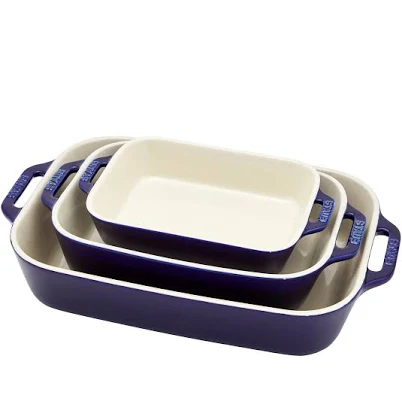
Staub 3-Piece Rectangular Baking Dish Set
Lower PFAS concern, enameled cast iron product, no nonstick coating.
Staub baking dishes are enameled cast iron without nonstick coatings, a lower-risk category. No PFAS disclosure by brand, but material choice itself does not require PFAS in typical manufacture.
The better-graded swap
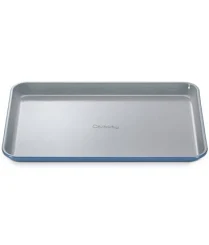
Caraway
Caraway Nonstick Ceramic Medium Baking Sheet
100/100 safety
Same rubric that flunked this product. The swap earned Excellent.
Still want this one anyway? Check the price on Amazon. We’d swap it.
Material
enameled cast iron
Brand disclosure
Brand is silent on PFAS
Lab data
No public lab test
Is Staub 3-Piece Rectangular Baking Dish Set non-toxic? What it is made of
These are cast iron cores with vitreous enamel coating (glass-like surface fused at high temperature). Unlike nonstick cookware, this enamel does not release harmful fumes when heated normally, and cast iron itself is inert once seasoned. The enamel layer prevents direct contact between acidic food and bare iron, reducing iron leaching into acidic dishes while also eliminating rust concerns. This material combination has lower concern for PFAS compared to many cookware options.
What’s concerning
Category baseline
The starting point for this type of product, before anything specific to this product is counted.
No PFAS disclosure
No public statement from the brand about PFAS in this product.
Enamel coating degradation over time
While vitreous enamel is durable, chipping or crazing from thermal shock, impact, or extended use can expose iron underneath and create sharp edges. Staub enamel is known for quality, but prolonged use and thermal stress may cause micro-fractures.
Iron leaching from exposed cast iron
If the enamel coating cracks or chips significantly, bare cast iron can contact acidic foods (tomato sauces, vinegar, citrus) and leach iron. While iron itself is not toxic at typical food levels, excess can be a concern for individuals with hemochromatosis. This is a long-term risk if the dish is used after damage.
Thermal shock fracture of enamel
Enameled cast iron is prone to sudden temperature changes; placing a hot dish in cold water or vice versa can cause crazing or chips. This is a known limitation of the material class, not specific to Staub, but proper handling prevents it.
What’s reassuring
Base material not linked to PFAS
The main material recorded for this product is not one associated with PFAS.
Lead
No public record of lead contamination in Staub enameled cookware. Modern manufacturers in the EU are subject to strict regulations on lead and cadmium in food-contact ceramics and enamels; no recalls or test failures are documented for this brand's baking dishes.
Source, ATSDR ↗Cadmium
Cadmium is a concern mainly in cheap, imported enameled cookware. Staub's German manufacturing and premium positioning suggest adherence to strict pigment standards; no documented cadmium incidents in their product line.
Source, ATSDR ↗The full breakdown
The brand's record and disclosure
Staub (owned by Zwilling J.A. Henkel) is a European brand with established quality control and no public record of safety recalls or enamel-leaching incidents in their cookware line. The company does not openly tout PFAS testing data, but enameled cast iron products are not formulated with PFAS-containing nonstick coatings, making PFAS contamination a lower concern than with modern nonstick alternatives. No major certifications (NSF, FDA pre-clearance) are marketed, but compliance with EU and US cookware standards is implied by distribution.
How it compares in its category
Enameled cast iron baking dishes have lower concern for PFAS, similar to uncoated stainless steel and ceramic. They outperform modern nonstick (Teflon-type coating/PFOA, PFAS concerns) and bare cast iron (iron leaching, rust). The main trade-off is weight and higher cost. This product sits at the premium safety end of the baking dish market.
If you buy it
Inspect the enamel finish before first use for cracks or chips; if present, return or do not use. Avoid sudden temperature swings (cold water on hot dish) as thermal shock can crack enamel. Use wooden or silicone utensils to prevent chipping. Hand washing is recommended to preserve the enamel; avoid abrasive scrubbers. If the enamel significantly chips or degrades over time, retire the dish rather than risk small enamel particles in food.
What we don’t know
- Basis
- Model estimate, 82% confidence, not a lab result
- Lab test
- None on record for this exact product
- Brand statement
- Staub has made none
Formulations change between production runs, so check the current label. How we grade.
Better-graded alternatives in Bakeware
Caraway
Nonstick Ceramic Medium Baking Sheet
- ceramic nonstick coating
- A third party reports verifying it as PFAS-free
- Ceramic coating degradation over time
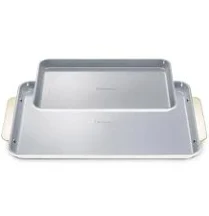
Caraway
Ceramic Nonstick Baking Sheet Duo
- ceramic nonstick coating
- A third party reports verifying it as PFAS-free
- Coating degradation and durability
2 hazards checked on this product. See all of them.
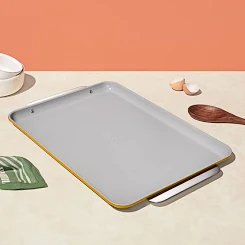
Caraway
Nonstick Ceramic Large Baking Sheet
- ceramic nonstick coating
- The brand calls it PFAS-free, which we have not verified
- Ceramic coating degradation and particle shedding
3 hazards checked on this product. See all of them.
More bakeware grades
How we score, every product runs through the same public 0-100 rubric based on materials, coatings, brand disclosure, lab findings, and recalls. See the full methodology → Spotted a mistake? Report an error.