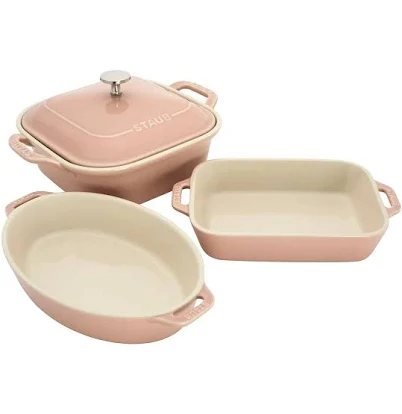
Staub 4-Piece Baking Dish Set
Lower PFAS concern, enameled cast iron baking dishes without nonstick coating.
Staub enameled cast iron baking dishes have a ceramic-based enamel coating over cast iron, not Teflon-family coating nonstick. No known PFAS risk with standard enamel finishes.
The better-graded swap
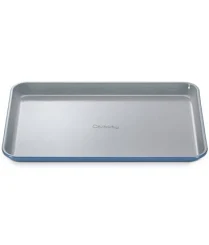
Caraway
Caraway Nonstick Ceramic Medium Baking Sheet
100/100 safety
Same rubric that flunked this product. The swap earned Excellent.
Still want this one anyway? Check the price on Amazon. We’d swap it.
Material
enameled cast iron
Brand disclosure
Brand is silent on PFAS
Lab data
No public lab test
Is Staub 4-Piece Baking Dish Set non-toxic? What it is made of
Staub baking dishes are enameled cast iron, meaning a thick vitreous enamel coating fused to cast iron substrate. The enamel layer is the food-contact surface and acts as a barrier preventing iron and other metals from leaching into food. Unlike nonstick cookware, this material contains no Teflon-type coating or PFOA, and the enamel's inert glass-like chemistry means it does not release volatile fumes at normal baking temperatures (typically under 500F where enameled cast iron is rated).
What’s concerning
No PFAS disclosure
No public statement from the brand about PFAS in this product.
Category baseline
The starting point for this type of product, before anything specific to this product is counted.
Enamel degradation and iron leaching
If the enamel coating is cracked, chipped, or crazes from thermal shock, the underlying cast iron can rust and leach elevated iron into acidic foods. Staub's enamel is thick and durable but not impact-proof; inspect regularly and discontinue use if damage appears on food-contact surfaces.
Thermal stress fracture of enamel
Enameled cast iron can develop crazing (fine surface cracks) or spalling if exposed to rapid temperature swings. This is a mechanical failure rather than a chemical hazard, but it compromises the protective barrier and can lead to iron leaching. Avoid thermal shock by allowing gradual heating and cooling.
What’s reassuring
Base material not linked to PFAS
The main material recorded for this product is not one associated with PFAS.
Lead
No public recalls or test reports document lead or cadmium in Staub enameled cookware. Modern vitreous enamel fired at high temperature is chemically stable; however, the brand does not disclose pigment sourcing or third-party testing, so direct verification is unavailable.
Source, ATSDR ↗Aluminum leaching
This product is cast iron, not aluminum, so aluminum leaching is not a concern. The enamel coating adds no known sources of aluminum or aluminum salts in Staub's formulation.
Teflon-type coating/nonstick fume risk
Enameled cast iron contains no Teflon-type coating or nonstick polymer coatings, eliminating thermal decomposition and fume release at cooking temperatures. This is a key safety advantage over traditional nonstick cookware.
The full breakdown
The brand's record and disclosure
Staub (owned by Zwilling J.A. Henckels) does not publish detailed enamel composition or third-party safety certifications on this product line, and the brand has not made public statements on PFAS use in cookware. However, Staub's enameled cast iron is widely distributed in European and North American markets and has no established record of enamel-related safety recalls or consumer complaints tied to chemical leaching. The brand's reputation rests on durability and heat tolerance rather than transparency.
How it compares in its category
Enameled cast iron baking dishes have lower concern for chemical exposure compared to some other cookware types. They carry far lower chemical leaching risk than ceramic-coated non-stick alternatives (which may contain proprietary Teflon-type coating replacements or heavy metal pigments), and they avoid the microplastic and leaching concerns of some silicone or plastic-handled bakeware. Cast iron enamel does not degrade as readily as cheaper ceramic coatings, though chipping or crazing is possible with thermal shock or impact.
If you buy it
Avoid rapid temperature changes (do not move from freezer directly to hot oven) to prevent enamel crazing. Inspect the enamel before use for cracks, chips, or rough spots; if found on the food-contact surface, do not use as the exposed cast iron can rust and leach iron at high levels. Hand wash gently and dry immediately to avoid rust at the iron base. The enamel is rated for oven use up to approximately 500F; do not use on stovetop or under broiler. If enamel chips develop over years of use, replacement is warranted.
What we don’t know
- Basis
- Model estimate, 82% confidence, not a lab result
- Lab test
- None on record for this exact product
- Brand statement
- Staub has made none
Formulations change between production runs, so check the current label. How we grade.
Better-graded alternatives in Bakeware
Caraway
Nonstick Ceramic Medium Baking Sheet
- ceramic nonstick coating
- A third party reports verifying it as PFAS-free
- Ceramic coating degradation over time
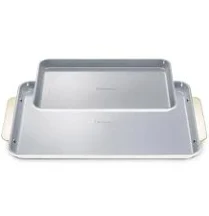
Caraway
Ceramic Nonstick Baking Sheet Duo
- ceramic nonstick coating
- A third party reports verifying it as PFAS-free
- Coating degradation and durability
2 hazards checked on this product. See all of them.
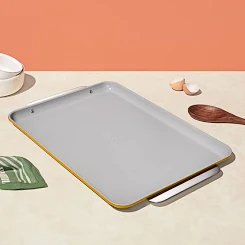
Caraway
Nonstick Ceramic Large Baking Sheet
- ceramic nonstick coating
- The brand calls it PFAS-free, which we have not verified
- Ceramic coating degradation and particle shedding
3 hazards checked on this product. See all of them.
More bakeware grades
How we score, every product runs through the same public 0-100 rubric based on materials, coatings, brand disclosure, lab findings, and recalls. See the full methodology → Spotted a mistake? Report an error.