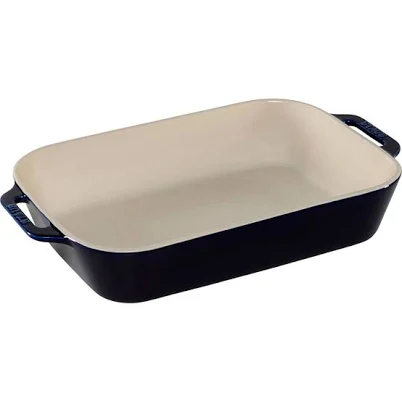
Staub Ceramic Rectangular Gratin Dish
Ceramic gratin dish, lower PFAS concern. Staub silent on PFAS.
Staub ceramic gratin dishes use ceramic glaze over stoneware, an inherently lower-concern material. Brand makes no PFAS claims, but ceramic cookware typically avoids Teflon-family coating coatings.
The better-graded swap
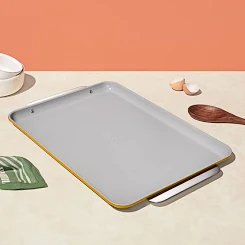
Caraway
Caraway Nonstick Ceramic Large Baking Sheet
90/100 safety
Same rubric that flunked this product. The swap earned Excellent.
Still want this one anyway? Check the price on Amazon. We’d swap it.
Material
Ceramic coating over stoneware/clay body
Brand disclosure
Brand is silent on PFAS
Lab data
No public lab test
Is Staub Ceramic Rectangular Gratin Dish non-toxic? What it is made of
Staub ceramic gratin dishes are stoneware (dense fired clay) with a glazed ceramic coating, not Teflon-type coating or metal. This construction avoids the fume risk of non-stick cookware and the aluminum leaching risk of bare aluminum pans. Ceramic glazes can theoretically contain lead or cadmium, but Staub products sold in EU and North America are subject to migration limits (EU Regulation 1275/2008, US FDA CFR 175.300) that restrict these elements. The glaze bonds to the clay body during high-temperature firing, making leaching unlikely under normal use.
What’s concerning
Category baseline
The starting point for this type of product, before anything specific to this product is counted.
No PFAS disclosure
No public statement from the brand about PFAS in this product.
Lead
Ceramic glazes can contain lead or cadmium, though regulatory limits in the EU and FDA enforce migration thresholds. Staub does not publish test reports, so compliance relies on assumed manufacturing standards rather than transparent verification.
Source, ATSDR ↗Glaze degradation and coating breakdown
Over years of use, ceramic glazes can develop fine cracks (crazing) or chip, especially if exposed to thermal shock or acidic foods. Degraded glaze may expose underlying clay, which poses higher leaching risk. Staub products show no widespread recall history for this issue.
Thermal shock and structural failure
Ceramic is brittle; rapid temperature changes (e.g., removing hot dish and placing on cold surface) can cause cracking. Staub instructions address this, but user error remains a use-phase risk.
What’s reassuring
Base material not linked to PFAS
The main material recorded for this product is not one associated with PFAS.
Teflon-type coating fume risk
Ceramic coating is not Teflon-type coating-based, so overheating will not release perfluorinated fumes. This is a significant safety advantage over traditional non-stick cookware.
Aluminum leaching
The product is stoneware with ceramic glaze, not aluminum, so this hazard does not apply to this material class.
The full breakdown
The brand's record and disclosure
Staub (owned by Zwilling J.A. Henckels, Germany) does not publicly disclose PFAS use in cookware or provide third-party test reports for lead/cadmium content on product pages. The brand has no documented recalls for ceramic cookware lead contamination in the US or EU. Staub markets ceramic cookware as suitable for families but does not engage transparently on chemical disclosure compared to competitors like Le Creuset, which similarly remains silent on PFAS in ceramic lines.
How it compares in its category
Ceramic gratin dishes from major brands (Staub, Le Creuset, Emile Henry) occupy a lower-risk position than non-stick ceramic cookware or glazed cast iron, which have more documented coating degradation concerns. Unglazed stoneware poses higher risk of lead leaching if produced without compliance testing. Staub's position in the mid-to-premium market generally correlates with tighter manufacturing controls, though this is not guaranteed without independent certification.
If you buy it
Use the dish at the temperatures stated in care instructions (typically oven-safe to 400F/200C); exceeding this may stress the glaze. Inspect the glaze annually for chips, cracks, or crazing; discard or cease using if significant damage appears, as exposed clay can leach more readily. Avoid prolonged storage of acidic foods (vinegar, tomato, citrus) in the dish, which can accelerate glaze degradation. Hand wash with soft sponges rather than abrasive scrubbers to preserve the coating.
What we don’t know
- Basis
- Model estimate, 82% confidence, not a lab result
- Lab test
- None on record for this exact product
- Brand statement
- Staub has made none
Formulations change between production runs, so check the current label. How we grade.
Better-graded alternatives in Bakeware
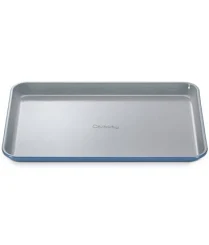
Caraway
Nonstick Ceramic Medium Baking Sheet
- ceramic nonstick coating
- A third party reports verifying it as PFAS-free
- Ceramic coating degradation over time
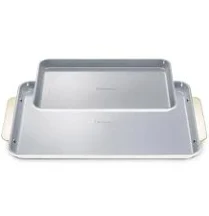
Caraway
Ceramic Nonstick Baking Sheet Duo
- ceramic nonstick coating
- A third party reports verifying it as PFAS-free
- Coating degradation and durability
2 hazards checked on this product. See all of them.
Caraway
Nonstick Ceramic Large Baking Sheet
- ceramic nonstick coating
- The brand calls it PFAS-free, which we have not verified
- Ceramic coating degradation and particle shedding
3 hazards checked on this product. See all of them.
More bakeware grades
How we score, every product runs through the same public 0-100 rubric based on materials, coatings, brand disclosure, lab findings, and recalls. See the full methodology → Spotted a mistake? Report an error.