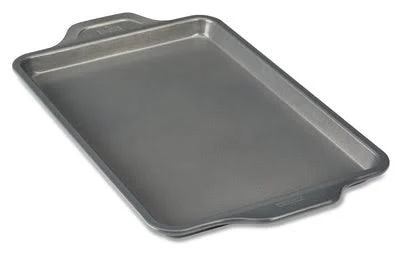
All-Clad Pro-Release Bakeware Jelly Roll Pan
Teflon-type coating non-stick coating, disclosed by the brand.
All-Clad says its nonstick contains Teflon-type coating, and lists its HA1, Essentials, NS1, D3 and D5 nonstick lines among its Teflon-type coating coated products. Teflon-type coating is a Teflon-family coating in the PFAS family.
The better-graded swap
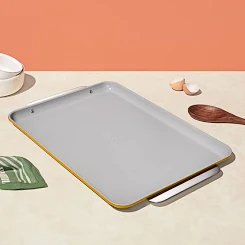
Caraway
Caraway Nonstick Ceramic Large Baking Sheet
90/100 safety
Same rubric that flunked this product. The swap earned Excellent.
Still want this one anyway? Check the price on Amazon. We’d swap it.
Material
Teflon-type coating non-stick coating, as disclosed by All-Clad
Lab data
No public lab test
Is All-Clad Pro-Release Bakeware Jelly Roll non-toxic? What it is made of
All-Clad Pro-Release uses Teflon-type coating (polytetrafluoroethylene), the synthetic polymer branded as Teflon, bonded as a non-stick coating over a steel or aluminum substrate. Teflon-type coating itself is thermally stable under normal baking conditions (up to roughly 260°C / 500°F), but Teflon-type coating production and degradation involve PFAS "forever chemicals" (PFAS) embedded in the coating matrix. The substrate material (aluminum or steel) is not specified in standard product literature but typical All-Clad bakeware uses hard-anodized aluminum, which reduces direct aluminum leaching risk.
What’s concerning
No PFAS disclosure
No PFAS-free statement from the brand for this product.
PTFE / Teflon confirmed
The brand discloses a Teflon-type coating.
Category baseline
The starting point for this type of product, before anything specific to this product is counted.
Teflon-type coating thermal degradation and fume risk
Teflon-type coating coatings release gaseous degradation products above 260°C; standard baking use remains below this threshold, but preheating unattended, broiler use, or stovetop placement (if applicable) can trigger fume release. Risk is lower in typical jelly roll pan use (dry, moderate heat) than in skillet or saucepan applications.
Coating delamination and particle release
Teflon-type coating non-stick coatings on all cookware, including All-Clad, can peel or flake with age, abrasion, or thermal cycling. Ingestion of small coating fragments is generally considered low-acute-risk due to Teflon-type coating's chemical inertness, but preventable via prompt replacement and gentle handling.
Aluminum leaching (substrate)
If the substrate is uncoated or anodized aluminum, leaching risk is minimal during normal baking under acidic or alkaline conditions; hard anodizing (typical for All-Clad) further reduces aluminum migration. Risk is present but low compared to bare aluminum, and not a differentiating hazard for this product class.
Coating degradation over thermal cycles
Repeated heating, cooling, and storage subject Teflon-type coating coatings to stress and micro-fracturing; All-Clad's quality mitigates this more than budget brands, but degradation is inevitable and accelerated by dishwasher use, metal utensils, or high heat exposure. This product will require replacement within 3-7 years with normal use.
PFAS
PFAS compounds present in Teflon-type coating production residues and the coating matrix may migrate into food at low levels under heat and friction. No public testing data exists for this specific product; risk is assessed based on Teflon-type coating chemistry and product use profile. Migration is not blocked by cooking, though direct contact with fatty or acidic foods may slightly increase mobilization.
Source, ATSDR ↗The full breakdown
The brand's record and disclosure
All-Clad discloses the use of Teflon-type coating non-stick coating in product specifications and marketing but does not publicly engage in transparency regarding PFAS content, manufacturing, or phaseout timelines. The brand has not published certifications (e.g., PFOA-free labeling, third-party testing) or committed to reformulation. All-Clad's parent company (Groupe SEB) has not issued brand-level PFAS reduction pledges comparable to some competitors. Disclosure of the coating material itself is a baseline; silence on PFAS specifics is typical for Teflon-type coating cookware manufacturers.
How it compares in its category
Teflon-type coating non-stick bakeware is the dominant category standard and generally performs well in everyday use, but carries inherent PFAS risk that ceramic and silicone alternatives avoid. All-Clad's hard-anodized construction and reputation for durability position it above budget Teflon-type coating alternatives, but it does not differentiate itself through PFAS reduction or alternative coatings. Ceramic-coated or uncoated steel bakeware eliminate Teflon-type coating/PFAS exposure entirely, though with reduced non-stick convenience and higher maintenance.
If you buy it
Keep baking temperatures below 200°C (400°F) to minimize Teflon-type coating polymer degradation and fume risk; avoid preheating empty pans and broiling. Hand-wash only; abrasive scrubbing and dishwasher cycles degrade the coating faster and accelerate potential leaching. Replace immediately if the non-stick surface shows peeling, scratching, or bare metal exposure. Store in a cool, dry place away from direct heat, as Teflon-type coating coatings degrade over time with thermal stress and humidity cycles, and inspect before each use.
What we don’t know
- Basis
- Model estimate, 45% confidence, not a lab result
- Lab test
- None on record for this exact product
- Brand statement
- All-Clad has made a specific claim
Formulations change between production runs, so check the current label. How we grade.
Better-graded alternatives in Bakeware
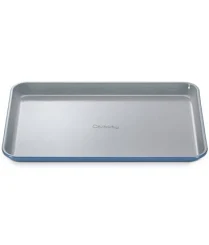
Caraway
Nonstick Ceramic Medium Baking Sheet
- ceramic nonstick coating
- A third party reports verifying it as PFAS-free
- Ceramic coating degradation over time
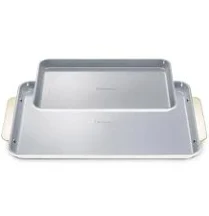
Caraway
Ceramic Nonstick Baking Sheet Duo
- ceramic nonstick coating
- A third party reports verifying it as PFAS-free
- Coating degradation and durability
2 hazards checked on this product. See all of them.
Caraway
Nonstick Ceramic Large Baking Sheet
- ceramic nonstick coating
- The brand calls it PFAS-free, which we have not verified
- Ceramic coating degradation and particle shedding
3 hazards checked on this product. See all of them.
More bakeware grades
How we score, every product runs through the same public 0-100 rubric based on materials, coatings, brand disclosure, lab findings, and recalls. See the full methodology → Spotted a mistake? Report an error.