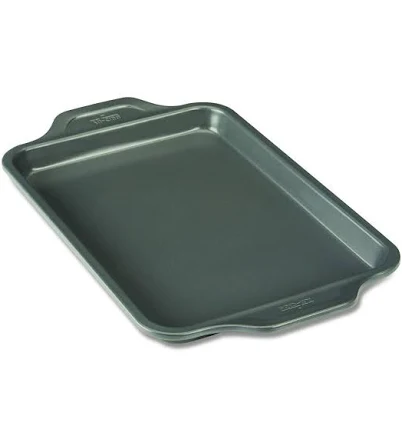
All-Clad Pro-Release Bakeware Quarter Sheet Pan
Teflon-type coating non-stick coating, disclosed by the brand.
All-Clad says its nonstick contains Teflon-type coating, and lists its HA1, Essentials, NS1, D3 and D5 nonstick lines among its Teflon-type coating coated products. Teflon-type coating is a Teflon-family coating in the PFAS family.
The better-graded swap
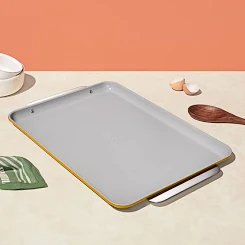
Caraway
Caraway Nonstick Ceramic Large Baking Sheet
90/100 safety
Same rubric that flunked this product. The swap earned Excellent.
Still want this one anyway? Check the price on Amazon. We’d swap it.
Material
Teflon-type coating non-stick coating, as disclosed by All-Clad
Lab data
No public lab test
Is All-Clad Pro-Release Bakeware Quarter non-toxic? What it is made of
This quarter sheet pan uses a Teflon-type coating-based non-stick coating bonded to a steel substrate. Teflon-type coating (polytetrafluoroethylene, also called Teflon) is a Teflon-family coating that contains PFAS compounds. When heated above its safe operating range (typically around 500°F), Teflon-type coating coatings can degrade and release fumes; overheating or mechanical damage accelerates breakdown and potential release of fluorinated compounds into food and air.
What’s concerning
No PFAS disclosure
No PFAS-free statement from the brand for this product.
PTFE / Teflon confirmed
The brand discloses a Teflon-type coating.
Category baseline
The starting point for this type of product, before anything specific to this product is counted.
Teflon-type coating fume risk (thermal degradation)
Heating Teflon-type coating non-stick coatings above approximately 500°F is documented to release fumes including perfluorinated compounds and carbonyl fluoride. Home oven use for baking typically stays below this threshold, but preheating above 400°F for extended periods or broiler use increases risk; accidental overheating or contact with a direct flame poses acute hazard.
Coating degradation and mechanical flaking
Teflon-type coating coatings degrade with age, thermal cycling, and mechanical contact. Dishwasher use, metal utensils, and abrasive scouring accelerate surface loss. As the coating thins or flakes, Teflon-type coating particles and underlying substrate exposure may occur; no industry standard limits when a non-stick pan should be replaced.
Aluminum substrate leaching
If the Teflon-type coating becomes damaged or worn, the underlying steel substrate may be exposed; however, steel oxidizes rather than leaches like bare aluminum. Risk is low compared to uncoated aluminum bakeware, but coating integrity is the protective barrier.
What’s reassuring
Off-gassing and volatile organic compounds (VOCs) during manufacturing and early use
No specific off-gassing complaints or test results on record for this product. Typical Teflon-type coating cookware may emit trace odors when first heated; this dissipates with normal use and is distinct from thermal degradation hazard.
Lead
All-Clad uses proprietary Teflon-type coating formulations and does not employ traditional ceramic glazes or enamels on this product. No recalls or test reports documenting lead or cadmium contamination in this product line.
Source, ATSDR ↗The full breakdown
The brand's record and disclosure
All-Clad explicitly discloses the Teflon-type coating non-stick coating in product documentation but has not published a public stance on PFAS reduction or phase-out timelines. The brand has not sought third-party certifications (such as GOTS, Oeko-Tex, or similar) that would signal commitment to alternative non-stick chemistries. All-Clad's silence on PFAS alternatives, despite mainstream industry movement toward ceramic or fluorine-free coatings, reflects a conventional market position rather than leadership on this hazard class.
How it compares in its category
Teflon-type coating non-stick bakeware remains the dominant commercial standard for even heat distribution and release. Ceramic-coated and stainless steel alternatives have entered the market but often perform less consistently with baked goods. All-Clad Pro-Release is positioned as a premium product in the Teflon-type coating category; it does not differentiate on PFAS or coating chemistry compared to mid-range competitors, and commands a higher price without mitigating the underlying hazard.
If you buy it
Never exceed 500°F oven temperature; most baking applications remain well below this threshold. Hand wash only; dishwasher use and abrasive scrubbing degrade the coating faster and increase flaking risk. Inspect the coating monthly for scratches, discoloration, or peeling; discard the pan if damage is visible, as compromised coating increases exposure potential. Store in a cool, dry place away from direct sunlight, which can accelerate polymer degradation over time.
What we don’t know
- Basis
- Model estimate, 35% confidence, not a lab result
- Lab test
- None on record for this exact product
- Brand statement
- All-Clad has made a specific claim
Formulations change between production runs, so check the current label. How we grade.
Better-graded alternatives in Bakeware
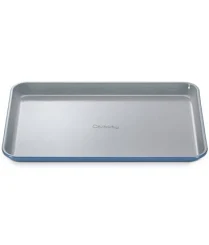
Caraway
Nonstick Ceramic Medium Baking Sheet
- ceramic nonstick coating
- A third party reports verifying it as PFAS-free
- Ceramic coating degradation over time
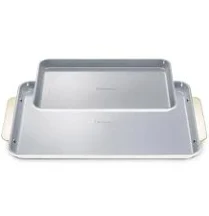
Caraway
Ceramic Nonstick Baking Sheet Duo
- ceramic nonstick coating
- A third party reports verifying it as PFAS-free
- Coating degradation and durability
2 hazards checked on this product. See all of them.
Caraway
Nonstick Ceramic Large Baking Sheet
- ceramic nonstick coating
- The brand calls it PFAS-free, which we have not verified
- Ceramic coating degradation and particle shedding
3 hazards checked on this product. See all of them.
More bakeware grades
How we score, every product runs through the same public 0-100 rubric based on materials, coatings, brand disclosure, lab findings, and recalls. See the full methodology → Spotted a mistake? Report an error.